

How To Cultivate Cordyceps Militaris: Complete Growing Guide
Cordyceps militaris is unlike the familiar wood-loving mushrooms grown in hardwood blocks. It is an insect-associated ascomycete that can be cultivated indoors on carefully balanced, sterilised grain-based media, usually in jars or other containers that provide a level fruiting surface and enough headroom for the upright orange fruiting bodies.
This guide explains a practical home-cultivation workflow using liquid culture or agar, with clear distinctions between culture testing, substrate preparation, colonisation and fruiting. It also explains why standard hardwood grow bags, ordinary bulk substrate and loose estimates of water or nutrition are unsuitable for this species.
Quick Answer
Prepare a proven rice- or grain-based Cordyceps fruiting medium in suitable jars or shallow containers, provide filtered gas exchange, sterilise it thoroughly and allow it to cool completely. Inoculate with a small amount of clean Cordyceps militaris liquid culture, ideally after testing the culture on agar. Let the substrate colonise without unnecessary disturbance, then introduce a consistent daily light cycle, suitable temperature, controlled humidity and gentle fresh-air exchange. Harvest when the orange stromata are fully developed and growth has slowed.
1. What is Cordyceps militaris?
Cordyceps militaris is an entomopathogenic fungus. In nature it infects insect larvae or pupae and produces bright orange club-shaped fruiting bodies from the host. Cultivated strains can also form fruiting bodies on sterilised grain-based media, so insects are not required for indoor cultivation.
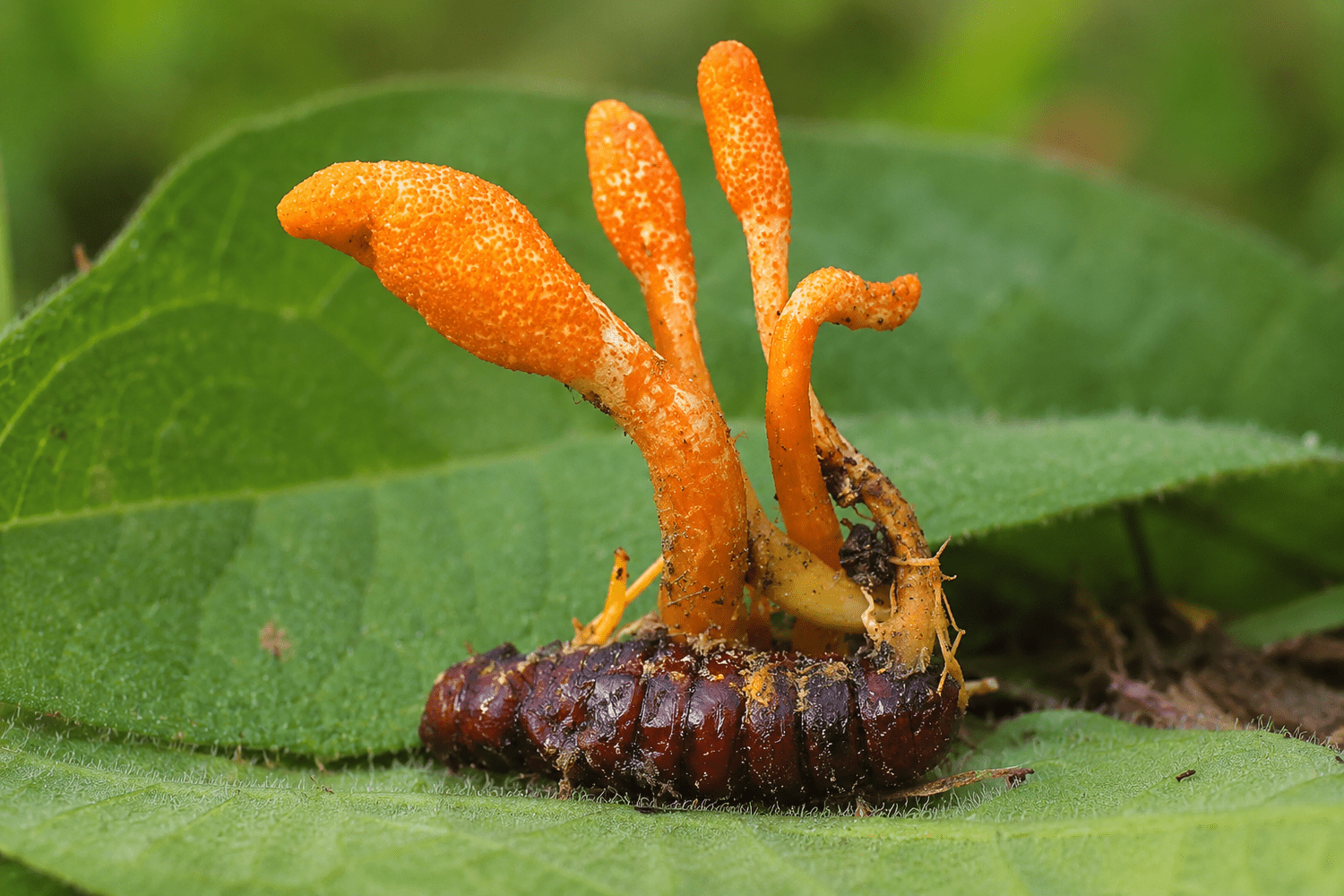
The upright orange structures are usually called stromata. They are not shaped like the caps and stems of Oyster or Shiitake mushrooms, and the cultivation method is correspondingly different.
2. Is Cordyceps militaris suitable for beginners?
It can be grown by a careful beginner, but it is less forgiving than Oyster mushrooms. The fruiting medium is highly nutritious, which makes complete sterilisation and clean inoculation especially important. Moisture, nutrition, container geometry, light and culture quality must also work together.
A sensible first attempt uses a small number of jars and one proven recipe. Avoid scaling up until the culture has been tested and the process has produced healthy fruiting bodies.
You are ready to try Cordyceps when you can:
- Prepare and sterilise media safely with appropriate pressure-sterilisation equipment.
- Work cleanly with liquid culture or agar.
- Provide filtered gas exchange without leaving the substrate exposed.
- Maintain a stable temperature and daily lighting schedule.
- Recognise contamination and keep suspicious containers sealed.
3. How Cordyceps cultivation differs from ordinary mushroom growing
Cordyceps method
Liquid culture or agar is introduced into a sterilised nutrient-rich grain medium. The same container is normally colonised and fruited.
Typical wood-loving method
Liquid culture colonises grain, then the resulting grain spawn inoculates hardwood or another bulk substrate.
It is also different from an ordinary 2 kg grain-spawn bag. Cordyceps is usually fruited directly from a measured production medium rather than growing a large bag of grain spawn for transfer to hardwood.
4. Start with a clean, fruiting-capable culture
A culture can look vigorous and still fail to produce normal stromata. Fruiting ability depends on strain genetics and culture history as well as environmental conditions. Research has shown that repeated subculturing and changes in mating-type composition can reduce or disrupt fruiting performance in Cordyceps militaris.
Liquid culture
A Cordyceps militaris liquid-culture syringe is a convenient inoculant for correctly prepared jars. Store the sealed syringe refrigerated, do not freeze it and distribute the mycelium through the liquid before inoculation.
Agar testing
Place one or two small drops onto a sterile agar plate before committing multiple production jars. Agar allows you to observe growth away from the opaque or highly nutritious fruiting medium and makes bacterial or mould contamination easier to detect.
Sterile LME agar plates can be used for testing, clean transfers and maintaining a limited working culture.
5. Choose suitable jars, lids and filtered gas exchange
The container must provide a level substrate surface, room above that surface for upright stromata and a way for gases to move without exposing the sterile medium directly to unfiltered room air.
Useful container features
- Heat-resistant glass or a pressure-sterilisable cultivation container.
- A wide enough opening for harvesting and cleaning.
- A secure lid with filtered gas exchange.
- A self-healing injection port when inoculating by syringe.
- Enough vertical headspace for the expected fruiting bodies.
Self-healing injection ports can be installed in custom lids, but the completed lid and container assembly must be cleaned and sterilised as part of the full preparation process. An injection port does not replace a filter.
6. Cordyceps substrate and nutrient balance
Brown rice, white rice, millet and other grains are commonly used as a base. Many cultivators add a carefully measured nutrient solution or dry supplement. The exact formula is strain and process dependent, so water and nutrition should be weighed rather than estimated.
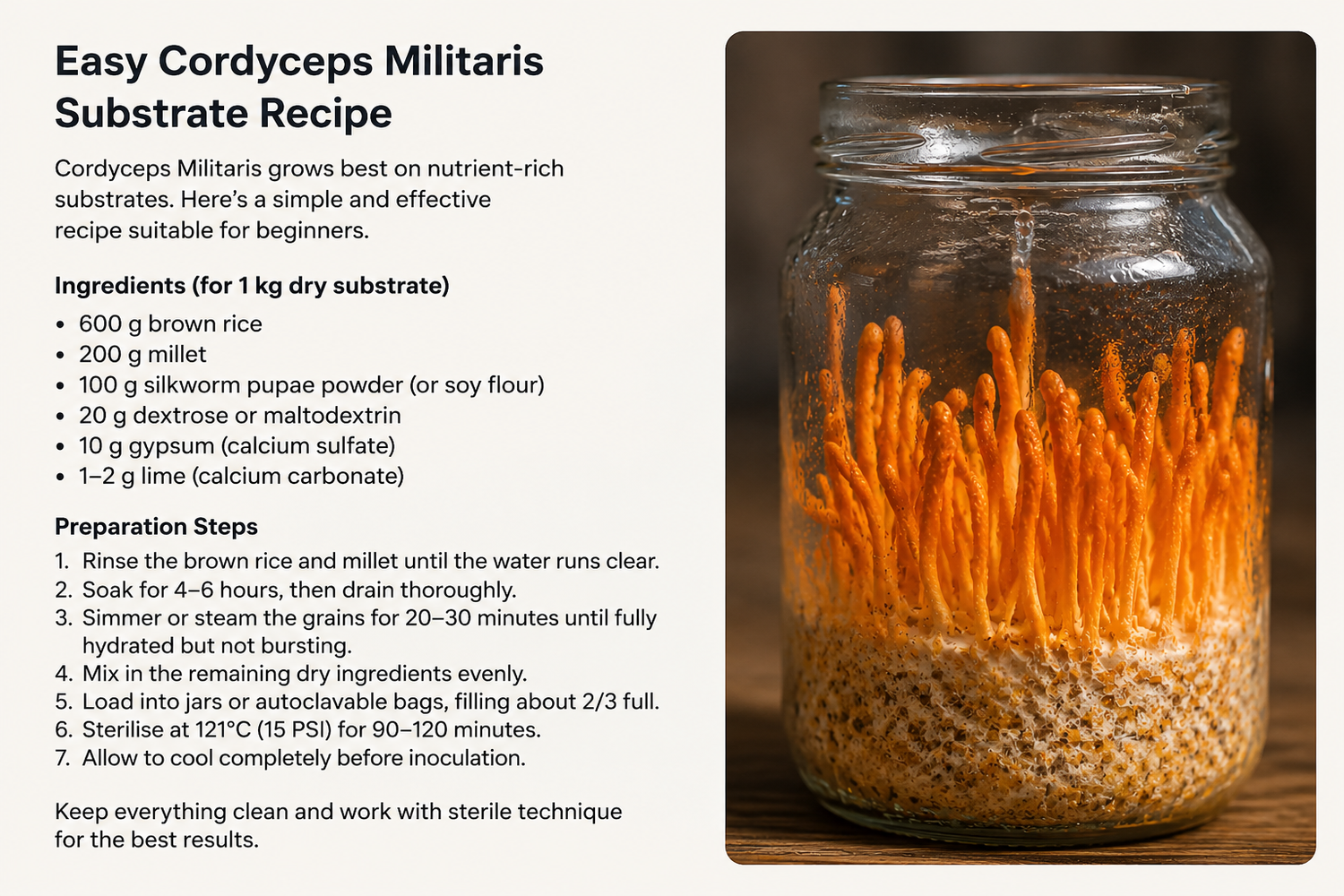
Why moisture matters
Too little water can leave the grain hard and limit colonisation. Too much free water can create dense, oxygen-poor areas and favour bacterial growth. The correct amount depends on the grain, soaking method, added nutrients and container fill.
Why nutrition matters
A weak medium may colonise but produce sparse or thin stromata. An excessively rich medium may contaminate easily or grow dense mycelium without reliable fruiting. Follow one tested formula instead of adding several supplements because they sound beneficial.
7. Load and sterilise the production containers
- Prepare the grain and nutrient components according to the chosen tested recipe.
- Mix evenly so that no jar receives a very different moisture or nutrient concentration.
- Load a shallow, level layer rather than filling the container to the lid.
- Leave enough headspace for fruiting bodies.
- Fit the prepared filtered lids or other suitable closures.
- Pressure-sterilise with equipment, loading and processing time appropriate to the jar volume and formula.
- Allow every container to cool completely before inoculation.
Highly nutritious Cordyceps media require full sterilisation. A brief steam treatment intended for low-nutrient bulk substrate is not equivalent. Processing time must account for the size and number of containers, how densely they are loaded and how quickly the centre of the medium reaches sterilisation temperature.
8. Inoculate with Cordyceps liquid culture
- Confirm that the jar and substrate are completely cool.
- Clean the work area and wash your hands.
- Use a still-air box or properly operated laminar-flow workspace.
- Shake or roll the capped syringe enough to distribute the mycelium through the liquid.
- Attach a new sterile needle without touching the shaft or tip.
- Clean the injection port and allow the disinfectant to dry.
- Inject a small measured amount into the prepared medium.
- Remove the needle and keep the container closed.
For a small production jar, approximately 1 to 2 ml is often enough to introduce active mycelium, although the correct amount depends on jar size, recipe and inoculation pattern. Emptying an entire syringe into one jar can add unnecessary moisture.
9. Colonisation: what healthy growth looks like
Keep the containers stable and avoid unnecessary handling. A practical starting range for many cultivated strains is approximately 20 to 24°C, but the best temperature depends on the specific strain and method.
Healthy signs
- White mycelium spreading steadily through and across the grain surface.
- An increasingly even colonised layer without wet, uncolonised pockets.
- No bright green, black, pink or strongly coloured competing colonies.
- No slimy grain or strong sour, rotten or fermented odour escaping through the filter.
Light during colonisation
Many practical methods use darkness or low light during early colonisation, then introduce a consistent light cycle after the medium has colonised. Complete darkness is not a universal biological requirement, but separating the colonisation and fruiting phases makes the process easier to control.
10. Introduce fruiting conditions
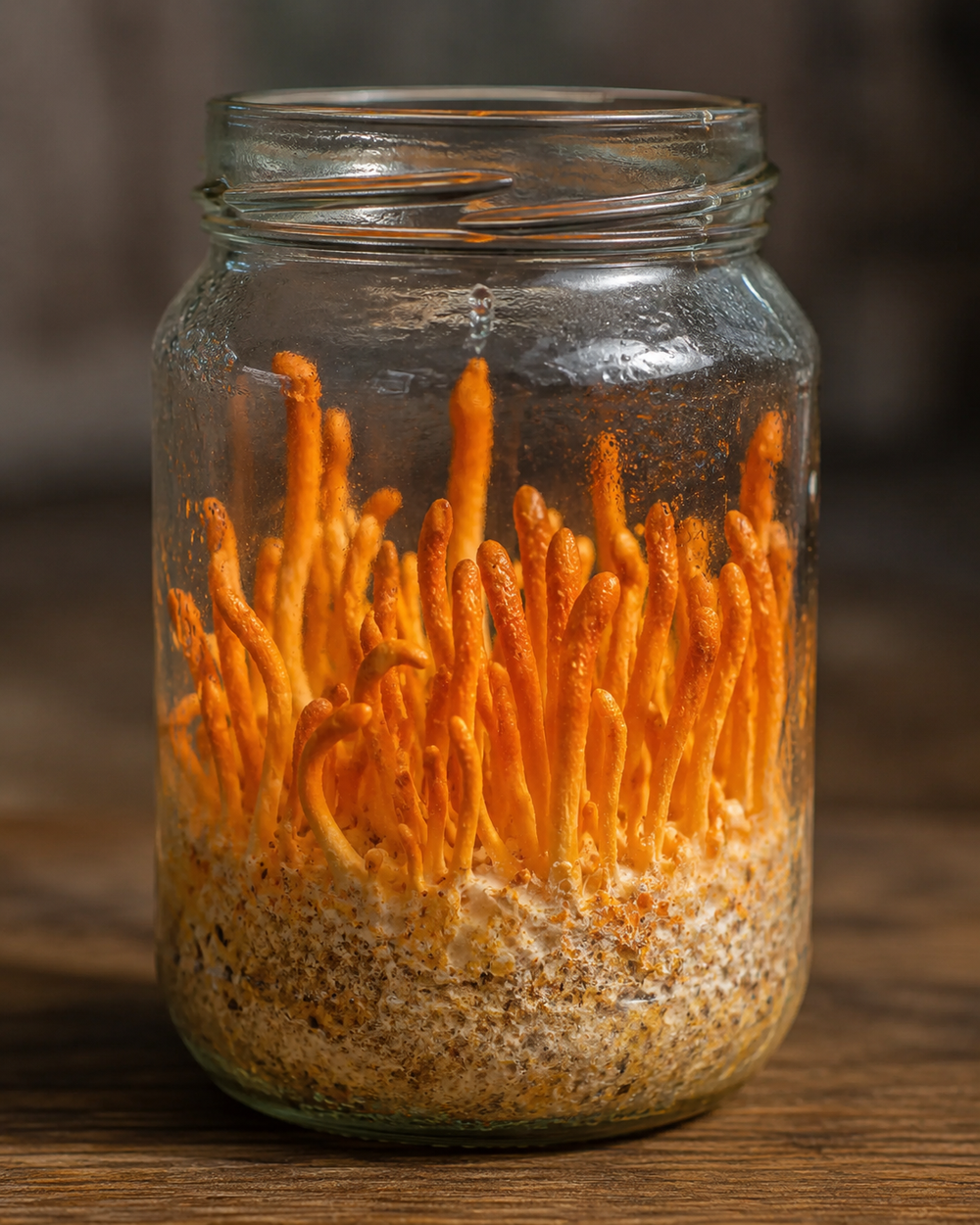
Move to fruiting conditions only after the substrate surface is fully and evenly colonised. Some systems fruit beneath a filtered closure, while others move opened jars into a clean controlled chamber. Follow one proven method and avoid exposing an incompletely colonised high-nutrient medium.
| Factor | Practical starting point | What to watch |
|---|---|---|
| Temperature | Approximately 18 to 22°C for many cultivation methods | Strain-specific responses vary; avoid abrupt swings and excessive heat |
| Light | A consistent daily cycle, commonly 12 to 16 hours | Light quality and intensity affect pigmentation and fruiting development |
| Humidity | Often around 70 to 85% relative humidity | Avoid drying, but also avoid condensation dripping onto the substrate |
| Fresh air | Gentle, regular exchange | Prevent stale conditions without directing a drying draught at the jars |
Published experiments demonstrate that temperature and light strongly influence fruiting, colour and metabolite production, but the optimum conditions are not identical for every strain or cultivation formula. Treat the table as a starting point and keep records.
11. Lighting for Cordyceps militaris
Light is a developmental signal for Cordyceps militaris, not merely a convenience for the grower. Insufficient or unsuitable lighting can contribute to pale, weak or poorly differentiated growth.
Practical lighting guidance
- Use a timer for a repeatable daily schedule.
- Provide broad, even illumination across all containers.
- Avoid placing one side of a jar very close to a hot lamp.
- Do not assume that brighter is always better.
- Keep the light source outside wet areas unless it is designed for that environment.
Research has found different responses to wavelength, intensity and photoperiod. For a home grow, consistency is more useful than chasing one supposedly perfect colour of LED without controlling the other variables.
12. Humidity, condensation and fresh air
The air must be humid enough to prevent the developing stromata from drying, but the substrate should not be repeatedly soaked. Heavy condensation that runs down the jar can disturb the surface and encourage bacterial problems.
Signs of insufficient humidity
- Tips drying or becoming brittle.
- Growth stopping while the substrate remains otherwise clean.
- Fruiting bodies becoming thin and desiccated.
Signs of excessive moisture or poor air balance
- Persistent large droplets falling onto the substrate.
- Wet, slimy areas at the base.
- Stale odours or bacterial-looking patches.
- Weak irregular growth despite adequate light.
Increase fresh-air exchange in small controlled steps. A strong fan aimed directly at open containers may solve stale air while creating a new drying problem.
13. When and how to harvest
Harvest when the stromata are fully elongated, strongly coloured and no longer making obvious daily growth. Exact maturity varies by strain, so compare the whole jar rather than relying on one fixed number of days.
- Use clean hands, gloves and a clean cutting tool.
- Cut the cluster near the substrate surface without digging deeply into the medium.
- Remove loose grain or substrate from the base.
- Inspect the harvest and discard any material from a contaminated container.
For drying, use clean food-safe equipment and a temperature appropriate to the intended product. Dry until the fruiting bodies are fully crisp before sealing them in a moisture-resistant container. Condensation inside the storage container means the material was not dry enough or was packed while warm.
14. Common problems and useful checks
| Problem | Possible causes | Useful next check |
|---|---|---|
| The jar will not colonise | Weak culture, unsuitable moisture, overheated culture, cold conditions or contamination | Test the culture on agar and review sterilisation and cooling records |
| Fully white but no stromata | Culture degeneration, incompatible genetics, unsuitable nutrition, missing light trigger or wrong temperature | Confirm culture history, lighting schedule and strain-specific fruiting conditions |
| Thin or weak fruiting bodies | Low light, poor nutrient balance, unstable environment or weak genetics | Compare jars from the same batch and alter one variable at a time |
| Pale fruiting bodies | Light quality or intensity, strain variation or early development | Check the timer, lamp distance and progression over several days |
| Wet or slimy base | Excess water, condensation, poor gas exchange or bacteria | Keep sealed, isolate the jar and review recipe hydration |
| Green, black, pink or spreading coloured growth | Competing mould or other contamination | Keep the container closed and remove it from the grow area |
Use the free Mushroom Grow Doctor to work through contamination, stalled growth and fruiting-condition problems.
15. Why Cordyceps cultures sometimes stop fruiting
A clean-looking culture is not automatically a productive culture. Cordyceps militaris can lose fruiting performance after repeated subculture, and successful fruiting may depend on mating-type and strain characteristics.
Reduce the risk of culture decline
- Label every culture with the date and transfer generation.
- Maintain a clean master culture rather than transferring from old production jars.
- Avoid unnecessary repeated liquid-to-liquid expansion.
- Test a small production batch before preparing many jars.
- Compare failures across more than one jar before blaming environmental conditions.
If several clean jars colonise normally but repeatedly fail to form stromata under verified conditions, the culture itself may need to be replaced or returned to an earlier master.
16. Frequently asked questions
Can Cordyceps militaris grow in a standard hardwood grow bag?
No. Standard hardwood grow bags are intended for wood-loving species. Cordyceps is normally fruited from a specialised sterilised grain-based medium in jars or other suitable containers.
Can I inject Cordyceps liquid culture directly into prepared jars?
Yes, provided the jars contain a suitable fully sterilised Cordyceps medium, have cooled completely and can be inoculated through a clean sterile workflow.
How much liquid culture should I use?
For a small jar, approximately 1 to 2 ml is often enough, but the amount depends on container size and recipe. Excess liquid can disturb the moisture balance.
Does Cordyceps need insects?
No. Although it naturally fruits from insect hosts, cultivated strains can produce stromata on sterilised grain-based media.
Does Cordyceps need light?
Light is important for normal fruiting development and orange pigmentation. A consistent daily light cycle is commonly introduced after colonisation.
How long does cultivation take?
There is no universal timetable. Culture vigour, recipe, jar size, temperature, light and genetics all affect colonisation and fruiting. Track visible development instead of relying on one promised harvest date.
Why is the substrate fully colonised but not fruiting?
Possible causes include unsuitable lighting, temperature, nutrition, gas exchange or a culture that has lost fruiting ability. Check records systematically and change one variable at a time.
Can I open a suspicious jar to smell it?
No. Keep a suspicious jar closed and separate it from healthy cultures. Opening contaminated high-nutrient media can release spores or contaminated droplets into the growing area.
17. Recommended products, guides and research
Cordyceps militaris Liquid Culture
Living Cordyceps mycelium supplied in a sterile liquid-culture syringe for agar work and prepared production media.
Sterile LME Agar Plates
Test culture cleanliness, make controlled transfers and maintain a limited working culture.
Self-Healing Injection Ports
Create a clean injection point in custom pressure-sterilisable Cordyceps jar lids.
Thermometer and Hygrometer
Monitor temperature and relative humidity during colonisation and fruiting.
Related Artisan Mushrooms guides
- Complete Beginner's Guide to Mushroom Liquid Culture
- Substrate Preparation: Essential Guide
- Inoculation and Colonisation
- Mushroom Fruiting Chambers, Monotubs and Martha Tents
Research used to check this guide
Final Thoughts
Successful Cordyceps cultivation starts with recognising that this is not a hardwood-bag species. Use a clean fruiting-capable culture, a measured grain-based production medium, suitable filtered containers and full sterilisation. After colonisation, light, temperature, moisture and fresh air must be introduced as a controlled combination rather than adjusted randomly.
Start with a few jars, keep detailed notes and change only one variable at a time. A small repeatable process is far more useful than a large batch built on an untested recipe.
Free Artisan Mushrooms Tools
Use these free tools to choose a mushroom, plan a project, calculate substrate ingredients or troubleshoot a grow.
Mushroom Selector
Compare species based on experience, available space and growing method.
Mushroom Grow Planner
Build a practical route for beginner, indoor and outdoor mushroom projects.
Substrate Mix Calculator
Calculate hardwood, wheat-bran and CVG quantities for compatible mushroom species.
Mushroom Grow Doctor
Work through contamination, colonisation and fruiting problems step by step.
Need personal cultivation support? Email growhelp@artisanmushrooms.ie with the species, relevant dates, growing conditions and clear photographs.
© 2026 Artisan Mushrooms Ireland. Original article and layout. May not be copied or redistributed without written permission.