

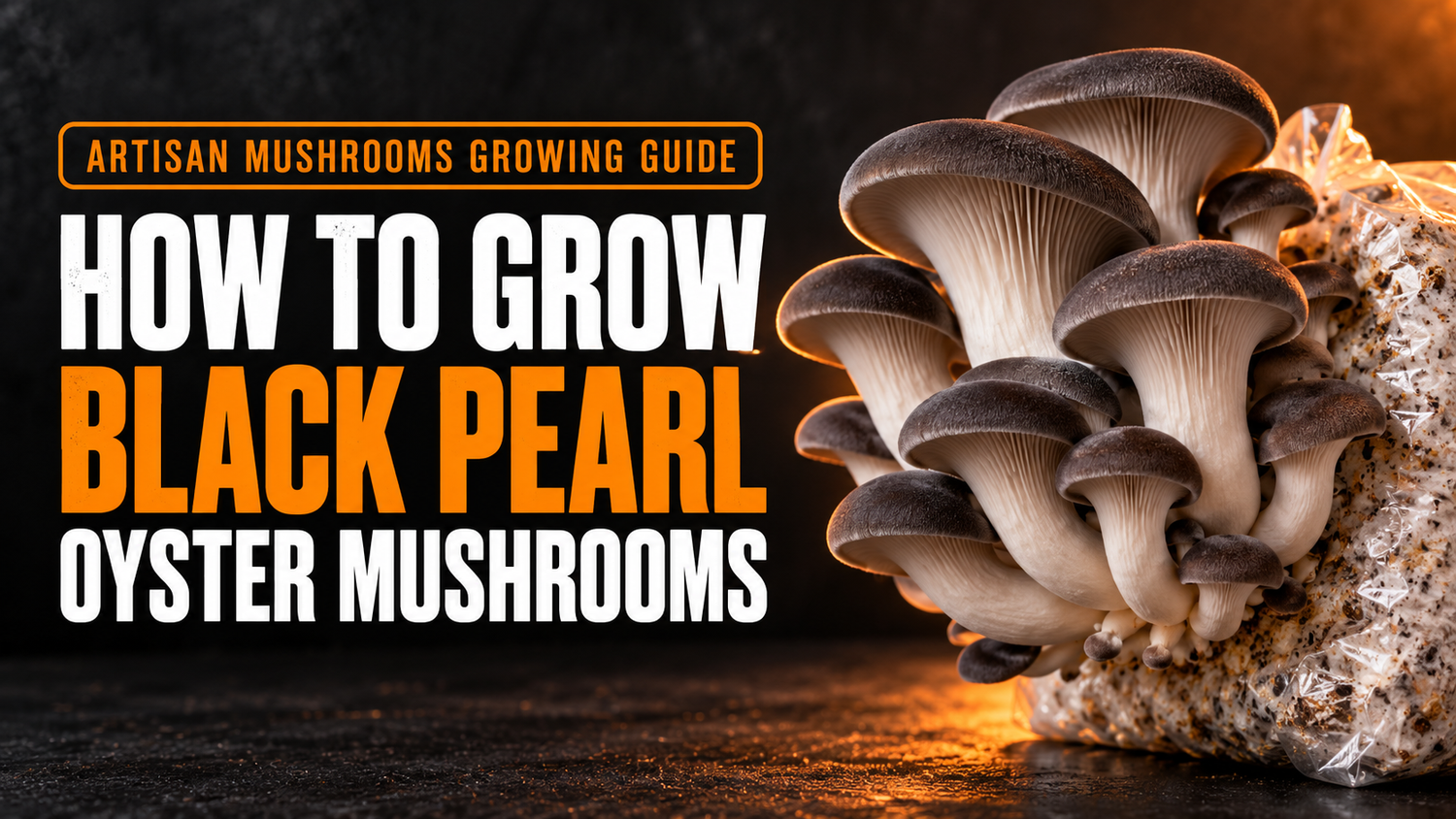
Black Pearl combines Oyster-like vigour with dense stems and substantial caps reminiscent of King Oyster. Supplemented hardwood is an excellent indoor substrate, with cool fruiting conditions helping produce its characteristic dark-capped form.
Start in the lower grain layer
Inject through the black self-healing port into the lower sterilised grain layer. Allow healthy grain colonisation before redistributing the grain, let it recover, then mix the colonised grain through the upper hardwood and wheat-bran substrate.
Do not inject the upper hardwood and do not mix the whole bag immediately after inoculation.
Black Pearl at a Glance
Black Pearl can fruit somewhat warmer, but cooler conditions generally produce darker caps and the dense morphology growers associate with the strain.
Introduce the Culture Cleanly
Mix the syringe
Gently redistribute the mycelium through the liquid.
Clean the port
Wipe with alcohol and allow it to dry.
Inject the grain
Deliver the culture into the lower grain layer.
Leave sealed
Allow the culture to establish before mixing.
Wait for Strong Healthy Growth
Healthy Black Pearl mycelium should spread white growth progressively through the grain.
Keep the bag away from direct sunlight, radiators and strong heat sources. Ambient humidity is not critical while the substrate remains sealed.
Use visible fungal development rather than a fixed number of days to decide when to mix.
Redistribute the Grain
Once a substantial portion of grain shows established healthy growth, gently break and mix the grain within the lower section.
Allow it to recover until strong white growth returns.
Spread the Spawn Through the Fruiting Substrate
After recovery, mix the strongly colonised grain through the upper hardwood layer. Distribute it evenly, reshape the substrate into a compact block and leave it sealed.
Wait Until the Block Is Ready
Allow the hardwood to become thoroughly colonised. The block should be clean, increasingly firm and well bound by fungal growth.
Avoid repeatedly breaking the block after this stage.
Use a Small Side Opening
Move the mature block into cool fruiting conditions and make a small X or slit in the side of the bag.
Leave the remaining plastic around the substrate. It helps retain moisture and concentrates fruiting at the selected opening.
| Factor | Starting Point |
|---|---|
| Temperature | Approx. 13–18°C |
| Pinning humidity | Approx. 90–95% RH |
| Development humidity | Approx. 85–92% RH |
| Fresh air | High |
| Light | Bright indirect / gentle artificial |
Individual Black Pearl genetics can vary. Use these numbers as useful starting points rather than rigid limits.
Thick Stems Are Not Automatically a Problem
Black Pearl naturally produces heavier stems than many ordinary Oyster strains.
A substantial stem with a well-developed cap can therefore be normal. Extremely elongated stems combined with poorly expanded caps, however, suggest excessive carbon dioxide.
Harvest While Caps Are Fresh
Harvest once the caps have developed strongly but before they become heavily flattened, curled upward or release large quantities of spores.
Remove the whole cluster cleanly at the base.
Remove loose tissue from the opening and let the block recover. Healthy Black Pearl blocks may produce further flushes from the same opening, although later harvests commonly become smaller.
Caps are pale
Warmer fruiting conditions can reduce dark pigmentation. Genetics and light also influence cap colour.
Long stems, tiny caps
Increase fresh-air exchange while maintaining humidity.
Pins dry out
Check humidity and direct airflow around the fruiting opening.
No pins
Check block maturity and whether conditions are cool enough for your culture.
Green mould
Keep the bag closed and isolate a contaminated block from clean cultures.
Black Pearl Questions
Is Black Pearl a King Oyster?
It is generally sold as a Pleurotus ostreatus × P. eryngii hybrid rather than a pure King Oyster.
Can I use the hardwood grow bag?
Yes. Supplemented hardwood is an excellent substrate for this hybrid.
Where do I inject?
Into the lower grain layer through the self-healing port.
Why are the stems so thick?
Dense stems are characteristic of Black Pearl. Only extreme stem elongation with poor caps strongly suggests stale air.