

Saprotrophic vs Mycorrhizal Mushrooms: What’s the Difference?
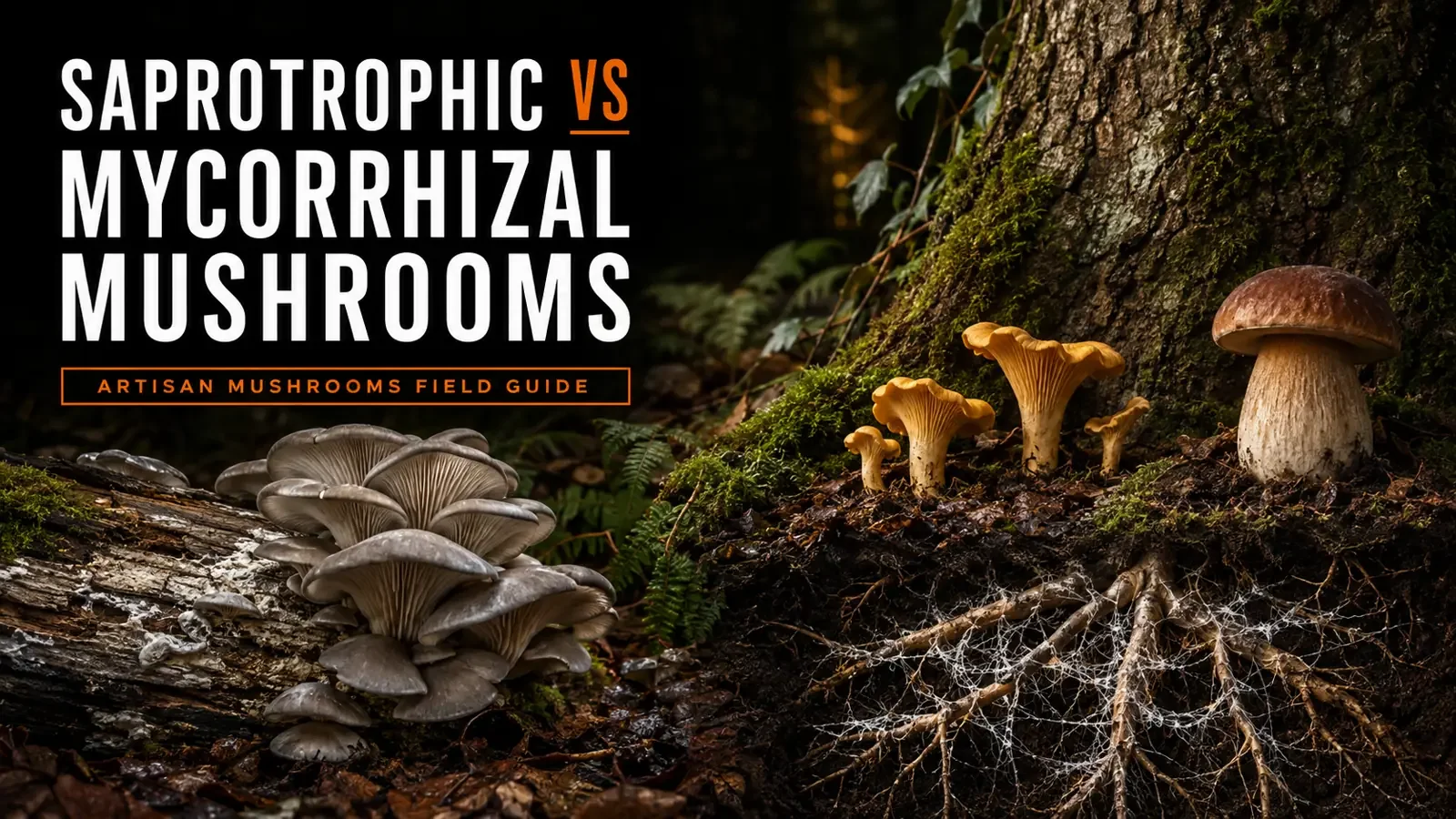
Why can an Oyster mushroom grow from a bag of hardwood, while a chanterelle appears beneath a living tree and stubbornly refuses to grow on the same substrate? The answer is not simply that one species is easier. They use fundamentally different ways of obtaining food.
Understanding the difference between saprotrophic and mycorrhizal fungi explains where mushrooms appear in nature, what they do for a woodland and why some prized edible species are practical to cultivate while others remain closely tied to living roots.
Quick answer
Saprotrophic fungi digest dead organic material such as wood, straw, leaf litter or compost. Mycorrhizal fungi form a close partnership with the living roots of a plant: the fungus helps the plant access water and mineral nutrients, while the plant supplies sugars and other carbon compounds made through photosynthesis.
This is why Oyster, Shiitake and Lion’s Mane can be grown on prepared substrates, while chanterelles, porcini and many truffles normally require a compatible living host.
A note on the terminology
Saprotrophic is the preferred biological term for an organism that obtains nutrients from dead organic matter. You will also see saprobic and saprotroph. The older word saprophytic is still common in mushroom books and casual conversation, but “-phytic” suggests a plant-like mode of life, so mycologists generally favour saprotrophic.
Mycorrhizal describes a fungus that forms a mycorrhiza: a close association between fungal hyphae and plant roots. The word comes from the Greek words for fungus and root.
Saprotrophic vs mycorrhizal mushrooms at a glance
| Feature | Saprotrophic mushrooms | Mycorrhizal mushrooms |
|---|---|---|
| Main carbon source | Dead organic matter | Carbon compounds supplied by a living plant |
| Relationship with plants | Usually decomposes dead plant material rather than depending on a living host | Forms an intimate association with compatible living roots |
| What the fungus provides | Releases nutrients during decomposition and helps recycle organic material | Extends the root’s effective reach for water and nutrients such as phosphorus and nitrogen |
| Common habitat clue | Dead logs, stumps, woodchip, straw, dung, compost or leaf litter | Soil near suitable living trees or plants |
| Typical cultivation | Often practical on a prepared substrate under controlled conditions | Usually requires a compatible host plant and a functioning root association |
| Examples | Oyster, Shiitake, Lion’s Mane, Enoki, Pioppino, Wine Cap | Chanterelle, porcini, many Amanita, Russula and Lactarius species, many truffles |
How saprotrophic fungi feed
A saprotrophic fungus grows its hyphae through a suitable dead material and releases enzymes outside its cells. Those enzymes break large, complex compounds into smaller molecules that the fungus can absorb. It is external digestion on a microscopic scale.
Different decomposers specialise in different materials. Wood-decay fungi may be particularly effective at breaking down cellulose, hemicellulose and lignin. Other species are better adapted to leaf litter, grass, compost or dung. This specialisation is one reason substrate choice matters so much in cultivation.
When an Oyster mushroom colonises a hardwood block, the block is not merely holding the fungus upright. It is food. The mycelium converts part of that woody material into new fungal tissue and, when conditions are suitable, produces mushrooms to release spores.
How mycorrhizal fungi feed
Mycorrhizal fungi live in partnership with plants. Their hyphae explore soil far beyond the immediate root surface and can access water and nutrients from tiny spaces that roots cannot reach efficiently. In return, the plant transfers recently fixed carbon to the fungus.
In an ectomycorrhiza, fungal tissue forms a mantle around fine root tips and grows between some of the root’s outer cells. Many familiar woodland mushrooms, including porcini, chanterelles, milkcaps and brittlegills, are associated with ectomycorrhizal trees.
Arbuscular mycorrhizal fungi enter root cells and form highly branched exchange structures. They associate with a vast range of plants, but they generally do not produce the large, familiar mushroom fruiting bodies that foragers notice in woodland.
Follow the carbon
The clearest way to remember the difference is to ask where the fungus obtains its carbon.
Saprotrophic route
Mycorrhizal route
Why this difference matters for mushroom cultivation
Most gourmet species cultivated in bags, bottles, beds or logs are saprotrophic. Growers can prepare a material the fungus recognises as food, remove or reduce competitors, inoculate it with clean culture or spawn and control the fruiting environment.
A mycorrhizal species is a different proposition. Supplying sterilised grain or hardwood is not enough, because the fungus normally depends on carbon from a compatible living host. It must recognise the plant, colonise suitable roots, persist in soil and receive the right environmental signals before fruiting.
Typical saprotrophic grow
Culture or spawn → prepared substrate → complete colonisation → temperature, humidity, light and fresh air → mushrooms within weeks or months.
Typical mycorrhizal project
Compatible tree seedling → successful root inoculation → healthy soil partnership → seasonal development → possible mushrooms after several years, with no guarantee.
This is why a syringe labelled porcini or chanterelle should not be treated like Oyster mushroom liquid culture. Even if the culture is genuine and viable, inoculating a bag of grain does not reproduce the ecological partnership required for normal fruiting.
Examples of each mushroom lifestyle
| Mushroom or group | Typical lifestyle | Practical implication |
|---|---|---|
| Oyster mushrooms (Pleurotus) | Saprotrophic wood decomposers | Well suited to straw or hardwood-based cultivation |
| Shiitake | Saprotrophic wood decomposer | Commonly grown on hardwood logs or supplemented hardwood blocks |
| Lion’s Mane | Primarily a wood-decay fungus; ecology can include weak pathogenic activity on stressed trees | Reliably cultivated on hardwood substrate |
| Wine Cap | Saprotrophic | Well suited to outdoor woodchip beds |
| Chanterelles | Mycorrhizal | Depend on compatible trees; not a normal grow-bag species |
| Porcini and other boletes | Mostly ectomycorrhizal | Closely associated with living trees and difficult to fruit predictably |
| Many truffles | Ectomycorrhizal | Cultivated using inoculated host trees in managed orchards over several years |
| Many Amanita, Russula and Lactarius | Ectomycorrhizal | Usually encountered in association with particular trees or woodland types |
| Morels | Ecologically variable and unusually complex | Some behave saprotrophically; others form plant associations. Commercial fruiting requires specialist methods |
Can mycorrhizal mushrooms be cultivated?
Yes, but usually not by treating them like decomposer mushrooms. Truffle orchards are the best-known example. Young trees are inoculated with a compatible truffle fungus, the root association is checked, and the trees are planted into carefully managed soil. Fruiting may take several years and depends on climate, soil chemistry, irrigation, competing fungi and the continued health of the host.
Researchers have also produced chanterelle fruiting bodies with inoculated host plants under controlled conditions, but translating this into a simple, dependable home method is difficult. Porcini cultivation remains similarly challenging.
So “mycorrhizal mushrooms cannot be cultivated” is too absolute. The more accurate statement is that they generally require living hosts, longer timeframes and ecosystem management rather than an isolated bag of substrate.
Can you tell the difference in the field?
Habitat provides clues, but it does not prove a mushroom’s identity or nutritional strategy.
- Directly attached to a dead log or stump: strongly suggests a wood-decay saprotroph, although some wood fungi can also attack living or stressed trees.
- Growing through woodchip, compost or dung: commonly indicates a saprotrophic species adapted to that material.
- Emerging from soil beneath oak, birch, beech, pine or spruce: may suggest a mycorrhizal association, especially if the same mushrooms recur near that host.
- Apparently growing from bare ground: remains ambiguous. Buried roots, wood, old stumps or organic debris may be hidden below the surface.
Different jobs in a healthy woodland
Saprotrophic fungi release nutrients locked in fallen wood, dead roots and leaf litter. Without decomposers, organic debris would accumulate and nutrients would cycle far more slowly. Wood-decay fungi are particularly important because only specialised organisms can efficiently dismantle lignin-rich material.
Mycorrhizal fungi connect plant roots to a much larger volume of soil. The partnership can improve access to water and nutrients, influence seedling establishment and shape how carbon moves below ground. A woodland is not served by one guild replacing the other; it depends on interactions among decomposers, mutualists, pathogens, endophytes, plants and animals.
The two guilds can also compete for nutrients in forest soil. Some ectomycorrhizal fungi have enzymes that help them obtain nutrients from organic matter, but this does not make them independent saprotrophs in the ordinary sense. Their carbon economy still centres on the living host.
Common misconceptions
What should a beginner grow?
Start with a proven saprotrophic gourmet species. Oyster mushrooms are forgiving and fast, while Lion’s Mane and Shiitake introduce slightly different fruiting habits on hardwood. These fungi allow you to learn sterile inoculation, colonisation, humidity and fresh-air control in a reasonable timeframe.
A prepared Beginner Mushroom Grow Kit removes much of the uncertainty by pairing compatible culture and substrate. Growers who want to understand the full process can start with sterilised grain and move the finished spawn into a suitable hardwood or straw substrate.
Mycorrhizal cultivation is better approached as a long-term tree or orchard project, not as the next step after a first indoor grow bag.
Saprotrophic and mycorrhizal mushroom FAQs
What is the difference between saprotrophic and mycorrhizal fungi?
Saprotrophic fungi obtain carbon by digesting dead organic matter. Mycorrhizal fungi receive carbon from a living plant in exchange for helping its roots access water and nutrients.
Is “saprophytic” the same as “saprotrophic”?
They are often used to mean the same thing, but saprotrophic is the preferred modern term for fungi that feed on dead organic matter. Saprobic is another common equivalent.
Are Oyster mushrooms mycorrhizal?
No. Oyster mushrooms are saprotrophic wood decomposers. This is why they can be cultivated on materials such as straw and hardwood-based substrate.
Are chanterelles saprotrophic or mycorrhizal?
Chanterelles are mycorrhizal. They form associations with compatible living trees and are not normally cultivated on an isolated log or grow bag.
Are porcini mushrooms mycorrhizal?
Yes. Porcini and many other boletes form ectomycorrhizal partnerships with trees, which makes predictable cultivation far more difficult than growing a decomposer such as Oyster mushroom.
Are truffles mycorrhizal?
Many prized truffles are ectomycorrhizal. Commercial truffle orchards use inoculated host trees and carefully managed soil, with harvests typically requiring several years.
Are morels saprotrophic or mycorrhizal?
Morel ecology is complex. Some species or life stages can behave saprotrophically, while others show associations with living plants. They should not be placed into one simple category without considering the species and context.
Can you grow mycorrhizal mushrooms from liquid culture?
Culture can be used in specialist work to inoculate compatible plants, but injecting grain or a normal grow bag does not reproduce the root partnership needed by species such as porcini or chanterelles.
Why are saprotrophic mushrooms easier to grow?
The grower can reproduce their food source using wood, straw, compost or another suitable substrate. Mycorrhizal fungi normally need a compatible living host and a functioning soil ecosystem.
Do mycorrhizal fungi decompose organic matter?
Some can use enzymes to obtain nutrients from organic material, but they generally rely on their living host for carbon. That makes them ecologically different from independent saprotrophic decomposers.
Can one fungus be both saprotrophic and mycorrhizal?
Fungal strategies are not always perfectly rigid. Some species show mixed, facultative or poorly understood behaviour, but most familiar cultivated mushrooms and woodland mycorrhizal mushrooms fit their main guild consistently enough for the distinction to remain useful.
How can I tell whether a wild mushroom is mycorrhizal?
Look at habitat, substrate and nearby potential host trees, then confirm the species using reliable identification features and references. Position alone is not enough because roots and buried wood may be hidden.
Which saprotrophic mushroom is easiest for beginners?
Pearl Oyster is one of the most forgiving choices. It colonises quickly, fruits in conspicuous clusters and works on several prepared substrates.
A practical route into saprotrophic cultivation
You do not need to memorise fungal guilds before growing your first mushrooms. Start with a species and substrate that are known to work together, then learn what the mycelium is doing at each stage.
A compatible culture, sterile substrate and the basic supplies needed for a first inoculation.
A ready-to-inoculate food source for suitable wood-decomposing gourmet species.
Use clean liquid culture to create vigorous spawn before moving it into bulk substrate.
Related growing guides
Sources and further reading
© 2026 Artisan Mushrooms Ireland. Original article and image. May not be copied or redistributed without written permission.
