 Image 1 of 1

2kg Premium Mushroom Grain Spawn FAQ
What is mushroom grain spawn?
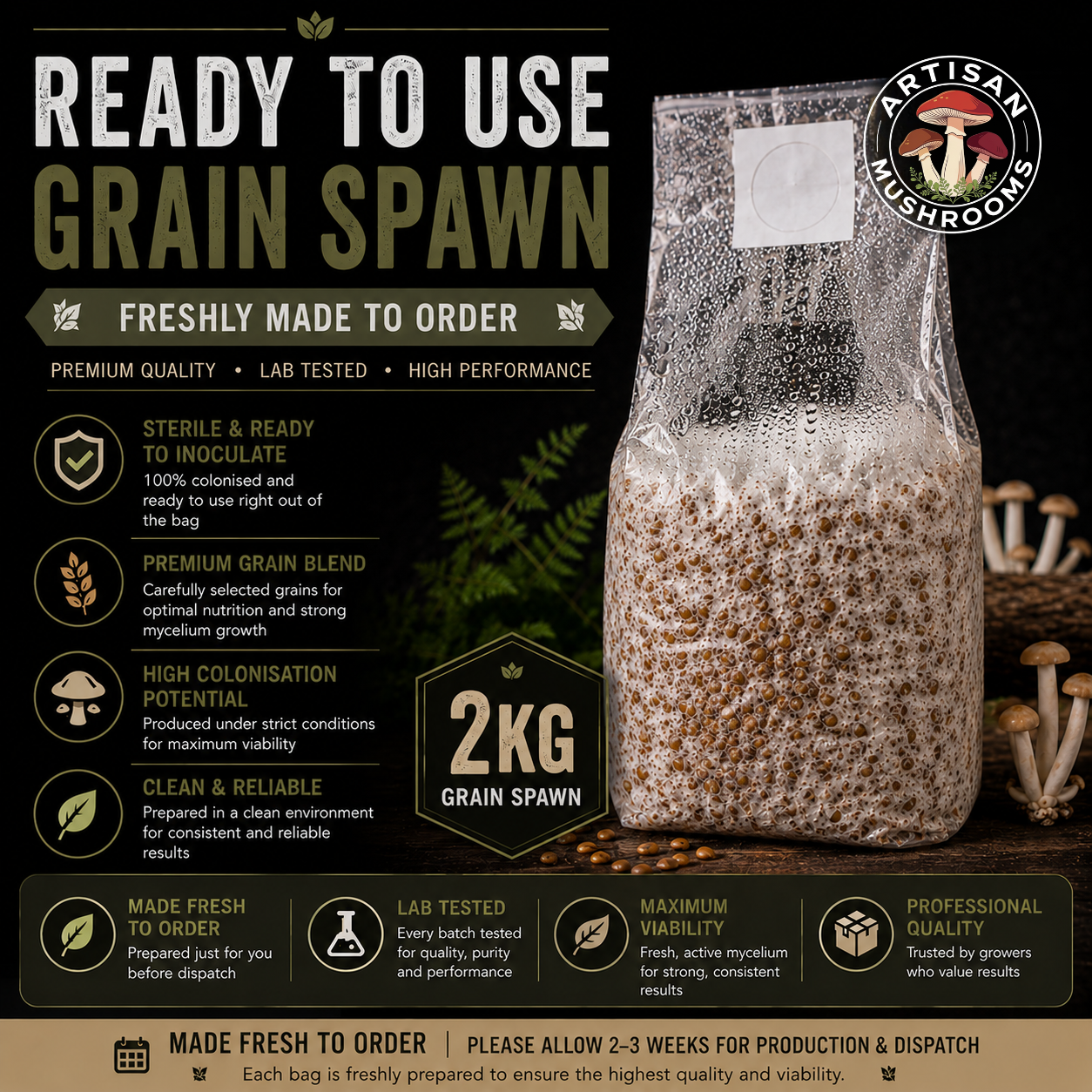
Mushroom grain spawn is sterilised grain that has already been fully colonised by living mushroom mycelium.
Each colonised grain acts as an individual inoculation point when the spawn is mixed into a suitable bulk substrate. This allows the mushroom mycelium to spread quickly and evenly throughout the growing material.
Grain spawn is commonly used to inoculate:
Hardwood sawdust substrate
Straw
Hardwood chips
Outdoor mushroom beds
Prepared mushroom compost
Species-appropriate bulk substrates
Additional sterilised grain
The grain spawn is the living starter culture used to establish the mushroom mycelium in a larger quantity of growing material.
What is included with the 2kg grain spawn?
Each order contains approximately 2 kg of fresh mushroom grain spawn colonised with the mushroom species selected when ordering.
The spawn is supplied in a sealed filter-patch cultivation bag.
It does not include:
A fruiting substrate
A mushroom grow kit
A liquid culture syringe
A sterile needle
An alcohol wipe
A fruiting chamber
Wood chips or straw
Compost or casing material
The correct bulk substrate must be obtained separately and will depend on the mushroom species selected.
Is the grain already colonised?
Yes. This product contains grain that has already been colonised with mushroom mycelium.
It is ready to be mixed into a suitable fruiting substrate or used to establish an outdoor mushroom bed.
You do not need to inject the bag with liquid culture.
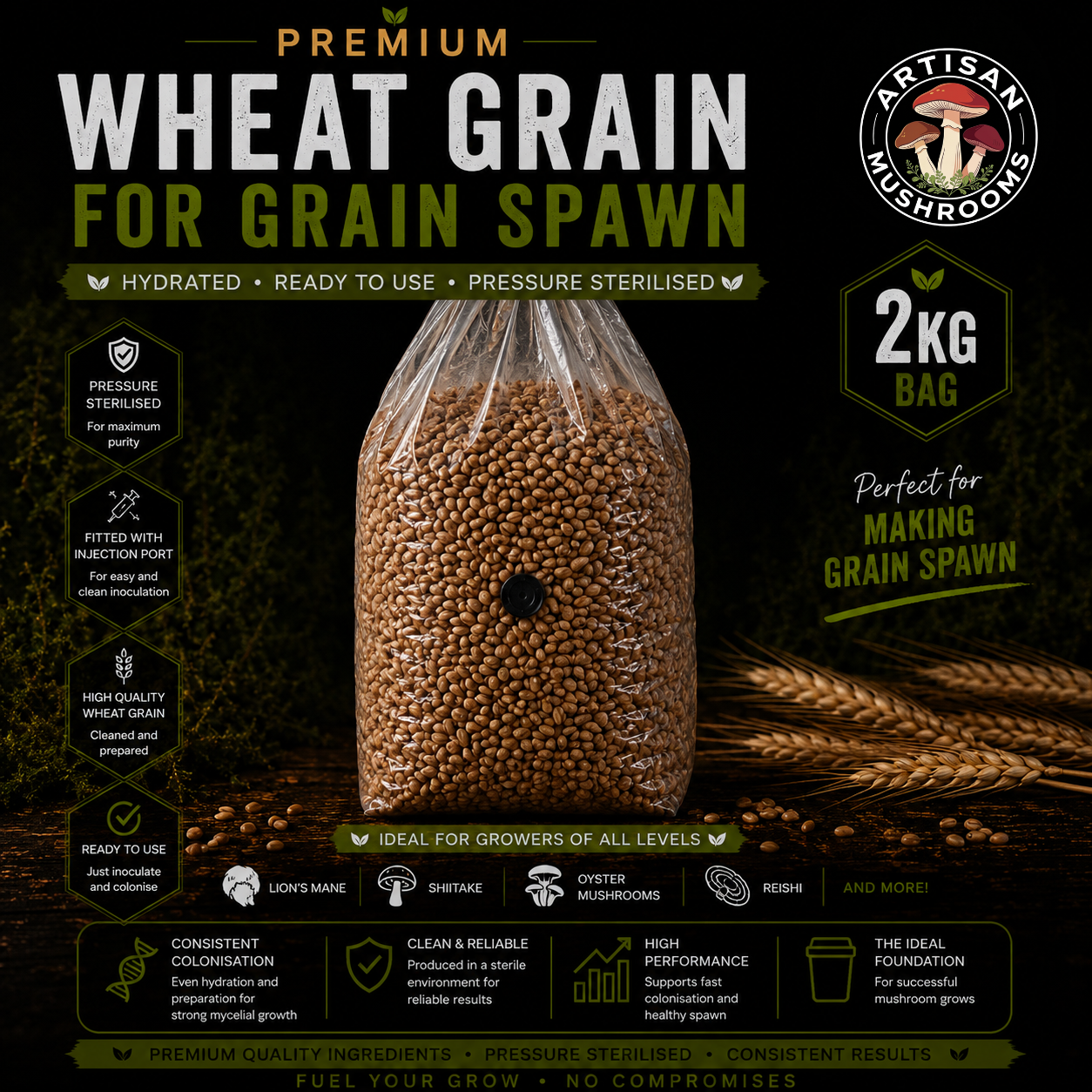
This is different from our 2kg Sterilised Wheat Grain Bag with Injection Port, which contains sterile, uncolonised grain and must be inoculated before use.
What is the difference between grain spawn and a sterile grain bag?
Grain spawn already contains living mushroom mycelium.
A sterile grain bag contains hydrated and pressure-sterilised grain but does not yet contain a mushroom culture.
The basic difference is:
Premium Grain Spawn
Already inoculated
Fully colonised with the selected mushroom species
Ready to mix with a suitable substrate
Does not require a liquid culture syringe
Prepared fresh to order
Sterilised Grain Bag
Contains no mushroom culture
Must be inoculated with liquid culture or agar
Must colonise before it can be used as spawn
Includes a self-healing injection port
Allows the customer to produce their own grain spawn
Choose Premium Grain Spawn when you want active mushroom mycelium that is ready to use.
Choose a Sterilised Wheat Grain Bag when you want to inoculate and produce your own grain spawn.
Is the grain spawn ready to use?
Yes. Once received, the grain spawn can be mixed with an appropriate prepared substrate.
Before opening the bag:
Confirm that you have received the correct mushroom species.
Prepare the fruiting substrate.
Allow any heat-treated substrate to cool completely.
Clean the growing container and working area.
Wash your hands and wear clean gloves.
Break up the colonised grain while the bag is still sealed.
Open the spawn only when you are ready to use it.
Mix it evenly throughout the prepared substrate.
Close the growing container or filter bag.
Allow the new substrate to colonise.
For the best viability, use the grain spawn as soon as reasonably possible after delivery.
Why is the grain spawn made fresh to order?
Grain spawn contains living mushroom mycelium.
Preparing it fresh helps provide:
Vigorous mycelial growth
Strong recovery after mixing
Better substrate colonisation
Reduced ageing during storage
Greater viability when delivered
More dependable performance
The selected mushroom culture must first grow throughout the sterilised grain before the bag can be dispatched.
This means Premium Grain Spawn cannot always be shipped immediately.
How long does grain spawn take to prepare?
Preparation time depends on the mushroom species and its rate of colonisation.
Fast-growing Oyster mushroom species may colonise relatively quickly. Slower species such as Shiitake, Maitake or some Reishi varieties may require additional time.
Because the spawn is produced fresh to order, dispatch may take several weeks.
The spawn is sent only after the mycelium has sufficiently colonised the grain and the bag has been checked for healthy development.
Why can the preparation time vary?
Preparation time can be affected by:
Mushroom species
Culture vigour
Incubation temperature
Grain moisture
Bag size
Mycelial density
Recovery after mixing
Final quality checks
Mushroom cultures are living organisms and do not all grow at exactly the same speed.
Allowing the grain sufficient time to colonise is more important than dispatching a partially colonised bag.
Which mushroom species are available as grain spawn?
Available species may vary depending on current culture availability.
Grain spawn can be produced for many gourmet and specialty mushrooms, including selected:
Oyster mushroom varieties
Lion’s Mane
Bear’s Head Lion’s Mane
King Oyster
Shiitake
Chestnut Mushroom
Maitake
Enoki
Turkey Tail
Reishi varieties
Wine Cap
Golden Wine Cap
Other suitable saprotrophic mushroom species
Select the required species from the product options when ordering.
Different species require different final substrates and fruiting conditions.
Can I request any mushroom species as grain spawn?
Not every liquid culture is suitable for sale or use as conventional grain spawn.
Grain spawn is most useful for saprotrophic species that naturally colonise wood, straw, compost or other decomposing organic material.
Mycorrhizal species such as Chanterelles and Hedgehog mushrooms require a long-term relationship with living tree roots. Grain colonised by these cultures would be used only as an experimental outdoor inoculation carrier rather than as conventional ready-to-fruit grain spawn.
Available grain-spawn species are shown in the product selection menu.
Is grain spawn a complete mushroom grow kit?
No. Grain spawn is an inoculation material rather than a complete grow kit.
It must normally be mixed with a larger quantity of species-appropriate substrate.
Examples include:
Hardwood sawdust for Lion’s Mane, Shiitake, Chestnut and Reishi
Straw for selected Oyster mushrooms
Hardwood chips for Wine Cap and outdoor Oyster beds
Prepared compost for Portobello
Supplemented sawdust for Enoki and Maitake
The grain provides active mycelium and nutrition, but it does not usually provide enough water, structure or volume for a productive mushroom crop by itself.
Can mushrooms fruit directly from the grain spawn bag?
Mushrooms may occasionally begin forming inside an old or fully colonised grain spawn bag, but fruiting directly from the grain is not the recommended cultivation method.
Grain alone can:
Dry out quickly after opening
Become contaminated easily
Produce limited yields
Form small or irregular mushrooms
Overheat when kept in a dense mass
Lack the structure required by the species
The grain spawn should be transferred to a suitable fruiting substrate for the best results.
Should I inject liquid culture into the grain spawn?
No. The grain is already colonised with mushroom mycelium.
Injecting additional liquid culture can:
Add unnecessary moisture
Introduce another culture
Increase contamination risk
Create uneven genetics
Damage healthy established spawn
Make the grain excessively wet
Use the grain spawn directly with a suitable prepared substrate.
Customers who want to inoculate grain with their own liquid culture should purchase an uncolonised 2kg Sterilised Wheat Grain Bag.
What substrate should I use with the grain spawn?
The correct substrate depends on the mushroom species.
Hardwood-loving mushrooms
Species such as Lion’s Mane, Shiitake, Chestnut, Maitake, Enoki, Turkey Tail and Reishi generally perform well on sterilised hardwood sawdust.
Our 2kg Sterilised Hardwood and Wheat Bran Substrate provides a prepared hardwood-based option.
Oyster mushrooms
Oyster mushrooms can grow on:
Pasteurised straw
Hardwood sawdust
Hardwood pellets
Hardwood chips
Suitable agricultural by-products
Species-appropriate bulk substrate blends
Wine Cap and Golden Wine Cap
These species perform best in outdoor beds containing:
Hardwood chips
Straw
Hardwood mulch
A mixture of wood chips and straw
Portobello
Portobello requires properly prepared mushroom compost followed by a casing layer.
Our Sterilised Bulk CVG Substrate can be used as a moisture-retaining casing layer above fully colonised Portobello compost.
Can I use the grain spawn with your hardwood substrate?
Yes. Grain spawn can be mixed with our 2kg Sterilised Hardwood and Wheat Bran Substrate.
This combination is suitable for many wood-decaying species, including selected:
Lion’s Mane varieties
Oyster mushrooms
Shiitake
Chestnut Mushroom
Maitake
Enoki
Turkey Tail
Reishi varieties
Chicken of the Woods as an experimental option
The sterile hardwood substrate must be opened and inoculated under very clean conditions.
Once the grain spawn and hardwood substrate have been mixed, seal the filter bag and allow the new block to colonise completely before introducing fruiting conditions.
Can I use the grain spawn with a hardwood grow bag?
Our Sterile Hardwood Mushroom Grow Bag is primarily designed for direct liquid-culture inoculation through its self-healing injection port.
It can also be opened and mixed with grain spawn, but this requires clean handling inside a still-air box or in front of a laminar-flow hood.
Opening a sterilised grow bag in ordinary room air can expose the nutrient-rich substrate to mould spores and bacteria.
For grain-spawn inoculation, our separate 2kg Sterilised Hardwood and Wheat Bran Substrate may provide a more convenient bulk-substrate option.
Can I mix grain spawn with CVG?
This depends on the mushroom species.
CVG contains coco coir, vermiculite and gypsum. It retains moisture and provides structure, but it contains less suitable nutrition for wood-decaying gourmet species than hardwood or straw.
Selected Oyster mushroom species may colonise CVG when it is mixed with a generous quantity of healthy grain spawn. However, hardwood sawdust or straw is generally a more species-appropriate substrate.
For Portobello mushrooms, CVG is used as a casing layer over colonised compost rather than being mixed with grain spawn as the main substrate.
Lion’s Mane, Shiitake, Chestnut, Maitake, Enoki and Reishi should normally be transferred to hardwood-based substrate rather than CVG.
Can I use grain spawn with straw?
Yes. Straw is suitable for selected mushroom species, particularly Oyster mushrooms.
The straw should be:
Clean
Free from visible mould
Chopped or suitably prepared
Properly hydrated
Pasteurised or sterilised as appropriate
Cooled completely before inoculation
Moist but not waterlogged
Break up the grain spawn and distribute it evenly through the prepared straw.
A higher spawn rate can help the mushroom mycelium colonise the straw rapidly before competing organisms become established.
Can I use grain spawn with hardwood chips?
Yes. Grain spawn can be used to establish an outdoor hardwood-chip mushroom bed.
This method is especially suitable for:
Wine Cap
Golden Wine Cap
Selected Oyster mushroom varieties
Chestnut Mushroom as an experimental outdoor option
Other suitable wood-decaying species
A basic outdoor method is:
Select a shaded or partially shaded location.
Hydrate clean, untreated hardwood chips.
Place a layer of chips over natural soil.
Break the grain spawn into individual grains and small clusters.
Distribute the spawn evenly over the chips.
Add another layer of hydrated chips.
Repeat the layering process if sufficient material is available.
Finish with a protective layer of chips, straw or leaf litter.
Water the bed thoroughly.
Keep it consistently moist during establishment.
Cover the grain completely to protect it from sunlight, drying, birds and rodents.
How much outdoor bed can 2kg of grain spawn inoculate?
A practical rate for an outdoor mushroom bed is approximately 1 kg of grain spawn per square metre.
A 2 kg bag can therefore inoculate approximately 2 square metres of prepared woodchip or straw bed.
The exact area depends on:
Mushroom species
Bed depth
Woodchip size
Amount of straw
Season
Moisture
Local competition
Desired colonisation speed
Using a higher spawn rate normally produces faster and more dependable establishment.
Can grain spawn be used to inoculate logs?
Loose grain spawn is not normally the best material for inoculating logs.
Grain can be difficult to pack securely into drilled holes and may be attractive to insects, birds and rodents.
Sawdust spawn or wooden plug spawn generally provides better contact with the interior of a log.
Grain spawn can first be used to colonise a hardwood sawdust substrate. The resulting sawdust spawn can then be packed into drilled holes in suitable logs.
Can I use grain spawn for an outdoor garden bed?
Yes. Selected mushroom species can be established in outdoor garden beds using grain spawn.
Suitable locations include:
Shaded woodchip paths
Beneath shrubs
Orchards
Forest gardens
Polytunnels
Vegetable-garden paths
Mulched garden borders
Areas beside hedges
Use a species suited to outdoor bed cultivation.
Wine Cap, Golden Wine Cap and selected Oyster mushrooms are among the most practical options.
Outdoor cultivation depends on rainfall, temperature, substrate moisture and competition from other organisms. Fruiting times and yields cannot be guaranteed.
How much substrate can one 2kg bag inoculate?
The appropriate quantity depends on the mushroom species and cultivation method.
A spawn rate of approximately 10% to 20% by wet substrate weight is a practical starting range for many indoor bulk-substrate projects.
At this rate, one 2 kg bag of grain spawn can inoculate approximately:
10 kg of prepared substrate at a 20% spawn rate
20 kg of prepared substrate at a 10% spawn rate
Higher spawn rates usually provide faster colonisation and can reduce the period during which contamination may establish.
Lower spawn rates use the grain more economically but normally take longer to colonise.
Can I use the full 2kg bag with one 2kg substrate bag?
Yes. Mixing one 2 kg grain spawn bag with one 2 kg substrate bag creates a high spawn rate.
This may provide:
Very rapid colonisation
Numerous inoculation points
Strong nutritional support
Reduced colonisation time
Greater resistance to competing organisms
However, a one-to-one ratio uses more spawn than is normally required.
One 2 kg grain spawn bag can usually inoculate several 2 kg substrate bags, depending on the species and desired spawn rate.
What spawn rate should a beginner use?
A spawn rate of approximately 15% to 20% by wet substrate weight is a practical starting point for beginners.
A higher spawn rate:
Creates more inoculation points
Shortens colonisation time
Helps the mycelium establish rapidly
Reduces the time available for contaminants
Provides more consistent growth
Experienced growers may use lower spawn rates when working with vigorous cultures and carefully prepared substrates.
How do I break up the grain spawn?
Break up the grain while the bag remains sealed.
A practical method is:
Allow a refrigerated bag to warm slightly while sealed.
Gently press and massage the colonised grain.
Break large mycelial blocks into smaller clusters.
Continue until the grains are mostly loose.
Avoid striking the filter patch or bag seal.
Open the bag only when the substrate is ready.
The mycelium may hold the grains together firmly.
Work gradually rather than hitting the bag against a hard or dirty surface.
Why is the grain spawn one solid block?
Healthy mushroom mycelium binds the individual grains together as it colonises the bag.
A firm block can indicate strong mycelial growth.
The spawn should be broken into separate grains and small clusters before it is mixed with the substrate.
This distributes the mycelium more evenly and provides more inoculation points.
Does breaking up the spawn damage the mycelium?
Breaking up fully colonised grain temporarily damages some of the visible mycelial connections, but healthy mycelium normally recovers quickly.
After the spawn is mixed into a suitable substrate, new mycelium grows from the surface of each colonised grain.
Avoid repeatedly breaking up the bag during storage.
Break it apart shortly before use.
Why does the grain look less white after breaking it up?
The white mycelium can become less visible after the colonised grains are separated.
This is normal.
The internal grain remains colonised even though the outer mycelial network has been disturbed.
Healthy spawn usually begins recovering within several days when maintained under suitable conditions.
Should I wait for the spawn to recover after delivery?
If the bag has been heavily disturbed during delivery, allow it to rest while sealed.
Keep it at a species-appropriate temperature for approximately two to five days and monitor it for mycelial recovery.
Healthy spawn should begin reconnecting and producing fresh white growth.
If the bag is needed immediately and appears healthy, it can generally be used without a long recovery period.
Do not leave mature spawn at warm temperatures for an unnecessarily long time.
How should I mix the grain spawn with substrate?
The exact method depends on whether the final substrate is sterile or pasteurised.
Sterilised supplemented substrate
Work inside a still-air box or in front of a properly operated laminar-flow hood.
Clean the working area.
Wash your hands and wear clean gloves.
Disinfect the outside of both bags.
Break up the grain spawn while sealed.
Open the sterile substrate and spawn only when ready.
Add the required quantity of spawn.
Mix it evenly through the substrate.
Seal the filter bag immediately.
Label it with the species and date.
Incubate under suitable conditions.
Pasteurised straw or outdoor material
Perfect laboratory sterility is not normally possible or required.
Use clean tools, clean hands and healthy spawn. Mix the grain evenly through the prepared material and protect it from drying.
Should grain spawn be layered or mixed evenly?
For indoor substrate bags, mixing the grain evenly normally provides the fastest and most uniform colonisation.
For outdoor beds, layering can be convenient.
A layered outdoor bed may include:
Hydrated wood chips or straw
A layer of broken-up grain spawn
Another layer of substrate
Additional grain spawn
A final protective substrate layer
The grain should not remain exposed on the surface.
Should I compress the substrate after adding grain spawn?
The substrate should be gently settled but not heavily compressed.
Excessive compression can:
Reduce air spaces
Slow mycelial growth
Create poorly aerated sections
Trap excess water
Encourage bacterial problems
Cause uneven colonisation
The final substrate should remain loose enough for gas exchange while being firm enough to maintain its intended shape.
What temperature should the substrate be before adding spawn?
The substrate must be completely cool before grain spawn is added.
Do not add grain spawn to warm or hot substrate.
Excessive heat can:
Damage or kill the mycelium
Encourage bacterial growth
Create condensation
Cause uneven recovery
Overheat the centre of the growing block
The substrate should be at normal room temperature or within the colonisation range of the selected species.
What temperature is needed after spawning?
The correct temperature depends on the selected mushroom species.
A practical general range for many gourmet species is approximately 20°C to 25°C.
Examples include:
Oyster mushrooms: approximately 20°C to 25°C
Lion’s Mane: approximately 20°C to 24°C
Shiitake: approximately 18°C to 24°C
Chestnut Mushroom: approximately 21°C to 25°C
Maitake: approximately 21°C to 26°C
Enoki: approximately 20°C to 25°C
Reishi: approximately 24°C to 28°C
The centre of a large substrate bag may become warmer than the room because actively growing mycelium produces heat.
A digital thermometer and hygrometer can help monitor the growing environment.
Does the newly inoculated substrate need darkness?
Complete darkness is not normally required.
Low ambient light or ordinary indirect room light is suitable for most gourmet mushroom species during colonisation.
Avoid direct sunlight because it can:
Overheat the substrate
Dry the bag
Create condensation
Cause major temperature fluctuations
Trigger premature fruiting in some species
Temperature, cleanliness and gas exchange are more important than complete darkness.
How long will the grain spawn take to colonise a substrate?
Colonisation time depends on:
Mushroom species
Spawn rate
Substrate type
Substrate preparation
Temperature
Moisture content
Bag size
Mycelial vigour
Gas exchange
Substrate density
Fast-growing Oyster mushrooms may colonise a suitable substrate within approximately one to three weeks.
Lion’s Mane, Chestnut, Shiitake, Maitake and Reishi may require several weeks or longer.
Do not introduce fruiting conditions based only on a fixed number of days.
Assess the actual condition and maturity of the colonised substrate.
How do I know when the new substrate is fully colonised?
Signs of complete colonisation may include:
Healthy mycelium visible throughout the substrate
The substrate becoming firm and held together
No large uncolonised sections
No spreading green, black, pink or unusual growth
No foul or sour smell
Species-appropriate colour and texture
Recovery after mixing
No loose nutrient-rich areas remaining
Some species require further maturation after the substrate appears colonised.
For example:
Shiitake requires popcorning and browning.
Maitake benefits from additional consolidation.
Reishi may develop a dense surface layer.
Chestnut can benefit from an additional resting period.
Lion’s Mane may begin fruiting before the block appears completely white.
Should I mix the substrate again during colonisation?
No. Once grain spawn has been evenly distributed through the final substrate, leave it undisturbed.
Mixing again can:
Break the developing mycelial network
Delay colonisation
Introduce contamination
Damage the bag
Compact the substrate
Disturb developing primordia
Inspect the substrate through the bag or container rather than repeatedly opening it.
What does healthy grain spawn look like?
Healthy grain spawn normally contains white or cream-coloured mushroom mycelium growing around and between the grains.
Depending on the species, it may appear:
Fine and wispy
Cotton-like
Dense and solid
Rope-like
Slightly leathery
Patchy after shipping
Firmly bound together
Cream or pale tan in older sections
Some species have distinctive characteristics.
Lion’s Mane mycelium may appear finer than Oyster mycelium.
Reishi can form dense white growth and produce amber droplets.
Chicken of the Woods may produce yellow or orange pigmentation.
The appearance should be considered together with the selected mushroom species.
What are the yellow or amber droplets in the spawn bag?
Small yellow, amber or brown droplets may be fungal metabolites.
They can appear when the mycelium is:
Actively digesting the grain
Mature
Recovering from temperature changes
Experiencing mild stress
Stored for an extended period
Becoming too warm
A small amount of clear or amber liquid does not necessarily indicate contamination.
Large amounts of dark liquid combined with slimy grain, a sour smell or stalled growth may indicate a problem.
Why is there condensation inside the bag?
Condensation can form when the temperature inside the spawn differs from the surrounding air.
It may occur:
During delivery
After refrigeration
When the spawn is recovering
During warm weather
When the mycelium is actively producing heat
Following room-temperature changes
A moderate amount of condensation is normal.
Heavy pooling combined with slimy or discoloured grain may indicate excessive moisture or bacterial contamination.
How can I tell if the grain spawn is contaminated?
Possible contamination signs include:
Green mould
Black mould
Pink or red growth
Rapidly spreading grey mould
Slimy grain
Sour or fermented smells
Rotten odours
Excessive dark liquid
Grain that remains wet and uncolonised
Mushroom mycelium stopping around another organism
A severely swollen bag with no healthy growth
Some mushroom species produce natural yellow, orange, tan or brown pigmentation.
Do not diagnose contamination from colour alone without considering the selected species and growth pattern.
What should I do if the spawn appears contaminated?
Keep the bag sealed and separate it from clean cultures and substrates.
Do not open a heavily contaminated grain bag indoors.
Opening it can release mould spores into the growing area.
If the bag appears contaminated when it arrives:
Keep it sealed.
Photograph the bag clearly.
Photograph the shipping label and packaging.
Contact us as soon as possible.
Do not mix it with substrate.
Keep it away from clean cultivation materials.
Do not attempt to remove one visible contaminated section from a grain-spawn bag.
Why has the bag started producing mushrooms?
A mature grain-spawn bag may begin fruiting when:
It has been stored for too long.
It has received light and fresh-air signals.
Temperatures have changed.
The mycelium has fully consumed the available grain.
The bag contains a vigorous fruiting species.
The culture is attempting to reproduce.
Use the spawn promptly if it remains healthy.
Small early fruiting structures can usually be broken up and mixed with the intended substrate.
Heavily fruited, dried or deteriorating spawn may have reduced colonisation performance.
Can overgrown grain spawn still be used?
Mature spawn can often still be used when:
It smells clean
It contains no visible mould
The grains can be broken apart
The mycelium remains healthy
It has not dried severely
It has not become heavily slimy
Fruiting has not consumed much of the grain
Very old spawn may recover more slowly.
Fresh spawn is recommended for the most vigorous substrate colonisation.
How should the grain spawn be stored?
Use the grain spawn as soon as possible after delivery.
When immediate use is not possible, most cool-to-moderate gourmet mushroom grain spawn can be stored in a refrigerator at approximately 2°C to 4°C.
Keep the bag:
Sealed
Clean
Upright
Away from freezing temperatures
Away from raw food spills
Protected from punctures
With the filter patch unobstructed
Storage requirements can vary between mushroom species.
Warm-growing species may be more sensitive to prolonged refrigeration, so follow any species-specific instructions supplied with the order.
Can grain spawn be frozen?
No. Do not freeze grain spawn.
Freezing can:
Damage the living mycelium
Rupture cells
Split hydrated grains
Create excessive moisture after thawing
Weaken recovery
Increase contamination risk
Store it refrigerated when appropriate, but never frozen.
How long can grain spawn be refrigerated?
Grain spawn is best used while fresh.
The useful storage period depends on:
Mushroom species
Culture age
Grain moisture
Refrigerator temperature
Bag condition
Mycelial vigour
Whether fruiting has begun
Use the spawn as soon as reasonably possible rather than planning for long-term storage.
Inspect the bag before use and allow refrigerated spawn to warm slightly while it remains sealed.
Should I open the bag while it warms up?
No. Keep the grain-spawn bag sealed while it moves closer to the intended working temperature.
Opening a cold bag in warm air can allow condensation and airborne contaminants to enter.
Prepare the substrate and work area first, then open the spawn only when ready to mix it.
Can I use some grain spawn and save the remainder?
Opening the bag exposes the remaining grain to airborne mould spores and bacteria.
For the best results, use the full bag in one cultivation session.
If only part of the spawn is used:
Work under very clean conditions.
Remove the required amount quickly.
Reseal the bag immediately.
Refrigerate the remainder when appropriate.
Use it as soon as possible.
Do not assume it remains contamination-free.
Inspect it carefully before later use.
Repeated opening significantly increases contamination risk.
Can I use the grain spawn for grain-to-grain transfers?
Yes. Healthy grain spawn can be used to inoculate additional sterilised grain.
A small amount of fully colonised grain can create many new growth points in a fresh grain bag or jar.
Grain-to-grain transfer requires advanced sterile technique because both containers must be opened.
The transfer should be performed:
Inside a still-air box
In front of a properly operated laminar-flow hood
Using clean gloves and equipment
With the receiving grain completely sterilised and cooled
Without exposing either bag longer than necessary
Repeated grain-to-grain expansion can increase contamination risk and may eventually reduce culture performance.
How much spawn should be used for a grain-to-grain transfer?
A transfer rate of approximately 5% to 10% colonised grain is commonly sufficient.
A higher rate provides faster colonisation but uses more of the original spawn.
Mix the colonised grains evenly through the fresh sterile grain after the transfer.
Do not use grain spawn showing signs of contamination.
Can grain spawn be used to make liquid culture?
Transferring exposed grain directly into liquid culture is not generally recommended.
Grain can carry hidden bacteria or contaminants that may rapidly spread through the liquid.
A cleaner process is:
Transfer healthy mycelium from the grain to agar.
Isolate clean growth on a fresh LME agar plate.
Transfer a clean agar wedge into sterile liquid-culture solution.
Allow the culture to grow.
Test the finished liquid culture on agar before use.
This provides an opportunity to visually inspect and clean the culture before it enters the liquid medium.
Can grain spawn be eaten?
No. Grain spawn is produced as mushroom cultivation material and is not intended for direct consumption.
It may contain:
Dense living mycelium
Partially digested grain
Metabolic compounds
Cultivation-bag residues
Material handled as a growing input rather than food
Use it only to inoculate an appropriate mushroom substrate.
Can grain spawn be planted directly in garden soil?
Grain spawn should not usually be buried in plain soil without a suitable food source.
Most cultivated mushroom species require material such as:
Hardwood chips
Straw
Hardwood sawdust
Compost
Woody mulch
Other species-appropriate organic matter
Plain soil does not provide enough suitable nutrition for most saprotrophic mushroom species.
For outdoor cultivation, layer the grain spawn with hydrated wood chips, straw or another appropriate substrate.
Can I combine two different grain-spawn species?
Do not mix two mushroom species in the same indoor substrate bag or small growing container.
The cultures may compete for the available nutrition, resulting in:
Uneven colonisation
One species suppressing the other
Reduced yields
Difficult fruiting management
Unpredictable mushroom production
Increased contamination risk
Use a separate substrate container for each species.
Different outdoor beds can be established close to one another, but each bed should still be inoculated with one chosen species.
Can I grow several flushes from substrate inoculated with the spawn?
Yes. A healthy, fully colonised fruiting substrate may produce more than one flush.
The number and size of flushes depend on:
Mushroom species
Substrate quantity
Spawn rate
Available nutrition
Moisture
Temperature
Humidity
Fresh-air exchange
Harvest timing
Contamination
Block damage
The grain spawn establishes the culture, but the final yield is mainly determined by the fruiting substrate and growing environment.
Is successful mushroom production guaranteed?
Grain spawn provides healthy mushroom mycelium, but successful mushroom production depends on several factors outside the spawn itself.
These include:
Correct substrate selection
Proper substrate preparation
Clean handling
Spawn rate
Colonisation temperature
Substrate moisture
Gas exchange
Complete colonisation
Fruiting temperature
Humidity
Fresh-air exchange
Lighting
Mushroom genetics
Contamination control
Mushroom cultivation involves living organisms, so exact colonisation times, yields and flush numbers cannot be guaranteed.
Is grain spawn suitable for beginners?
Yes. Ready-to-use grain spawn removes the need to:
Prepare grain
Hydrate grain
Load grain bags
Pressure sterilise grain
Inoculate grain with liquid culture
Wait for the grain to colonise
Test the grain culture before use
The customer can begin directly at the substrate-inoculation stage.
Beginners must still select an appropriate substrate and provide the correct colonisation and fruiting conditions for the chosen species.
What should I do if the bag is damaged during delivery?
Inspect the grain-spawn bag before opening it.
Check for:
Tears
Punctures
A damaged seal
A detached filter patch
Leaking grain
Visible contamination
Unusual odours escaping through damaged packaging
Do not use a bag that has clearly lost its sealed condition.
Photograph the bag and outer packaging and contact us as soon as possible.
Minor compression, grain movement or broken-up mycelium caused by delivery does not necessarily mean the bag is damaged.
Where is the grain spawn prepared and shipped from?
Our Premium Mushroom Grain Spawn is prepared fresh under controlled laboratory conditions in Ireland.
The grain is sterilised, inoculated with the selected mushroom culture and allowed to colonise before dispatch.
Fast shipping is available to customers across Ireland, the UK, Europe, the United States and Canada.