 Image 1 of 3
 Image 2 of 3
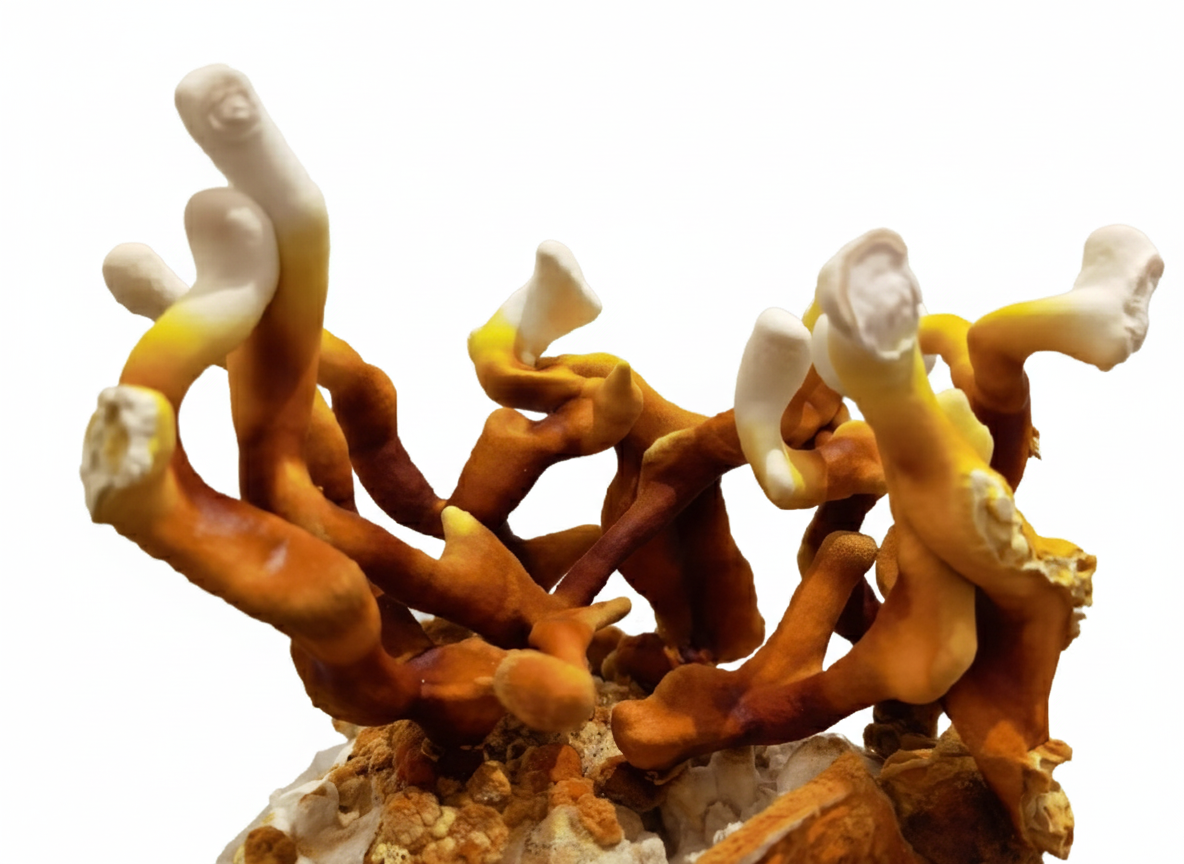 Image 3 of 3
Antler Reishi Liquid Culture FAQ
What is the scientific name of Antler Reishi?
The scientific name for our Antler Reishi culture is Ganoderma multipileum.
It is a tropical Reishi species known for producing striking upright, branching fruiting bodies that resemble antlers.
Young growth normally begins white or cream before gradually developing yellow, orange, red and reddish-brown colouring. Mature sections can develop the glossy, lacquered surface associated with Reishi mushrooms.
Like other Reishi species, Antler Reishi is a tough, woody polypore rather than a soft culinary mushroom.
Is Antler Reishi a separate species or just a fruiting shape?
The term Antler Reishi can refer both to a selected Ganoderma culture and to a particular fruiting shape.
Our Antler Reishi culture is identified as Ganoderma multipileum, a distinct species that naturally produces vigorous, elongated and branching growth.
However, environmental conditions also strongly influence its final shape.
Elevated carbon dioxide and restricted fresh-air exchange encourage narrow, elongated antlers. Increased fresh-air exchange may cause the tips to widen and develop fan-shaped or shelf-like caps.
The genetics provide the potential for strong antler formation, while the growing environment determines how fully that shape develops.
How is Antler Reishi different from Red Reishi?
Antler Reishi and Red Reishi are different Ganoderma cultures.
Our Antler Reishi is Ganoderma multipileum, while Red Reishi is generally identified as Ganoderma lingzhi or a closely related lacquered Ganoderma species.
Antler Reishi is particularly well suited to producing upright, branching fruiting bodies under elevated carbon dioxide.
Red Reishi can also form antlers when fresh-air exchange is restricted, but it is more commonly cultivated to produce broad, glossy shelf-shaped conks.
Antler Reishi is generally a warm-growing species and can produce vigorous branching structures when cultivated inside the humid air space of a filter bag.
What substrate is best for growing Antler Reishi?
Antler Reishi grows particularly well on sterilised hardwood-based substrates.
Suitable materials include:
Oak sawdust
Beech sawdust
Rubberwood sawdust
Mixed deciduous hardwood sawdust
Hardwood pellets
Hardwood sawdust supplemented with wheat bran
Other suitable untreated hardwood materials
Adding a nutritious supplement such as wheat bran can support vigorous mycelial growth and fruiting.
Supplemented hardwood substrate must be properly sterilised because its higher nutrient content makes it more susceptible to contamination.
Our 2kg Sterilised Hardwood and Wheat Bran Substrate provides a prepared fruiting substrate suitable for Antler Reishi cultivation.
Can I inoculate a hardwood grow bag directly?
Yes. Antler Reishi liquid culture can be injected directly into our Sterile Hardwood Mushroom Grow Bag.
The bag contains sterilised hardwood substrate supplemented with wheat bran and includes a self-healing injection port.
After inoculation, keep the bag sealed while the mycelium colonises the substrate.
Once the block is fully colonised, antlers can often be developed within the humid air space above the substrate. Keeping the bag mostly closed maintains elevated carbon dioxide and encourages elongated branching growth.
Direct inoculation is the simplest option for growers who do not want to prepare separate grain spawn and hardwood substrate.
Can Antler Reishi liquid culture be used on grain?
Yes. Sterilised grain is commonly used to expand Antler Reishi mycelium before transferring it to hardwood substrate.
The liquid culture can be injected into our 2kg Sterilised Wheat Grain Bag.
Allow the grain to become fully colonised before mixing it with our 2kg Sterilised Hardwood and Wheat Bran Substrate.
Using grain spawn creates numerous inoculation points throughout the final hardwood block. This can provide faster and more even colonisation than injecting a large hardwood substrate bag directly.
Grain is normally used as a culture-expansion medium rather than the complete Antler Reishi fruiting substrate.
Do you sell sterilised grain and hardwood substrate?
Yes. We offer pre-sterilised wheat grain bags, sterilised hardwood and wheat bran substrate, and ready-to-inoculate hardwood grow bags.
Using prepared grain and substrate removes the need to hydrate, mix and pressure sterilise your own growing media.
A typical grain-to-hardwood growing process is:
Inoculate a pre-sterilised grain bag with Antler Reishi liquid culture.
Allow the grain to become fully colonised.
Mix the colonised grain spawn with sterilised hardwood and wheat bran substrate.
Allow the hardwood substrate to become completely colonised.
Give the block additional time to consolidate.
Leave air space above the substrate.
Introduce warm fruiting conditions with high humidity and gentle lighting.
Restrict fresh-air exchange to encourage antler development.
Allow the antlers to grow upwards and branch inside the bag.
Harvest when they are fully developed, firm and deeply coloured.
Alternatively, the liquid culture can be injected directly into our Sterile Hardwood Mushroom Grow Bag.
Is Antler Reishi suitable for beginners?
Yes. Antler Reishi can be suitable for beginners, especially when a ready-to-inoculate hardwood grow bag is used.
Reishi mycelium is generally vigorous and the fruiting bodies are firm and slow-growing. This makes them less vulnerable to brief humidity fluctuations than soft mushrooms such as Oyster mushrooms.
The main cultivation challenge is controlling fresh-air exchange.
Too much fresh air can cause the antlers to flatten into caps. Too little gas exchange can eventually stall growth, even though elevated carbon dioxide is required for the desired antler form.
The ready-to-inoculate hardwood grow bag provides the simplest option because the culture can be injected directly through the self-healing injection port.
How should I store the liquid culture?
Keep the Antler Reishi liquid culture syringe refrigerated at approximately 2°C to 4°C until you are ready to use it.
Do not freeze it.
For the best viability, use the culture within three months of receiving it.
Before inoculation, allow the syringe to move closer to room temperature and shake it gently to distribute the mycelium throughout the nutrient solution.
Keep the protective cap fitted during storage. Attach a new sterile needle immediately before inoculating grain, agar or a hardwood grow bag.
How much liquid culture should I use?
The amount of liquid culture required depends on the size and type of growing medium.
For one of our sterile LME agar plates, one or two small drops are normally sufficient.
A small grain jar may require approximately 1 to 2 ml.
When inoculating our 2kg Sterilised Wheat Grain Bag or Sterile Hardwood Mushroom Grow Bag, approximately 5 to 10 ml can be used.
Using too much liquid culture can introduce excess moisture into the grain or substrate and increase the risk of bacterial contamination.
Does the syringe contain mushroom spores?
No. Antler Reishi liquid culture contains living Ganoderma multipileum mycelium suspended in a sterile nutrient solution.
It is not a mushroom spore solution.
Because the mycelium is already actively growing, liquid culture can begin colonising a suitable medium without waiting for spores to germinate.
The culture can be used to inoculate sterilised grain, hardwood substrate or a sterile LME agar plate.
Can I test Antler Reishi liquid culture on agar?
Yes. Testing the culture on agar allows you to observe its growth before inoculating a larger grain or substrate bag.
Place one or two small drops onto one of our sterile LME agar plates.
Keep the plate sealed and monitor the mycelium as it spreads from the inoculation point.
Healthy Antler Reishi mycelium is normally white or cream. It may become dense, cottony or slightly leathery as it matures.
Do not open a colonised agar plate outside a clean working environment. Exposure to normal room air can introduce mould spores and bacteria.
What conditions does Antler Reishi need to colonise?
Antler Reishi generally colonises well under warm conditions.
Suitable starting conditions include:
Temperatures of approximately 24°C to 28°C
Darkness or low ambient light
A clean and stable incubation area
Filtered gas exchange
No direct sunlight
Properly hydrated substrate
Minimal disturbance during early growth
The grain or hardwood substrate should be allowed to become fully colonised before fruiting conditions are introduced.
Avoid prolonged extreme heat. The centre of a large colonising bag can become warmer than the surrounding room because actively growing mycelium produces heat.
What does healthy Antler Reishi mycelium look like?
Healthy Antler Reishi mycelium normally appears white or cream-coloured.
As it colonises grain or hardwood substrate, it may develop:
Fine white strands
Cotton-like patches
Dense white growth
Thick surface mycelium
A slightly leathery mycelial layer
Pale yellow pigmentation
Yellow or amber droplets
Small amber droplets may be fungal metabolites and do not always indicate contamination.
Green, black, pink or foul-smelling growth may indicate mould or bacterial contamination.
A healthy colonised bag should smell earthy or mushroom-like rather than sour, rotten or fermented.
How long does Antler Reishi take to colonise?
Colonisation time depends on temperature, culture vigour, inoculation rate, substrate density and bag size.
A grain bag may require approximately two to five weeks to become fully colonised.
A supplemented hardwood block may require approximately four to eight weeks or longer.
The visible outer surface may become white before the centre of the block is fully colonised. Allow sufficient time for the mycelium to spread throughout the entire substrate.
Antler Reishi fruiting bodies develop slowly compared with Oyster mushrooms. Even after colonisation is complete, the antlers may require several additional weeks or months to reach maturity.
Does Antler Reishi need a maturation period?
Yes. A fully colonised Antler Reishi block can benefit from additional time to consolidate before fruiting.
During this stage, the mycelium continues breaking down the hardwood and building a strong network throughout the substrate.
Keep the bag sealed and continue providing filtered gas exchange.
A mature block should:
Be colonised throughout
Feel firm and well held together
Contain no large loose areas
Contain no wet, uncolonised patches
Smell clean and mushroom-like
Show no spreading mould
The exact maturation period varies according to the substrate and culture.
What conditions does Antler Reishi need to fruit?
Antler Reishi generally performs well under warm and humid fruiting conditions.
Suitable starting conditions include:
Temperatures of approximately 22°C to 28°C
Relative humidity of approximately 85% to 95% during early growth
Relative humidity of approximately 80% to 90% as the antlers mature
Gentle indirect daylight or artificial lighting
Limited fresh-air exchange
Elevated carbon dioxide
No direct sunlight
Sufficient vertical space above the substrate
High humidity is especially important while the first primordia and soft growing tips are developing.
The antlers should not remain continuously wet. Excessive surface moisture combined with poor ventilation can encourage bacterial damage.
A digital thermometer and hygrometer can help monitor temperature and humidity throughout colonisation and fruiting.
Does Antler Reishi require light?
Yes. Antler Reishi benefits from gentle light during fruiting.
Suitable options include:
Indirect daylight
Diffused window light
A low-intensity grow light
A regular day-and-night lighting cycle
Light helps guide the direction of the antlers and can influence their branching pattern and colour.
Strong direct sunlight should be avoided because it can overheat and dry the developing fruiting bodies.
Complete darkness may result in pale, weakly oriented or irregular growth.
How do I encourage strong antler formation?
Antler-shaped growth is encouraged by elevated carbon dioxide and limited fresh-air exchange.
A practical method is:
Allow the hardwood block to colonise and consolidate completely.
Leave generous air space above the substrate inside the grow bag.
Keep the top of the bag closed or only loosely folded.
Allow filtered gas exchange through the filter patch.
Maintain warm temperatures and high humidity.
Provide gentle indirect lighting.
Allow the fruiting bodies to grow upwards inside the bag.
Avoid opening the bag completely while the antlers are forming.
The young antlers may begin as white or cream growth before developing yellow, orange and reddish-brown colouring.
Do not completely seal a bag that has no suitable filter patch. Antler Reishi requires oxygen even when elevated carbon dioxide is being maintained.
Should I leave the grow bag closed?
The bag should normally remain mostly closed during early antler development.
The filter patch provides limited gas exchange while allowing carbon dioxide produced by the culture to accumulate inside the bag.
This encourages the fruiting bodies to remain narrow, upright and elongated.
Leave sufficient empty space above the substrate so the antlers have room to grow.
If the fruiting bodies reach the top of the bag, the top can be extended, loosely opened or covered with another clean humidity-retaining enclosure.
Avoid suddenly exposing the young antlers to dry room air.
Can Antler Reishi still grow if the bag is opened?
Yes, but increased fresh-air exchange may change the shape of the fruiting bodies.
After the bag is opened, the antlers may:
Continue branching
Develop wider tips
Begin forming fan-shaped caps
Produce shelf-like sections
Develop broader lacquered surfaces
Eventually release spores
Opening the bag is useful when the antlers have outgrown the available space or when cap development is desired.
To preserve a narrow antler form, keep fresh-air exchange limited while continuing to provide filtered gas exchange.
How do I encourage Antler Reishi to form caps?
Increase fresh-air exchange after the antlers have formed.
A practical method is:
Allow the antlers to reach the desired height.
Open the top of the bag or make a controlled fruiting opening.
Increase fresh-air exchange gradually.
Maintain high surrounding humidity.
Continue providing gentle indirect light.
Avoid strong airflow directly against the fruiting bodies.
As carbon dioxide decreases, the growing tips may flatten and expand into fan-shaped or shelf-like caps.
Cap formation is not required. Antler-shaped fruiting bodies can be harvested without allowing them to develop broad caps.
What carbon dioxide level is needed for antler growth?
Antler formation is encouraged by carbon dioxide levels substantially above normal fresh-air conditions.
For home cultivation, precise carbon dioxide measurement is not essential. The enclosed air space inside a filter-patch grow bag normally allows carbon dioxide to accumulate naturally.
Practical signs that conditions favour antler growth include:
Long, narrow fruiting bodies
Upright growth
Repeated branching
Small or absent caps
Pale active growing tips
If the growing tips begin flattening into broad caps, the culture is probably receiving stronger fresh-air exchange.
Do not completely eliminate oxygen. The goal is restricted ventilation rather than an airtight environment.
Why are my Antler Reishi mushrooms forming caps?
Cap development usually means the fruiting bodies are receiving stronger fresh-air exchange and lower carbon dioxide levels.
This is normal and does not indicate that the culture has failed.
To encourage continued antler growth:
Reduce unnecessary ventilation.
Keep the grow bag mostly closed.
Maintain filtered gas exchange.
Avoid directing a fan towards the grow.
Use a clean humidity enclosure if the antlers have outgrown the bag.
Maintain suitable warmth and humidity.
Existing caps will not normally return to narrow antlers, but new branches may develop in a more antler-like form under restricted ventilation.
Why are the antlers thin and stretched?
Thin, stretched antlers can be normal for Antler Reishi, particularly under elevated carbon dioxide.
However, extremely weak or fragile growth may be caused by:
Insufficient light
Low humidity
Excessive heat
An exhausted substrate
Poor substrate nutrition
Inadequate oxygen
A very immature block
Unstable growing conditions
Provide gentle indirect light and ensure the filter patch is not blocked.
Do not completely seal the culture in an airtight container.
Why are the antlers not branching?
Branching can be influenced by genetics, light direction, available space, temperature and fresh-air exchange.
A single upright antler may eventually begin forming side branches as it matures.
To encourage natural branching:
Provide gentle light from above or from more than one direction.
Maintain stable warmth.
Keep humidity high.
Leave sufficient space around the antlers.
Avoid touching or damaging the growing tips.
Maintain restricted but adequate gas exchange.
Do not cut the antler tips in an attempt to force branching. Damage can create an entry point for contamination.
Why are the growing tips white?
White or cream growing tips are normal on actively developing Antler Reishi.
The newest tissue begins pale before gradually developing yellow, orange, red or reddish-brown colouring.
A healthy white tip usually indicates that the antler is still extending.
As growth slows and the fruiting body matures, the pale section may become smaller and the darker lacquered colour may move closer to the tip.
Why is my Antler Reishi changing colour?
Antler Reishi can change colour considerably as it develops.
Young fruiting bodies may begin white or cream before developing:
Yellow bands
Orange sections
Red colouring
Reddish-brown mature tissue
Dark mahogany areas
A glossy lacquered surface
Colour is influenced by genetics, age, temperature, light, humidity and fresh-air exchange.
Changing colour is normally part of healthy development, provided the fruiting bodies remain firm and continue growing.
What are the yellow or amber droplets on the block?
Small yellow, amber or brown droplets may be fungal metabolites.
They can appear when the mycelium is:
Actively breaking down the substrate
Consolidating a mature block
Experiencing environmental stress
Becoming too warm
Remaining in the bag for an extended period
Responding to excessive moisture
A small amount of clear or amber liquid does not necessarily indicate contamination.
Large amounts of dark liquid combined with a sour smell, slimy substrate or unusual mould colours may indicate a problem.
Why has my Antler Reishi stopped growing?
Growth may stall because of:
Low humidity
Excessive heat
Temperatures that are too cool
A dried substrate
Completely blocked gas exchange
Insufficient light
Sudden exposure to dry air
An immature block
Exhausted substrate
Contamination
Natural maturity
Check whether the pale growing tips are still present.
When the antlers become fully coloured, firm and woody, and the pale tips disappear, they may simply have reached maturity.
If the tips remain soft but begin drying, improve humidity without directly soaking the fruiting bodies.
Why are the antlers drying or cracking?
Drying and cracking can be caused by:
Low humidity
Strong direct airflow
High temperatures
Direct sunlight
Opening the bag too suddenly
A dry substrate block
Long periods without environmental monitoring
Increase surrounding humidity without continuously spraying the antlers.
Avoid directing fans towards the fruiting bodies.
Mature Reishi naturally becomes hard and woody. However, the pale active growing tips should remain smooth and fresh while expansion is continuing.
What is the brown dust around mature Antler Reishi?
Brown or rust-coloured dust around mature Antler Reishi is normally mushroom spores.
Antlers without developed caps may release little or no visible spore deposit. However, antlers that develop flattened cap sections can release large quantities of brown spores.
The spores may collect on:
The fruiting bodies
The inside of the grow bag
Shelves
Walls
Floors
Nearby growing equipment
Spore release is normal and does not indicate contamination.
Harvest before heavy spore production if you want to minimise cleaning.
Grow mature Reishi in a ventilated area away from bedrooms and frequently occupied living areas, particularly where anyone is sensitive to airborne particles.
When should Antler Reishi be harvested?
Antler Reishi can be harvested when the branches have reached the desired size and maturity.
Signs that the antlers are mature include:
The branches are firm and woody.
The red or reddish-brown colour is well developed.
The glossy surface has extended across most of the growth.
The pale growing tips have become small or disappeared.
The antlers have stopped extending.
Cap sections may have begun releasing brown spores.
Antlers can also be harvested earlier if they have reached the desired appearance and are beginning to outgrow the available space.
Use a clean, sturdy knife or pruning tool to cut the cluster close to the substrate.
Reishi fruiting bodies are tough and may be difficult to remove by twisting.
How long do Antler Reishi fruiting bodies take to mature?
Antler Reishi develops slowly compared with Oyster mushrooms and many other cultivated species.
After primordia appear, the antlers may require approximately six to twelve weeks or longer to reach maturity.
The exact time depends on:
Temperature
Humidity
Fresh-air exchange
Light
Substrate size
Available nutrition
Culture genetics
Desired antler size
Whether caps are allowed to develop
Stable conditions generally produce better growth than frequent environmental changes.
Can an Antler Reishi block produce more than one flush?
Yes. A healthy Antler Reishi block may produce additional growth after the first harvest.
After harvesting:
Remove loose fruiting-body material from the opening.
Allow the block to rest.
Keep it in a clean environment.
Maintain moderate humidity.
Prevent the substrate from drying completely.
Return the block to warm fruiting conditions.
Maintain restricted fresh-air exchange for new antler formation.
Later flushes may be smaller or slower than the first.
The number of flushes depends on the moisture, cleanliness and nutrition remaining in the block.
Can Antler Reishi be cultivated on logs?
Yes. Antler Reishi can be cultivated experimentally on suitable deciduous hardwood logs or wood sections.
Potential woods include:
Oak
Beech
Maple
Poplar
Willow
Alder
Other untreated deciduous hardwoods
A basic log method is:
Select recently cut, untreated hardwood logs.
Prevent the logs from drying excessively.
Drill inoculation holes in a staggered pattern.
Pack fully colonised sawdust spawn into the holes.
Seal the holes with food-safe wax.
Keep the logs in a shaded and humid location.
Maintain moisture during prolonged dry weather.
Allow sufficient time for the fungus to colonise the wood.
Wait for suitable warm and humid conditions to encourage fruiting.
Log cultivation can take one or more years and should be viewed as a long-term project.
The fruiting bodies may form shelves outdoors because natural fresh-air exchange is much stronger than the elevated carbon dioxide conditions used to produce antlers indoors.
Can a colonised hardwood grow bag be used to inoculate logs?
Yes. A fully colonised Sterile Hardwood Mushroom Grow Bag can be used as sawdust-based inoculation material for suitable hardwood logs.
Once the bag is fully colonised:
Open it in a clean working area.
Break the colonised material into manageable pieces.
Pack it firmly into drilled holes.
Seal the holes with food-safe wax.
Place the logs in a shaded location.
Prevent the wood from drying completely.
Outdoor log cultivation remains slower and less predictable than sterilised indoor block cultivation.
Can I inoculate a living tree?
Do not deliberately inoculate a healthy living tree.
Antler Reishi is a wood-decaying fungus and may contribute to internal decay.
Use:
Dead hardwood logs
Cut stumps
Sterilised hardwood blocks
Wood sections no longer attached to a living tree
Do not inoculate valuable garden trees, street trees, trees close to buildings or trees that could create a safety risk if weakened.
Always obtain the landowner’s permission before inoculating outdoor wood.
Can Antler Reishi be grown on CVG?
CVG should not be used as the main Antler Reishi substrate.
Coco coir, vermiculite and gypsum retain moisture but do not provide the woody nutrition required by this species.
Antler Reishi should be cultivated on a substrate based primarily on hardwood sawdust, hardwood chips or solid wood.
CVG is not required as a casing layer because Antler Reishi fruits directly from colonised woody substrate.
Can Antler Reishi be grown on straw?
Straw alone is not the preferred substrate for Antler Reishi.
The species is naturally adapted to wood and generally performs better on hardwood sawdust or solid hardwood.
Small amounts of agricultural by-products may be included in experimental substrate formulations, but hardwood should remain the main structural material.
For a practical cultivation process, use sterilised grain followed by supplemented hardwood sawdust.
Where are your Antler Reishi cultures shipped from?
All Antler Reishi liquid cultures are prepared fresh under sterile laboratory conditions and shipped directly from Ireland.
Each order includes a 10 ml Antler Reishi liquid culture syringe, a sterile 18G needle and an alcohol wipe.
Fast shipping is available to customers across Ireland, the UK, Europe, the United States and Canada.