 Image 1 of 3
 Image 2 of 3
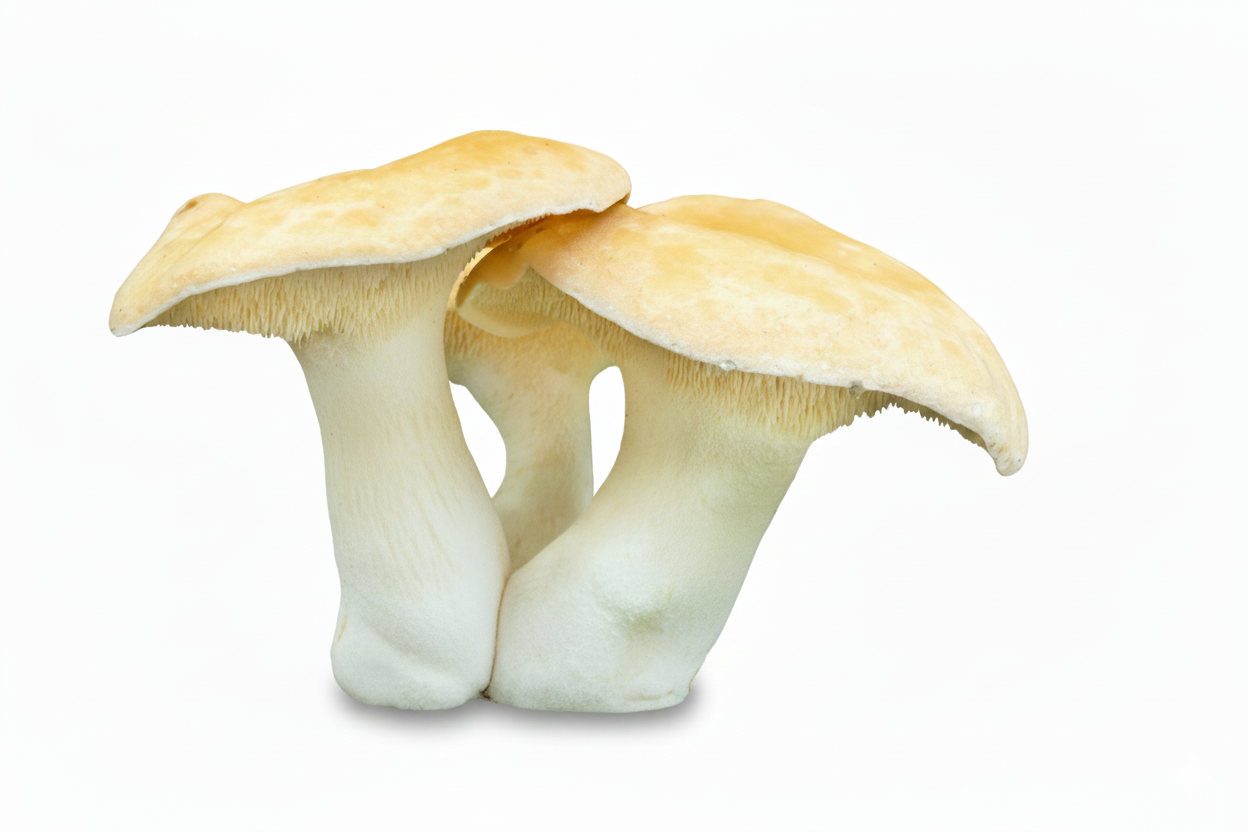 Image 3 of 3
Hedgehog Mushroom Liquid Culture FAQ
What is the scientific name of Hedgehog Mushroom?
The scientific name for Hedgehog Mushroom is Hydnum repandum.
It is also commonly known as Wood Hedgehog, Sweet Tooth Mushroom or Pied de Mouton.
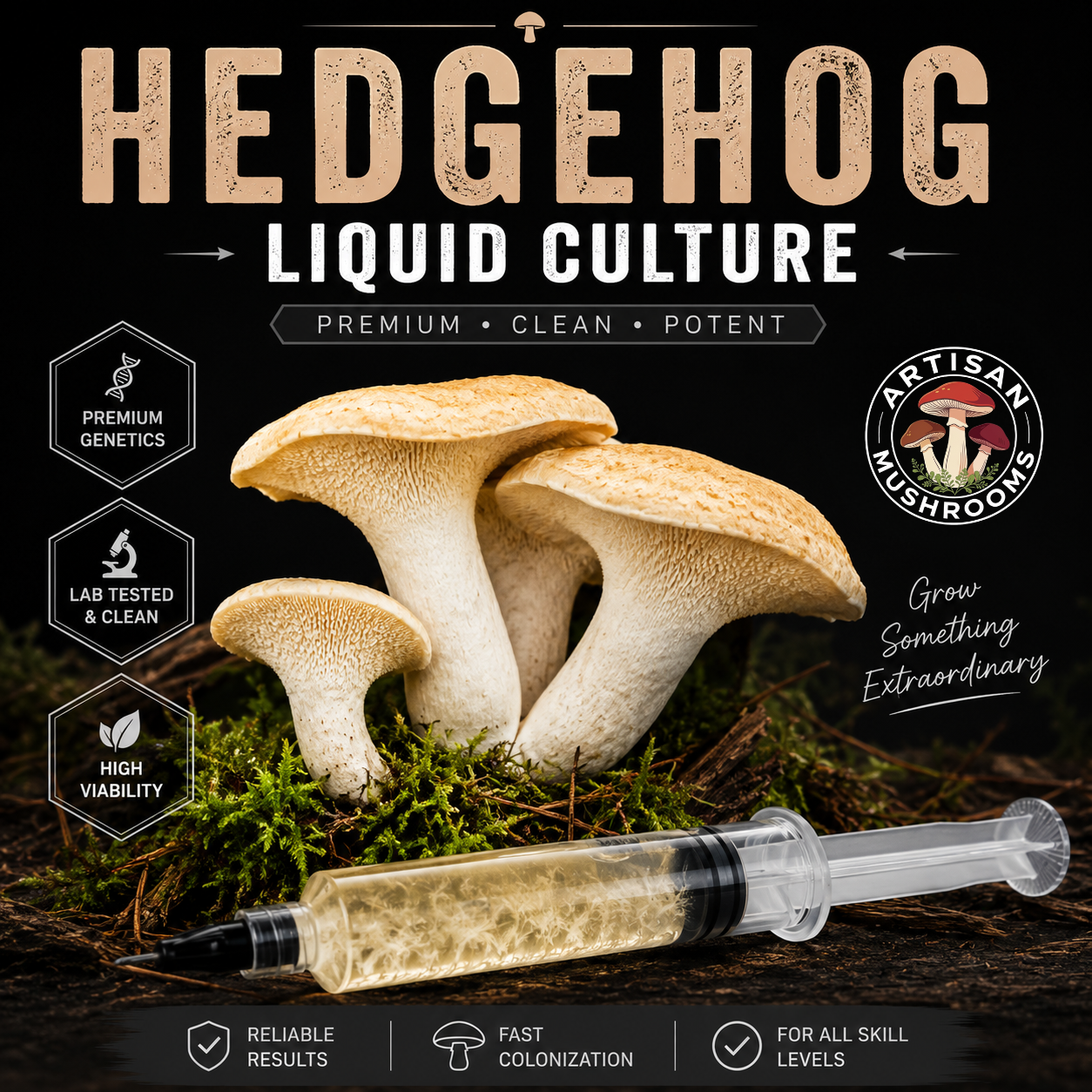
Hedgehog mushrooms are recognised by the soft, tooth-like spines found beneath their caps instead of traditional gills or pores. The fruiting bodies are generally pale cream, yellow, apricot or light orange.
Hedgehog Mushroom is an ectomycorrhizal woodland species. This means it must eventually establish a mutually beneficial relationship with the living roots of a suitable host tree.
Why is it called a Hedgehog Mushroom?
Hedgehog Mushroom gets its common name from the numerous soft spines hanging from the underside of the cap.
These spines give the mushroom a distinctive tooth-like or hedgehog appearance and contain the tissue that produces and releases its spores.
Unlike Lion’s Mane, which also produces visible spines, Hedgehog Mushroom grows from the ground in association with tree roots rather than fruiting directly from decaying hardwood.
What substrate is best for growing Hedgehog Mushroom?
Hedgehog Mushroom cannot be reliably cultivated as a conventional indoor mushroom using grain, hardwood sawdust or compost alone.
The liquid culture can first be expanded into sterilised grain or sterilised hardwood material. Once the material is well colonised, it can be planted around the active root zones of suitable trees.
Our 2kg Sterilised Wheat Grain Bag can be used to expand the culture and produce colonised grain for an outdoor woodland inoculation project.
Our 2kg Sterilised Hardwood and Wheat Bran Substrate provides a hardwood sawdust-based material that can also be inoculated and allowed to colonise before outdoor planting.
The colonised grain or hardwood material acts as an inoculation carrier. It is not a ready-to-fruit indoor substrate and does not remove the need for a compatible living tree.
Can Hedgehog Mushroom be grown indoors?
Hedgehog mycelium can be maintained and expanded indoors on suitable sterile media, but producing mature mushrooms indoors without a living host tree is not considered a reliable cultivation method.
Indoor work can be used for:
Expanding the liquid culture
Testing the culture on agar
Producing colonised grain
Producing colonised hardwood material
Preparing inoculum for an outdoor tree-root project
Once colonised, the carrier material should be introduced around the active roots of suitable trees.
The goal is for the Hedgehog mycelium to leave the carrier material, enter the surrounding soil and potentially establish a mycorrhizal relationship with the tree.
Can I inoculate a hardwood grow bag directly?
Yes. Hedgehog Mushroom liquid culture can be injected into our Sterile Hardwood Mushroom Grow Bag through its self-healing injection port.
The bag can be used as a culture-expansion medium. Allow the Hedgehog mycelium sufficient time to spread through the hardwood material before transferring it outdoors.
Once colonised, the material can be divided into several portions and planted around the active feeder-root zones of suitable trees.
The grow bag should not be treated as a conventional indoor fruiting block. Hedgehog Mushroom requires living tree roots and suitable woodland conditions before mushroom production can become possible.
Can Hedgehog Mushroom liquid culture be used on grain?
Yes. Hedgehog Mushroom liquid culture can be used to inoculate properly sterilised grain as a culture-expansion step.
The culture can be injected into our 2kg Sterilised Wheat Grain Bag and allowed to spread through the grain.
Once the grain is well colonised, divide it into several portions and plant it around the active root zone of a suitable tree.
Place the colonised grain beneath the soil or natural woodland litter rather than leaving it exposed on the surface. Covering it helps retain moisture and reduces the risk of birds or rodents eating the grain.
The colonised grain acts as an outdoor inoculation carrier. It should not be treated as a ready-to-fruit indoor substrate.
Do you sell sterilised grain and hardwood substrate?
Yes. We offer pre-sterilised wheat grain bags, sterilised hardwood and wheat bran substrate, and ready-to-inoculate hardwood grow bags.
These products can be used to expand Hedgehog Mushroom mycelium before the colonised material is transferred outdoors.
Using prepared and sterilised media removes the need to hydrate, mix and pressure sterilise your own grain or hardwood sawdust. It can also help reduce contamination during the initial culture-expansion stage.
The customer will still need access to suitable living trees and an appropriate outdoor planting area.
What is a typical Hedgehog Mushroom cultivation process?
A typical experimental cultivation process is:
Inoculate a pre-sterilised grain or hardwood grow bag with Hedgehog Mushroom liquid culture.
Keep the inoculated material at suitable temperatures while the mycelium establishes.
Allow the grain or hardwood material to become well colonised.
Select healthy, compatible trees in an established outdoor location.
Identify several areas containing fine, actively growing feeder roots.
Make small planting holes without seriously damaging the roots.
Place portions of colonised grain or hardwood material close to the feeder roots.
Replace the original soil and natural leaf or needle litter.
Maintain natural soil moisture during prolonged dry periods.
Avoid disturbing, compacting or treating the inoculated area with fungicides.
Allow the fungus sufficient time to encounter and potentially associate with the tree roots.
Hedgehog Mushroom cultivation is a long-term and experimental outdoor project. Successful root association and eventual mushroom production cannot be guaranteed.
Which trees are suitable for Hedgehog Mushroom cultivation?
Hedgehog Mushroom occurs naturally in both broadleaf and coniferous woodland.
Potential host trees include:
Beech
Oak
Birch
Pine
Spruce
Fir
Other compatible ectomycorrhizal trees
For growers in Ireland and Europe, healthy beech, oak, pine or spruce trees may provide practical candidates.
Choose established, healthy trees growing in well-drained soil with natural leaf litter, needle litter, moss or other woodland organic matter.
Tree compatibility may vary according to the culture, soil, climate and local woodland conditions. Planting near a potential host tree does not guarantee that a successful mycorrhizal relationship will form.
Is a broadleaf or conifer tree better?
Hedgehog Mushroom can occur with both broadleaf and coniferous trees, so either type may be suitable.
Broadleaf options may include beech, oak and birch.
Conifer options may include pine, spruce and fir.
The individual culture may establish more successfully with some trees than others. Local environmental conditions can also influence compatibility.
When possible, use several inoculation points around more than one suitable tree. This gives the mycelium additional opportunities to encounter compatible roots.
Do not introduce the fungus into protected natural habitats or land where you do not have permission to carry out an inoculation project.
Where around the tree should the colonised material be planted?
Do not place all the colonised material directly against the trunk.
The most useful feeder roots are normally found farther out from the trunk, often within the area beneath and around the outer tree canopy.
Carefully make several small planting holes around the root zone. Look for fine roots rather than large structural roots.
Place portions of colonised grain or hardwood material close to the fine roots, then replace the original soil and natural litter.
Distributing the material across several locations gives the mycelium more opportunities to contact suitable roots.
Avoid cutting, breaking or exposing more roots than necessary.
How deep should the colonised material be planted?
A shallow planting depth is normally appropriate because fine feeder roots and active soil organisms are often concentrated within the upper soil layers.
A practical method is to:
Move aside the natural leaf or needle litter.
Carefully loosen approximately 5 to 10 cm of soil.
Locate fine roots without seriously disturbing them.
Place a portion of colonised material close to the roots.
Replace the original soil.
Cover the area with the original leaf litter, needle litter or moss.
The material should be covered sufficiently to retain moisture and protect it from animals, but it should not be buried deeply in compacted or poorly aerated soil.
When is the best time to plant Hedgehog inoculum outdoors?
Spring and early autumn are generally suitable times for outdoor inoculation in Ireland and other temperate climates.
These periods normally provide:
Moderate temperatures
Regular rainfall
Moist soil
Active tree-root growth
Reduced risk of severe drying
Avoid planting during frozen conditions, prolonged drought or extreme heat.
A spring inoculation gives the mycelium a full growing season to establish. An early autumn inoculation may benefit from cooler temperatures and rainfall before winter.
The area should be watered during dry weather, particularly during the first growing season after planting.
Can I inoculate a young tree or seedling?
Yes. A young, healthy ectomycorrhizal tree may be used for an experimental inoculation project.
Young trees can be useful because their root systems are smaller and more accessible. However, they may also be more vulnerable to drying, root damage and environmental stress.
Plant the colonised material close to fine roots without damaging the root system.
Container-grown seedlings can potentially be inoculated before planting outdoors, but careful control of moisture, soil structure and competing fungi is required.
A tree that has already been growing in natural soil may already have relationships with other mycorrhizal fungi. Hedgehog mycelium will need to compete with those established organisms.
Is Hedgehog Mushroom suitable for beginners?
Hedgehog Mushroom can be attempted by beginners, but it is considerably more difficult and less predictable than Oyster mushrooms, Lion’s Mane or Shiitake.
The sterile culture-expansion stage can be simplified by using pre-sterilised grain or a ready-to-inoculate hardwood grow bag.
However, the colonised material must still be planted around the roots of a suitable living tree.
Successful mycelial growth in the grain or hardwood bag does not guarantee that the fungus will establish with the tree or produce mushrooms.
Hedgehog Mushroom is best suited to patient growers, woodland owners and mycology enthusiasts interested in long-term experimental outdoor cultivation.
How should I store the liquid culture?
Keep the Hedgehog Mushroom liquid culture syringe refrigerated at approximately 2°C to 4°C until you are ready to use it. Do not freeze it.
For the best viability, use the culture within three months of receiving it.
Before inoculation, allow the syringe to move closer to room temperature and shake it gently to distribute the Hedgehog mycelium throughout the nutrient solution.
Always keep the protective cap fitted while the syringe is in storage. Attach a new sterile needle immediately before inoculating grain, hardwood substrate or agar.
How much liquid culture should I use?
The amount of Hedgehog Mushroom liquid culture required depends on the size and type of expansion medium.
For one of our sterile LME agar plates, one or two small drops are normally sufficient.
A small grain jar may require approximately 1 to 2 ml.
When inoculating our 2kg Sterilised Wheat Grain Bag or Sterile Hardwood Mushroom Grow Bag, approximately 5 to 10 ml can be used.
Using too much liquid culture may introduce excess moisture into the grain or substrate, increasing the risk of bacterial contamination.
Does the syringe contain mushroom spores?
No. Hedgehog Mushroom liquid culture contains living Hydnum repandum mycelium suspended in a sterile nutrient solution.
It is not a mushroom spore solution.
The living mycelium can be used to inoculate sterilised grain, hardwood expansion material or a sterile LME agar plate.
Once the carrier material has become colonised, it can be used to introduce the Hedgehog mycelium around the root zones of suitable trees.
Can I test Hedgehog Mushroom liquid culture on agar?
Yes. Testing the culture on agar can help you observe mycelial growth and confirm that the culture is developing cleanly before inoculating a larger quantity of grain or hardwood substrate.
Place one or two small drops onto one of our sterile LME agar plates.
Keep the plate sealed and monitor it for clean mycelial growth.
Hedgehog mycelium may grow more slowly than vigorous saprotrophic mushrooms such as Oyster mushrooms.
Do not open a colonised agar plate outside a clean working environment, as exposure to airborne mould spores and bacteria can contaminate the culture.
What conditions does Hedgehog mycelium need during culture expansion?
Hedgehog Mushroom mycelium generally performs best under moderate temperatures.
Suitable starting conditions include:
Temperatures of approximately 20°C to 25°C
Darkness or low ambient light
A clean and stable growing environment
Filtered gas exchange
Properly hydrated grain or substrate
No direct sunlight
Minimal disturbance during early growth
Avoid temperatures approaching 30°C. Excessive heat may slow or stop the mycelium and increase the risk of bacterial contamination.
Hedgehog mycelium can grow more slowly and less aggressively than Oyster mushroom mycelium. Allow sufficient time before assuming that a clean, steadily growing culture has stalled.
How long does the grain or hardwood material take to colonise?
There is no dependable colonisation timetable for Hedgehog Mushroom.
Colonisation will depend on:
Temperature
Culture vigour
Inoculation rate
Grain or substrate preparation
Moisture content
Bag size
Gas exchange
Contamination levels
Visible growth may begin within several days or weeks, but complete colonisation may take considerably longer than it would for an aggressive Oyster mushroom culture.
Wait until the carrier material is well colonised before transferring it outdoors. Partially colonised grain is more vulnerable to competing organisms and may not provide enough established mycelium for the outdoor inoculation project.
Can Hedgehog Mushroom be grown on CVG?
CVG should not be used as the main Hedgehog Mushroom cultivation substrate.
Coco coir, vermiculite and gypsum can retain moisture, but they do not provide the living host roots required by this ectomycorrhizal species.
Hedgehog Mushroom may be maintained temporarily on various laboratory or culture-expansion media, but eventual mushroom production depends on a compatible relationship with a living tree.
For outdoor inoculation, colonised grain or hardwood-based material is a more practical carrier than CVG.
What outdoor conditions does Hedgehog Mushroom need?
Hedgehog Mushroom requires a suitable living host tree and a successfully established ectomycorrhizal relationship before mushroom production can occur.
A potentially suitable outdoor environment includes:
Healthy compatible broadleaf or conifer trees
Fine, actively growing feeder roots
Well-drained woodland soil
Natural leaf or needle litter
Moss and woodland organic matter
Consistent seasonal soil moisture
Shade or partial shade
A stable and relatively undisturbed root zone
Natural seasonal temperature changes
Sufficient time for the fungus to establish
Avoid dry, exposed, compacted or frequently cultivated ground.
Do not use fungicides around the inoculated root zone. Avoid applying excessive fertiliser, as heavily altered soil conditions may interfere with mycorrhizal development.
Even under apparently suitable conditions, successful establishment and mushroom production cannot be guaranteed.
How should I water the inoculated area?
Water the area thoroughly after planting the colonised material.
During prolonged dry periods, provide enough water to moisten the root zone without leaving the soil saturated.
Natural woodland soil should remain moist but well aerated.
Replace disturbed leaf litter, needle litter or moss after watering. This surface covering can help conserve soil moisture and protect the inoculated area from temperature extremes.
Avoid frequent shallow watering that only wets the surface. Occasional deeper watering is generally more useful during dry weather.
Do not waterlog the soil, as prolonged saturation can reduce oxygen around the roots and damage both the tree and the fungal mycelium.
How can I tell whether the outdoor inoculation has established?
Confirming establishment can be difficult because most of the fungal activity occurs underground.
Possible encouraging signs include:
Pale mycelial strands near the inoculation points
Colonised pieces of carrier material remaining active
Mycelial growth extending into nearby organic matter
Healthy tree growth
A natural mushroom or woodland smell
Eventual mushroom production near the inoculated root zone
Avoid repeatedly digging up the area to check it. Disturbing the soil can break developing mycelial connections and damage fine tree roots.
The absence of visible mushrooms does not necessarily mean the inoculation has failed. A root association may take a long time to develop and may not produce mushrooms every year.
How long does Hedgehog Mushroom take to produce mushrooms?
There is no dependable fruiting timetable.
The mycelium must:
Survive the transition from sterile carrier material into natural soil.
Compete with established soil organisms.
Encounter compatible tree roots.
Form a functioning mycorrhizal relationship.
Establish a sufficiently large underground network.
Experience suitable seasonal weather for fruiting.
This process may take several growing seasons.
Even a successfully established fungal and tree-root relationship may not produce mushrooms every year. Fruiting depends on rainfall, soil moisture, temperature, tree health and seasonal conditions.
Hedgehog Mushroom should therefore be treated as a long-term woodland cultivation project rather than a quick or predictable mushroom grow.
When do Hedgehog mushrooms normally fruit?
In temperate climates, Hedgehog mushrooms generally appear from late summer through autumn, depending on local weather and the individual woodland habitat.
Cooler temperatures and consistent rainfall may encourage fruiting once the underground mycelium is sufficiently established.
Fruiting times can vary according to:
Local climate
Host-tree species
Rainfall
Soil moisture
Elevation
Woodland type
Seasonal temperatures
An established mycelial network may remain underground without producing visible mushrooms during unsuitable weather.
How can Hedgehog mushrooms be identified safely?
Typical Hedgehog Mushroom characteristics include:
Pale cream, yellow, apricot or light orange caps
Irregular or wavy cap edges
Soft tooth-like spines beneath the cap
Pale, solid stems
White to cream-coloured flesh
Growth from soil or woodland litter near trees
However, outdoor inoculation areas may also produce unrelated wild mushrooms.
Never assume that every mushroom growing near an inoculated tree is Hedgehog Mushroom.
Use several identification characteristics and consult a reliable field guide, experienced mushroom identifier or local mycological group before consuming any wild or outdoor-grown mushroom.
When should Hedgehog mushrooms be harvested?
Hedgehog mushrooms are best harvested while they are firm, fresh and free from significant insect damage.
Younger specimens generally have a milder flavour. Older mushrooms may become softer or develop a more bitter taste.
Harvest by gently twisting the mushroom from the ground or cutting it carefully near the base.
Avoid unnecessarily disturbing the surrounding soil and leaf litter.
After harvesting, replace any displaced natural litter to help protect the underground mycelium and maintain soil moisture.
Where are your Hedgehog Mushroom cultures shipped from?
All Hedgehog Mushroom liquid cultures are prepared fresh under sterile laboratory conditions and shipped directly from Ireland.
Each order includes a 10 ml Hedgehog Mushroom liquid culture syringe, a sterile 18G needle and an alcohol wipe.
Fast shipping is available to customers across Ireland, the UK, Europe, the United States and Canada.