 Image 1 of 1
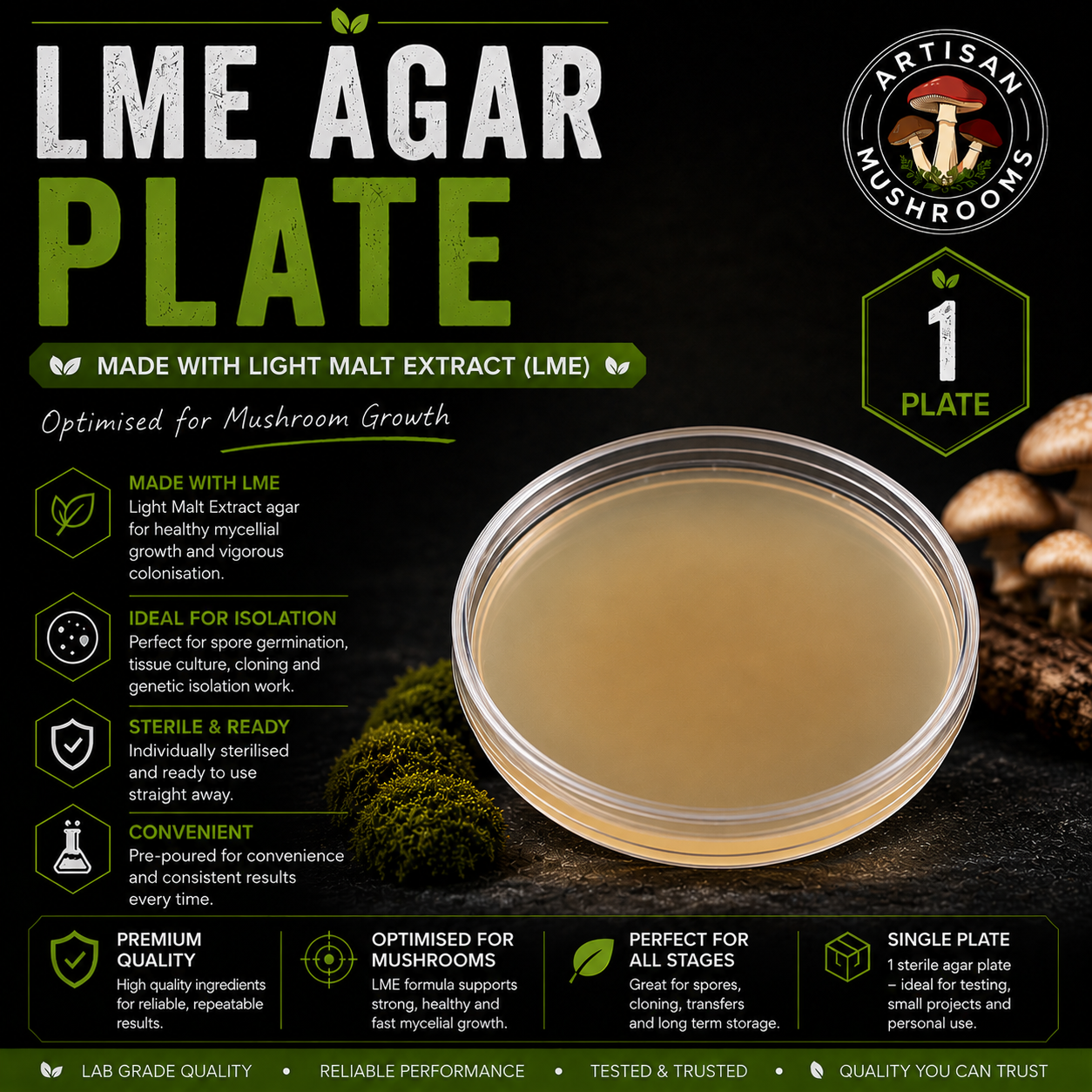
LME Agar Plate – Sterile Light Malt Extract Agar

LME Agar Plates FAQ
What are LME agar plates?
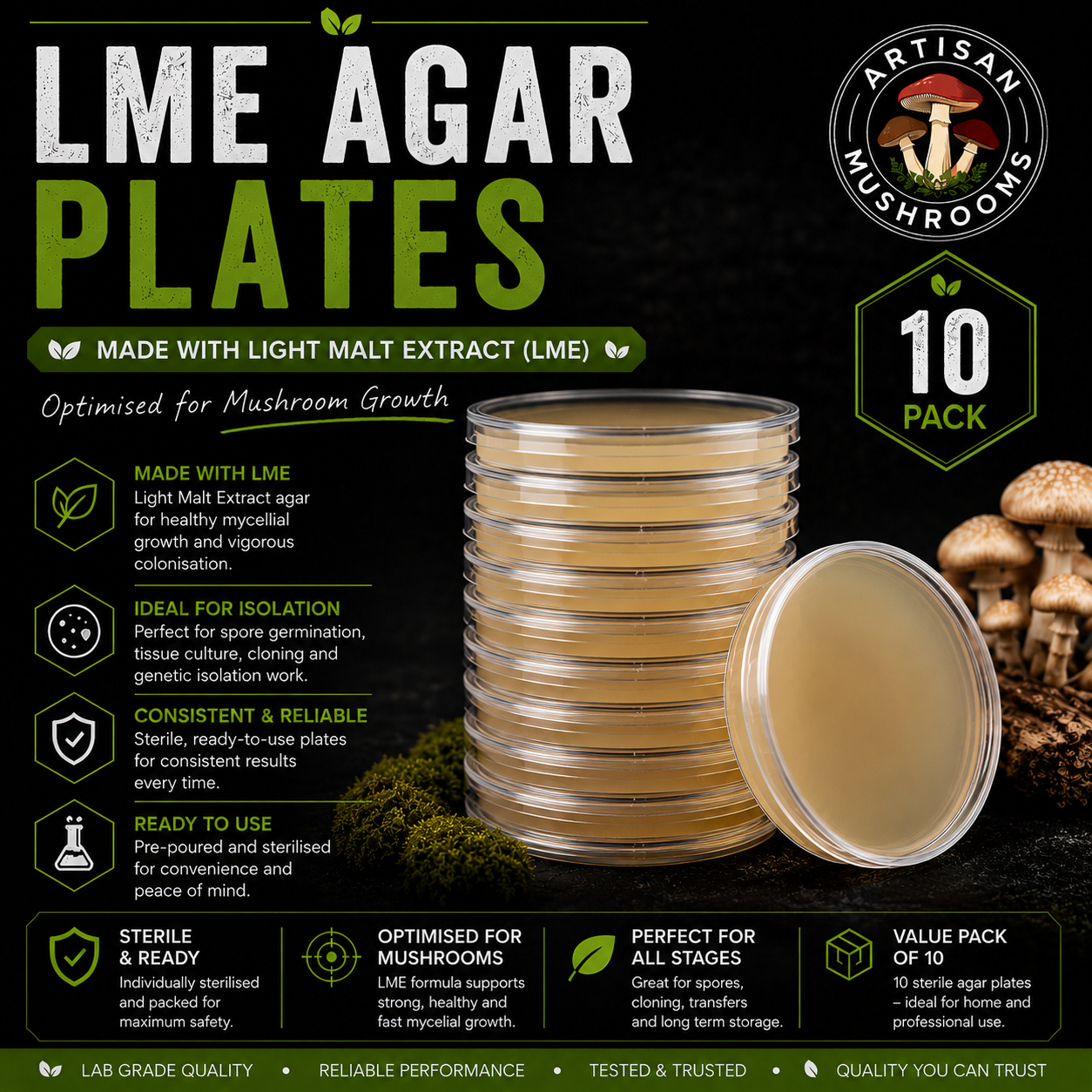
LME agar plates are Petri dishes containing a sterile, nutrient-rich growing medium made with Light Malt Extract and agar.
LME stands for Light Malt Extract.
Light Malt Extract supplies carbohydrates and nutrients that support mushroom mycelium, while agar turns the liquid mixture into a firm gel.
The clear, solid surface allows growers to observe mycelial growth, identify possible contamination and transfer selected sections of a culture.
What is included in the 10-pack?
Each pack contains:
10 sterile, pre-poured LME agar plates
Secure protective packaging for storage and delivery
The plates arrive ready to use.
Mushroom culture, spores, scalpels, inoculation tools and sealing film are not included unless purchased separately.
Customers who need only one plate can purchase our Single LME Agar Plate.
Are the plates ready to use?
Yes. The plates are prepared, poured and sterilised before shipping.
You do not need to:
Mix Light Malt Extract
Measure agar powder
Add water
Sterilise the media
Pour the plates
Wait for the agar to set
Keep each plate closed until you are ready to inoculate it.
Once opened, the agar is exposed to airborne mould spores, bacteria and other microorganisms.
What are LME agar plates used for?
LME agar plates can be used for:
Testing liquid culture
Mushroom tissue cloning
Spore germination
Agar-to-agar transfers
Isolating clean mycelium
Separating mycelium from contamination
Expanding mushroom cultures
Selecting healthy growth
Preparing agar wedges for grain
Starting liquid culture from clean agar
Maintaining valuable mushroom genetics
Educational and laboratory culture work
Agar allows you to see how a culture is developing before transferring it to a larger quantity of grain or substrate.
Are LME agar plates suitable for beginners?
Yes. Pre-poured LME agar plates are suitable for beginners who want to learn mushroom culture work without preparing agar themselves.
The plates remove several preparation stages, including:
Measuring ingredients
Heating the agar mixture
Sterilising media
Pouring plates
Managing pouring temperatures
Preventing condensation during preparation
However, sterile technique is still required when opening and inoculating the plates.
Agar work is most successful when performed inside a still-air box or in front of a properly operated laminar-flow hood.
What is Light Malt Extract?
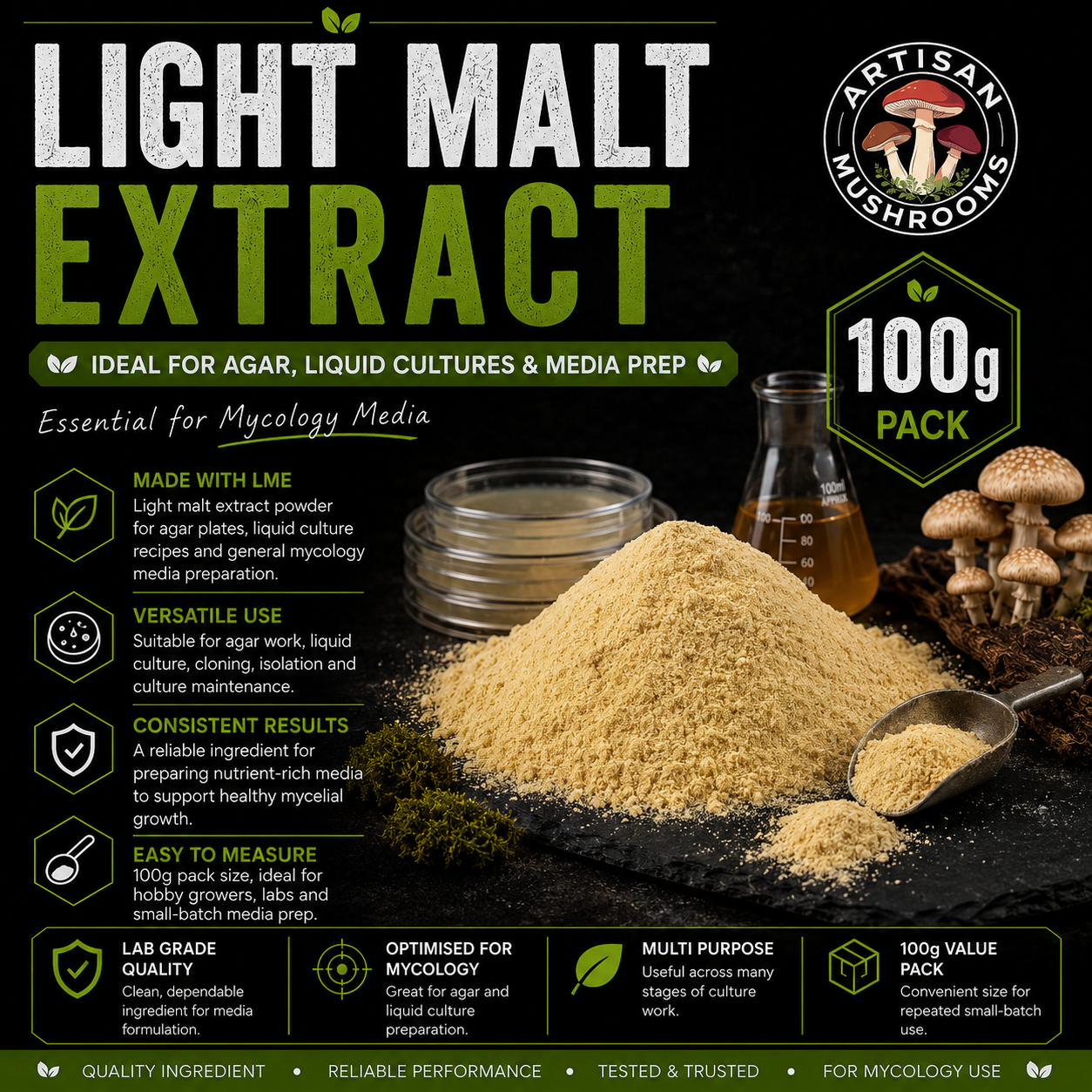
Light Malt Extract is a dried malt product containing carbohydrates and other nutrients that can support mushroom mycelium.
When combined with water and agar powder, it creates Light Malt Extract Agar.
Light Malt Extract Agar is commonly used for:
Mushroom cloning
Mycelium isolation
Culture transfers
Spore germination
Testing liquid cultures
General fungal culture work
Growers who prefer to prepare their own culture media can purchase our Light Malt Extract 100g.
What is agar?
Agar is a gel-forming material used to create a solid culture medium.
When heated with water, agar dissolves. As the mixture cools, it becomes a firm gel.
The solid surface allows mushroom mycelium to spread outwards where it can be observed and transferred.
Agar itself mainly provides structure. Light Malt Extract supplies much of the nutrition used by the growing mycelium.
Do the plates already contain mushroom mycelium?
No. The plates contain sterile LME agar only.
They do not contain:
Mushroom mycelium
Liquid culture
Mushroom tissue
Spores
Grain spawn
A pre-established fungal culture
You must inoculate each plate with your chosen mushroom culture, tissue sample, spore sample or agar transfer.
Browse our full selection of mushroom liquid cultures if you need a culture to place onto agar.
Can I use the plates to test liquid culture?
Yes. Testing liquid culture on agar is one of the most useful applications for LME agar plates.
A liquid culture can appear healthy while still containing bacteria, yeast or mould that may not be clearly visible in the liquid.
Placing a small sample on agar allows the growth to develop across a clear surface where it can be inspected.
A basic liquid-culture test is:
Work inside a clean still-air box or in front of a laminar-flow hood.
Clean your hands, gloves and working area.
Shake the liquid culture gently to distribute the mycelium.
Attach a sterile needle.
Open the agar plate only slightly.
Place one or two small drops near the centre.
Close the plate immediately.
Seal and label the plate.
Incubate it at a suitable temperature for the mushroom species.
Observe the growth without reopening the plate.
A clean result gives additional confidence before the culture is used to inoculate a large grain bag.
How much liquid culture should I put on an agar plate?
One or two small drops are normally sufficient.
Do not flood the agar surface.
Using too much liquid culture can:
Spread liquid across the complete plate
Make separate growth points difficult to observe
Create excessive surface moisture
Spread contamination rapidly
Make clean transfers more difficult
Encourage bacterial growth
The goal is to place a small, controlled sample on the agar.
A single 10 ml liquid culture syringe can test many plates when only one or two drops are used per plate.
Where should I place liquid culture on the plate?
Place one or two small drops close to the centre of the agar.
Central inoculation gives the mycelium space to grow outwards in all directions.
It also makes it easier to compare different areas of growth and select a clean leading edge for transfer.
Avoid placing the liquid against the outside edge of the plate, where growth may quickly reach the wall before it can be properly inspected.
Can I use LME agar plates to clone a mushroom?
Yes. Fresh mushroom tissue can be placed onto LME agar to produce a clone.
A mushroom clone is produced by growing mycelium from a small piece of internal tissue.
A basic cloning process is:
Select a fresh, healthy mushroom.
Work inside a still-air box or in front of a laminar-flow hood.
Clean your hands, gloves, working surface and tools.
Tear the mushroom open rather than cutting through the dirty exterior.
Use a sterile scalpel to remove a very small piece of clean internal tissue.
Open the agar plate only enough to insert the tissue.
Place the tissue near the centre of the plate.
Close and seal the plate immediately.
Label it with the species, source and date.
Monitor the plate for mycelial growth and contamination.
Internal stem tissue is commonly used because it has been protected from direct environmental exposure.
How large should a tissue sample be?
A very small piece is sufficient.
A tissue sample approximately the size of a grain of rice or smaller can provide enough material for mycelium to begin growing.
Using a large piece of mushroom tissue may increase the chance of:
Bacterial contamination
Excess moisture
Tissue decomposition
Contaminants being carried onto the plate
The sample touching the lid
Take the tissue from the clean internal part of a fresh mushroom.
Avoid using exposed gills, pores, cap surfaces or dirty stem bases when making a clone.
Can I use a dried mushroom for cloning?
Fresh mushroom tissue is strongly preferred.
Once a mushroom has dried, many of its cells may no longer be viable. The tissue may also carry mould spores and bacteria from handling, drying and storage.
Occasionally, mycelium may be recovered from partially dried or carefully preserved tissue, but success is much less predictable.
For reliable cloning, use a young, fresh and healthy mushroom.
Can spores be germinated on LME agar?
Yes. LME agar can be used for germinating appropriate mushroom spores.
Only a very small amount of spore material is required.
Using too many spores can produce dense and overlapping growth that is difficult to separate.
After germination, sections of healthy mycelium can be transferred to fresh agar plates for further isolation and expansion.
Spore germination can take longer than growth from liquid culture or an established agar wedge because the spores must first germinate and form compatible mycelium.
Can I use a spore syringe on an agar plate?
Yes. A small sample from a spore syringe can be placed on an agar plate.
One or two small drops are normally enough.
A large amount of solution can spread across the plate and make germination or contamination difficult to observe.
Shake the syringe as appropriate, use a sterile needle and place the sample near the centre of the plate.
Spore syringes are not automatically sterile. Testing them on agar allows the grower to identify clean growth and transfer it away from possible contamination.
Can I use a spore print on agar?
Yes. A very small amount of material from a spore print can be transferred to agar.
A sterile inoculation loop or sterile scalpel tip can be used to pick up a small sample.
Only a tiny amount is needed.
Opening a spore print and agar plate exposes both to the surrounding environment, so the transfer should be performed inside a still-air box or in front of a laminar-flow hood.
What is an agar-to-agar transfer?
An agar-to-agar transfer involves moving a small piece of healthy mycelium from one agar plate to a fresh plate.
This can be used to:
Expand a mushroom culture
Separate healthy mycelium from contamination
Select fast-growing areas
Preserve a culture
Create several working plates
Improve the uniformity of a culture
Transfer the clean leading edge of growth
A small wedge is cut from the selected area with a sterile scalpel and placed mycelium-side down on the fresh agar.
Which part of the mycelium should I transfer?
The clean leading edge of the culture is generally the preferred transfer area.
The leading edge is the outermost actively growing section of mycelium.
Choose an area that:
Appears healthy
Is growing away from the original inoculation point
Is well separated from visible contamination
Has not reached the edge of the plate
Shows the growth characteristics you want to preserve
Avoid taking transfers directly through suspicious, discoloured, wet or contaminated areas.
How large should an agar transfer be?
A small wedge is sufficient.
A transfer approximately 3 to 8 mm across can contain enough active mycelium to establish a fresh plate.
Using an excessively large wedge:
Uses more of the original culture than necessary
Can transfer hidden contamination
Takes up unnecessary space
May carry old or weakened agar
Reduces the number of transfers available from the plate
Place the wedge near the centre of the new plate with the mycelium touching the fresh agar.
Can one colonised plate make several new plates?
Yes. One clean colonised agar plate can be used to inoculate several fresh plates.
The exact number depends on:
The size of each wedge
The amount of healthy growth
The number of clean sectors
Whether part of the plate is being preserved
Whether any contamination is present
Using small wedges allows a single plate to create multiple working cultures.
Always retain a clean backup culture when working with valuable mushroom genetics.
Can agar be used to inoculate grain?
Yes. Clean colonised agar wedges can be transferred into sterilised grain.
A basic process is:
Confirm that the agar culture appears clean.
Prepare a fully sterilised grain jar or grain bag.
Work inside a still-air box or in front of a laminar-flow hood.
Cut the clean agar culture into several small wedges.
Transfer the wedges into the grain container.
Close the container immediately.
Gently distribute the wedges through the upper grain.
Incubate at the appropriate temperature for the species.
Monitor for mycelial recovery and colonisation.
Our 2kg Sterilised Wheat Grain Bag is suitable for liquid-culture inoculation. Agar wedges can also be added when the bag is opened under suitable sterile conditions.
Opening a grain bag to add agar requires more advanced sterile technique than injecting liquid culture through a self-healing port.
Should I put the entire agar plate into grain?
No. A few small wedges are normally sufficient.
Adding the complete agar plate can:
Introduce excessive agar
Carry hidden contamination
Make the grain unnecessarily wet
Use the complete culture at once
Leave no backup plate
Make the grain more difficult to break apart
Transfer several clean wedges and retain the remainder of the plate as a backup or for further expansion.
Can agar be used to start liquid culture?
Yes. A clean agar wedge can be transferred into a sterile liquid-culture solution.
Agar-to-liquid-culture transfer allows the grower to begin with mycelium that has already been visually inspected.
A basic process is:
Confirm that the agar culture appears clean.
Prepare and sterilise the liquid-culture solution.
Allow it to cool completely.
Work under suitable sterile conditions.
Cut a small wedge from the clean leading edge.
Transfer it into the liquid-culture container.
Close the container immediately.
Incubate and agitate according to the culture method.
Test the finished liquid culture on another agar plate before using it on grain.
The liquid culture can still become contaminated during transfer or incubation, so testing the finished culture remains important.
Can I use agar to isolate a clean culture?
Yes. Agar is one of the main tools used to separate healthy mushroom mycelium from contaminants.
When mushroom mycelium grows away from a contaminated inoculation point, a small piece can be transferred from the cleanest outer edge to a fresh plate.
Several transfers may be required.
Do not attempt to rescue a culture when:
Contamination covers most of the plate
Green mould has begun producing spores
The plate contains extensive bacterial slime
The mushroom mycelium cannot be clearly distinguished
The plate has been open in a contaminated room
Heavily contaminated plates should remain sealed and be discarded safely.
What is culture isolation?
Culture isolation is the process of selecting and transferring a specific section of mycelium to a fresh medium.
It may be used to:
Separate mushroom mycelium from contamination
Select vigorous growth
Develop a more uniform culture
Preserve a particular sector
Separate different growth patterns
Create clean working cultures from spore germination
Isolation does not automatically guarantee improved yields.
Growth speed and appearance on agar are useful observations, but fruiting performance must ultimately be tested on grain and substrate.
What does healthy mushroom mycelium look like on agar?
Healthy mushroom mycelium is often white or cream-coloured.
Depending on the species and culture, it may appear:
Fine and wispy
Cotton-like
Dense and solid
Rope-like
Feathered
Circular
Uneven or sectoring
Thin and almost transparent during early growth
Different mushroom species produce different growth patterns.
For example:
Oyster mushroom mycelium can grow quickly and densely.
Lion’s Mane mycelium may appear fine and less visible.
Shiitake may grow more slowly and develop denser patches.
Reishi can become thick, white and leathery.
Chicken of the Woods may develop yellow or orange pigmentation.
Some cultures may produce small amber droplets.
A culture should be judged using its complete appearance, growth pattern and smell only when handled safely in a controlled environment.
What is rhizomorphic mycelium?
Rhizomorphic mycelium forms visible rope-like or root-like strands.
This growth pattern can appear vigorous and organised.
However, rhizomorphic growth does not automatically mean that a culture will produce the highest mushroom yield.
Mycelial appearance is influenced by:
Mushroom species
Culture genetics
Agar nutrition
Temperature
Moisture
The age of the culture
The number of transfers
Environmental conditions
Both rhizomorphic and cotton-like cultures can be healthy.
What is tomentose mycelium?
Tomentose mycelium has a soft, fluffy or cotton-like appearance.
It may spread as an even mat rather than forming distinct rope-like strands.
Tomentose growth can be completely normal.
Do not assume that a cotton-like culture is contaminated simply because it is not strongly rhizomorphic.
The culture should be assessed for consistent growth, species-appropriate colour and absence of suspicious bacterial or mould colonies.
How long does mycelium take to appear?
Visible growth may appear within approximately two to fourteen days.
The timing depends on:
Mushroom species
Inoculation method
Culture age
Culture vigour
Incubation temperature
Amount of material placed on the plate
Whether spores must germinate
The condition of the tissue sample
Plate storage and handling
An established agar wedge or liquid culture may show growth relatively quickly.
Spores and tissue clones can take longer.
Do not repeatedly open the plate to check it.
What temperature should agar plates be incubated at?
The correct temperature depends on the mushroom species.
A practical general range for many gourmet mushroom cultures is approximately 20°C to 25°C.
Some species prefer cooler or warmer conditions.
Examples include:
Oyster mushrooms: approximately 20°C to 25°C
Lion’s Mane: approximately 20°C to 24°C
Shiitake: approximately 20°C to 24°C
Chestnut: approximately 21°C to 25°C
Enoki: approximately 20°C to 25°C
Reishi: approximately 24°C to 28°C
Avoid excessive heat.
High temperatures can accelerate bacterial growth, dry the agar and weaken some mushroom cultures.
Do agar plates need to be incubated in darkness?
Complete darkness is not normally required.
Plates can be incubated in:
A dark cupboard
Low ambient room light
A clean incubation box
An area protected from direct sunlight
Avoid direct sunlight because it can:
Overheat the plate
Dry the agar
Cause excessive condensation
Damage the developing culture
Create large temperature changes
Stable temperature is generally more important than complete darkness.
Should agar plates be incubated upside down?
Yes. Once inoculated and sealed, plates are generally incubated in an inverted position.
This means:
The agar-containing half is on top.
The lid is underneath.
Incubating plates this way helps reduce the chance of condensation falling from the lid onto the culture.
Water droplets moving across the agar can spread bacteria, spores or mycelial fragments and make the plate more difficult to interpret.
Allow liquid-culture drops to absorb into the agar before carefully turning the plate upside down.
Why is there condensation inside the plate?
Condensation forms when warm, moist air inside the plate contacts a cooler surface.
Common causes include:
Temperature changes during shipping
Moving plates between refrigeration and room temperature
Incubating the plates in a fluctuating environment
Opening a cold plate in warm air
Placing the plate near a heater or window
Turning a plate upside down before a liquid sample has absorbed
A small amount of condensation is common.
Heavy condensation can make the culture more difficult to observe and may allow water to move across the agar.
How can I reduce condensation?
To reduce condensation:
Store plates at a stable temperature.
Allow refrigerated plates to reach room temperature before opening.
Keep plates sealed while warming.
Incubate inoculated plates upside down.
Avoid heaters, radiators and direct sunlight.
Avoid frequent movement between warm and cold locations.
Use only one or two drops of liquid culture.
Do not open plates in a humid room.
Do not open a sterile plate simply to remove condensation.
Opening the plate creates a greater contamination risk than leaving a small amount of moisture inside.
Can I wipe condensation from inside the lid?
No. Do not open a sterile or inoculated plate to wipe the lid.
A cloth, tissue or finger can introduce contamination.
If condensation is present, keep the plate sealed and allow the temperature to stabilise.
Incubating the plate upside down will help prevent droplets from falling onto the agar.
What are the signs of bacterial contamination?
Bacterial contamination may appear as:
Wet or greasy patches
Translucent growth
Creamy or yellow slime
A shiny film
Mycelium that stops at a wet boundary
Liquid spreading around the inoculation point
Irregular colonies with no filament-like growth
Rapidly expanding moist areas
Bacteria can sometimes remain close to a tissue sample or liquid-culture drop.
A clean section of mushroom mycelium may occasionally be transferred away from a small bacterial area, but several transfers may be required.
What are the signs of mould contamination?
Mould may initially appear white and can be difficult to distinguish from mushroom mycelium.
As it matures, it may develop:
Green colouring
Blue-green colouring
Black spores
Grey fluffy growth
Pink or red patches
Yellow colonies
Very rapid circular growth
Powdery or dusty surfaces
Green mould is commonly associated with Trichoderma species.
Do not open a plate after mould has begun producing coloured spores.
Keep it sealed and remove it from the clean culture area.
Can yeast grow on agar plates?
Yes. Yeast contamination may form:
Smooth cream-coloured colonies
Shiny rounded spots
Wet-looking growth
Small pale dots
Growth resembling tiny droplets
Colonies without visible fungal strands
Yeast colonies can sometimes be mistaken for bacterial contamination.
Healthy mushroom mycelium normally spreads through visible filament-like growth rather than forming only smooth, rounded colonies.
What should I do with a contaminated plate?
Keep the contaminated plate sealed.
Do not open a heavily contaminated plate indoors.
A suitable process is:
Mark the plate as contaminated.
Separate it from clean cultures.
Place it inside a sealed bag.
Dispose of it safely.
Clean the surrounding storage or incubation area.
Wash your hands after handling it.
If the plate contains only a very small contamination point and healthy mycelium is growing well away from it, an experienced grower may transfer the clean leading edge to a new plate under controlled sterile conditions.
Do not attempt this once mould has spread or begun producing spores.
Can a contaminated plate contaminate nearby plates?
A sealed plate is less likely to spread contamination, but damaged or poorly sealed plates can release mould spores.
Keep contaminated plates away from clean cultures.
Inspect nearby plates for:
Cracked lids
Loose sealing film
Condensation carrying material towards the edge
Similar contamination appearing at the same time
Clean the incubation area after removing a contaminated plate.
Why is there no growth on my agar plate?
Possible causes include:
The culture sample was not viable.
The liquid-culture needle was blocked.
No mycelium entered the drop.
The plate is too cold.
The plate is too warm.
The tissue sample was old or damaged.
The spores have not germinated yet.
The agar surface dried out.
The sample was placed on the lid rather than the agar.
The culture is growing very slowly.
Contamination has inhibited the mushroom mycelium.
Allow sufficient time before deciding that the plate has failed.
Some cultures may take one to two weeks to show visible growth.
Why is the mycelium growing very slowly?
Slow growth may be caused by:
Low incubation temperature
Species-specific growth rate
Old culture material
A very small inoculation
Damaged tissue
Culture senescence
Dry agar
Bacterial contamination
A highly nutritious or unsuitable medium for that culture
Repeated transfers
Weak spore germination
Compare several plates inoculated from the same source.
If only one plate is slow, the issue may be localised to that plate or inoculation point.
Why has the mycelium stopped growing?
Mycelium may stop growing because:
It has reached contamination.
The agar has dried.
Incubation temperatures are unsuitable.
The plate has become too old.
The culture is weak.
Bacterial growth is present.
The mycelium has reached the edge.
The plate contains insufficient moisture.
The culture has been repeatedly transferred over a long period.
The species naturally grows slowly.
Transfer a clean section to a fresh plate before the culture becomes old or reaches the outer edge.
Why is the agar shrinking or pulling away from the plate?
Agar may shrink when it loses moisture.
This can happen because of:
Long storage
Warm incubation
Inadequate sealing
A cracked plate
Low environmental humidity
Repeated opening
Storage near a heat source
A small amount of shrinkage may still leave the plate usable.
A severely dried, cracked or hardened plate should not be relied upon for important culture work.
Why is the agar cracked?
Agar can crack because of:
Rough handling during transport
Freezing
Severe temperature changes
Drying
Bending or compressing the plate
Impact during storage
Minor cracking may not make the plate unusable if the plate remains sealed and sterile.
However, cracks can make growth more difficult to observe and may allow liquid to collect unevenly.
Photograph and contact us if plates arrive extensively damaged.
Can I use a plate that has turned cloudy?
Cloudiness can be caused by:
Condensation
Changes in the agar
Bacterial growth
Temperature damage
Contamination
Physical disturbance of the medium
Inspect the plate without opening it.
Do not use a plate when the agar has unexplained cloudiness, visible colonies, unusual colours or signs of contamination before inoculation.
How should unused agar plates be stored?
Keep unused plates sealed in their original protective packaging.
Store them:
Refrigerated at approximately 2°C to 8°C
Away from direct sunlight
Away from freezing temperatures
In a clean environment
Protected from physical damage
With stable temperatures
Away from raw food and dirty laboratory materials
Allow refrigerated plates to reach room temperature while still sealed before opening them.
This helps reduce condensation and prevents warm room air from immediately depositing moisture on the cold agar.
Can LME agar plates be frozen?
No. Do not freeze the plates.
Freezing can:
Damage the agar structure
Cause cracking
Separate water from the gel
Damage the plastic plates
Create excessive condensation after thawing
Make the medium unreliable
Store the plates refrigerated, not frozen.
How long can unused agar plates be stored?
Pre-poured agar plates are best used promptly.
Shelf life depends on:
Storage temperature
Packaging
Moisture loss
Plate sealing
Handling
Temperature fluctuations
Whether contamination was introduced
Before use, inspect every plate for:
Drying
Cracking
Cloudiness
Unexpected colonies
Discolouration
Damaged packaging
Do not use a plate that appears contaminated or significantly dried.
How should colonised agar plates be stored?
Actively growing plates can be kept at the appropriate incubation temperature until sufficient mycelium has developed.
For short-term storage, many established mushroom cultures can be refrigerated to slow their growth.
Before refrigeration:
Confirm that the culture appears clean.
Seal the plate securely.
Label it clearly.
Place it inside a clean protective bag or container.
Avoid freezing.
Protect it from repeated temperature changes.
Different species tolerate refrigerated storage differently.
For valuable cultures, maintain more than one backup and periodically transfer the culture to fresh media.
Can I keep a culture indefinitely on the same agar plate?
No. Agar plates are not intended for indefinite culture storage.
Over time:
The agar loses moisture.
Nutrients are depleted.
Metabolic waste accumulates.
The mycelium may weaken.
Contamination may develop.
The culture may grow into the plate edge.
The plastic and sealing material may deteriorate.
Transfer important cultures to fresh agar before the original plate becomes old or dried.
Long-term preservation requires more specialised culture-storage methods.
How should agar plates be labelled?
Label the bottom of the plate rather than only the lid.
The bottom is the section containing the agar.
Useful information includes:
Mushroom species
Strain or variety
Source of the culture
Inoculation date
Transfer number
Type of inoculation
Plate number
Notes about growth or contamination
For example:
“Lion’s Mane LC Test, 18 July 2026, Plate 1”
Labelling the bottom prevents information from becoming separated from the culture if lids are accidentally moved.
Should I write on the lid or bottom?
Write on the bottom edge of the agar-containing half.
Do not write across the centre because this can obstruct your view of the mycelium.
The lid can be removed or accidentally swapped, but the agar-containing half remains with the culture.
Use a permanent marker suitable for plastic.
Should I seal the plate after inoculation?
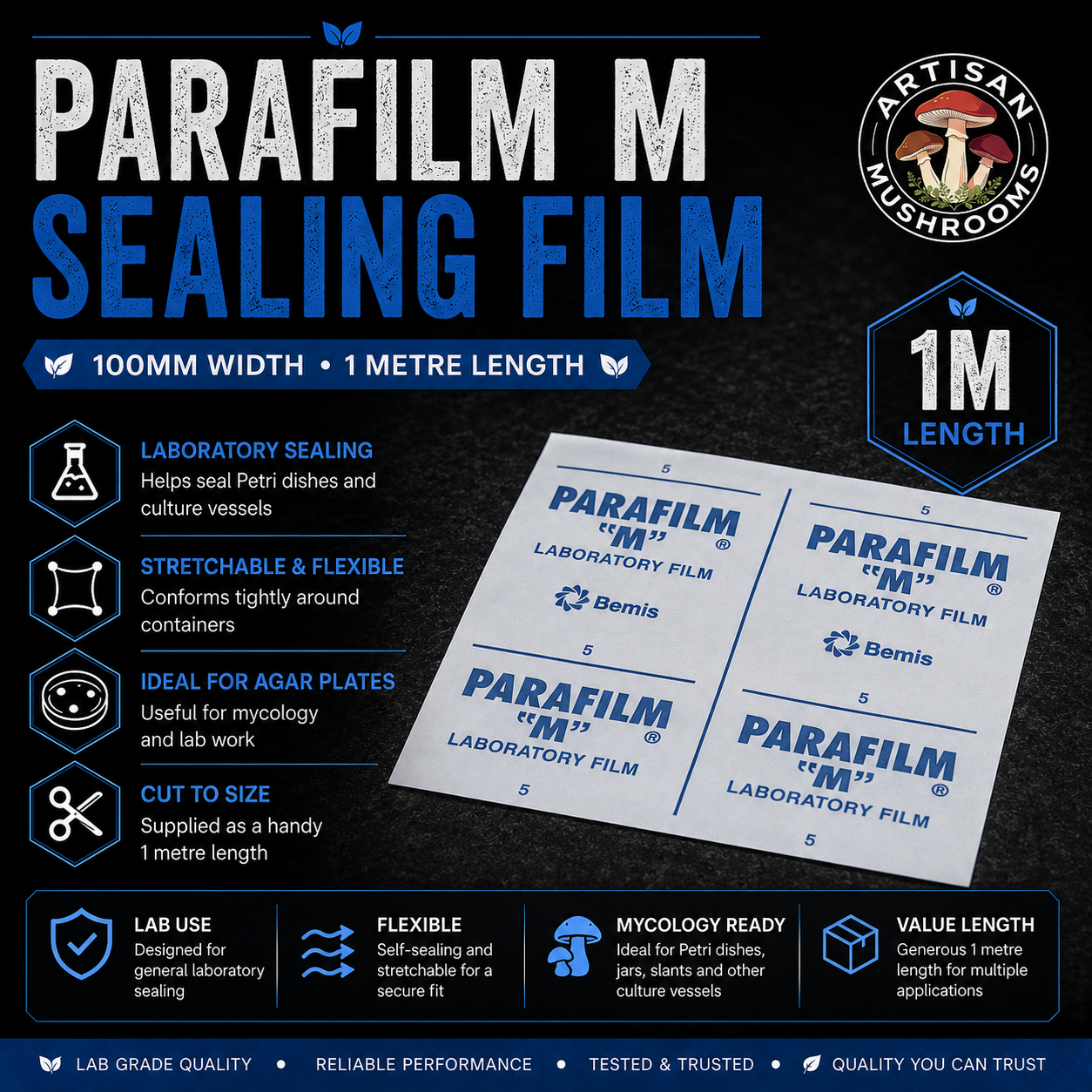
Yes. Seal the plate after inoculation using suitable laboratory film or appropriate plate-sealing tape.
Sealing helps:
Reduce contamination exposure
Prevent the lid from moving
Slow moisture loss
Keep the plate securely closed
Protect the culture during handling
Do not use a sealing method that damages the plate or traps unclean material inside.
Seal the plate immediately after inoculation.
Can household cling film be used to seal plates?
Purpose-made laboratory film or appropriate plate-sealing tape is preferable.
Household cling film can be difficult to handle cleanly and may not provide a consistent seal.
Whatever material is used should be:
Clean
Easy to apply
Suitable for laboratory culture work
Able to hold the lid in position
Applied without repeatedly opening the plate
Do not cover the complete top and bottom of the plate with an excessive amount of material.
Do I need a still-air box?
A still-air box is strongly recommended for home agar work when a laminar-flow hood is not available.
A still-air box reduces air movement around open plates.
This helps reduce the number of airborne contaminants that can land on the agar during inoculation or transfer.
The box itself does not sterilise the air or tools.
You must still:
Clean the box
Clean the working surface
Wash your hands
Wear clean gloves
Disinfect tools appropriately
Minimise movements
Open plates only slightly
Work efficiently
Can I open agar plates in an ordinary room?
Opening plates in an ordinary room carries a high contamination risk.
Air normally contains:
Mould spores
Bacteria
Yeast
Dust
Skin particles
Textile fibres
Pet hair
Other microorganisms
A plate may be open for only a few seconds and still collect contaminants.
Use a clean still-air box or a properly operated laminar-flow hood whenever possible.
Do I need a laminar-flow hood?
A laminar-flow hood is not essential for beginners, but it is useful for frequent or large-scale culture work.
A properly operated hood supplies a stream of filtered air across the working area.
A still-air box is a more affordable alternative for small-scale home culture work.
Both methods require good sterile technique.
A flow hood cannot compensate for:
Dirty tools
Unwashed hands
Poorly cleaned surfaces
Contaminated cultures
Incorrect working position
Obstructed airflow
What tools are needed for agar work?
Useful tools and supplies include:
A still-air box or laminar-flow hood
Sterile scalpel blades
A compatible scalpel handle
Alcohol wipes
Disposable gloves
Suitable laboratory disinfectant
A permanent marker
Laboratory sealing film or plate tape
A lighter or alcohol burner where appropriate
Clean paper towels
A waste container
The culture, spores or mushroom tissue being transferred
Plan the complete process before opening the first plate.
Should a scalpel be sterilised between transfers?
Yes. A scalpel blade should be sterile for every transfer.
When making several transfers, sterilise or replace the blade between cultures and after touching any potentially contaminated material.
Allow a heat-sterilised blade to cool before touching mushroom mycelium.
A hot blade can damage the culture or melt the agar.
Never cool a sterile blade by touching it against an unclean surface.
Can agar plates be reused?
No. Used agar plates should not be cleaned, resterilised and reused for new culture work.
After use, the plate may contain:
Mushroom mycelium
Mould spores
Bacteria
Yeast
Nutrient residue
Damaged plastic
Hidden contamination
Keep contaminated plates sealed during disposal.
Unused clean plates are intended for a single culture cycle.
Are the agar plates a mushroom-growing substrate?
Agar plates are used for culture work rather than mushroom production.
They contain enough nutrition to support a thin layer of mycelium, but not enough material to produce a normal mushroom crop.
The usual cultivation sequence is:
Establish or test the culture on agar.
Transfer clean mycelium to sterilised grain or liquid culture.
Allow the grain to become fully colonised.
Transfer the grain spawn to a species-appropriate fruiting substrate.
Provide the correct fruiting conditions.
Agar is the culture-development stage, not the final fruiting substrate.
Can mushrooms fruit directly from an agar plate?
Small or abnormal fruiting structures may occasionally form on an old or fully colonised plate.
This does not make agar a practical fruiting substrate.
The plate contains limited water, nutrition and physical space.
A culture that begins fruiting on agar should normally be transferred to fresh media or used to inoculate grain before the plate dries out.
Can the plates be used for all mushroom species?
LME agar supports many cultivated mushroom species, including:
Oyster mushrooms
Lion’s Mane
Shiitake
Chestnut
Enoki
Maitake
Reishi
Turkey Tail
Chicken of the Woods
Wine Cap
Portobello
Cordyceps cultures
Other gourmet and specialty mushrooms
Growth speed and appearance will vary between species.
Some specialised cultures may perform differently on alternative media, but LME agar is a versatile general-purpose medium for mushroom culture work.
Can I use agar with Chanterelle or Hedgehog cultures?
Yes. Chanterelle and Hedgehog mycelium can be expanded or observed on agar.
However, successful growth on an agar plate does not remove their need for a compatible living host tree during long-term outdoor cultivation.
Agar can be used for:
Culture testing
Mycelium observation
Clean transfers
Limited expansion
Preparing material for further experimental work
It is not a substitute for the living root relationship required by these mycorrhizal species.
Can I use LME agar for Cordyceps militaris?
Yes. LME agar can be used to maintain, test and expand Cordyceps militaris mycelium.
The agar plate is used for culture work rather than fruiting.
After clean growth has been established, the culture can be transferred to liquid culture or a specialised Cordyceps fruiting medium.
Repeated culture expansion can affect some Cordyceps strains, so maintain clean backup cultures and avoid unnecessary transfers.
Why does my culture look different on LME agar?
Mycelial appearance can change according to:
Agar recipe
Nutrient concentration
Temperature
Culture age
Moisture
Transfer size
Genetics
Number of transfers
Incubation conditions
A culture that appears cotton-like on one medium may appear more rope-like on another.
Growth appearance alone should not be used to predict mushroom yield or quality.
Cleanliness, vigour and eventual fruiting performance are more important.
Should I transfer the culture before it reaches the edge?
Yes. Important cultures are generally transferred before the mycelium reaches and presses against the outer edge of the plate.
Transferring earlier allows you to select fresh, actively growing mycelium.
It also reduces the chance of:
The culture growing beneath the lid edge
Hidden edge contamination
Moisture loss
The mycelium becoming old
Difficulty selecting a clean leading edge
The ideal timing depends on growth rate and how the plate will be used.
What should I do if plates arrive damaged or contaminated?
Inspect the plates when they arrive.
Look for:
Cracked dishes
Broken lids
Leaking agar
Extensive agar cracking
Open or damaged packaging
Visible mould or bacterial colonies
Severely dried agar
Heavy unexplained cloudiness
Do not open or inoculate a plate that appears contaminated.
Photograph the packaging and affected plates and contact us as soon as possible.
Minor condensation or small movements in the agar caused by temperature changes do not automatically mean the plates are contaminated.
Why might the agar move during delivery?
The agar is a firm gel, but temperature changes and rough handling can occasionally cause it to:
Shift slightly
Crack
Pull away from an edge
Develop surface moisture
Produce condensation inside the lid
Allow the plates to rest at a stable temperature before using them.
A plate that remains sealed, clean and largely intact may still be usable.
Contact us when damage is extensive or the plate’s sterile condition appears compromised.
Are the plates guaranteed to remain contamination-free after use?
The plates are prepared under sterile laboratory conditions, but sterility cannot be maintained once a plate is opened or inoculated unless correct handling techniques are used.
Results depend on:
The cleanliness of the culture
The inoculation environment
Tool sterilisation
Hand hygiene
Plate-opening time
Sealing method
Incubation temperature
Storage
Air quality
Handling technique
A contaminated plate does not automatically mean that the original unused plate was contaminated.
The location and growth pattern of the contamination can help identify when it was introduced.
Where are the LME agar plates prepared and shipped from?
Our LME agar plates are prepared under sterile laboratory conditions in Ireland.
Each 10-pack contains 10 sterile, pre-poured Light Malt Extract agar plates securely packaged for delivery.
Fast shipping is available to customers across Ireland, the UK, Europe, the United States and Canada.