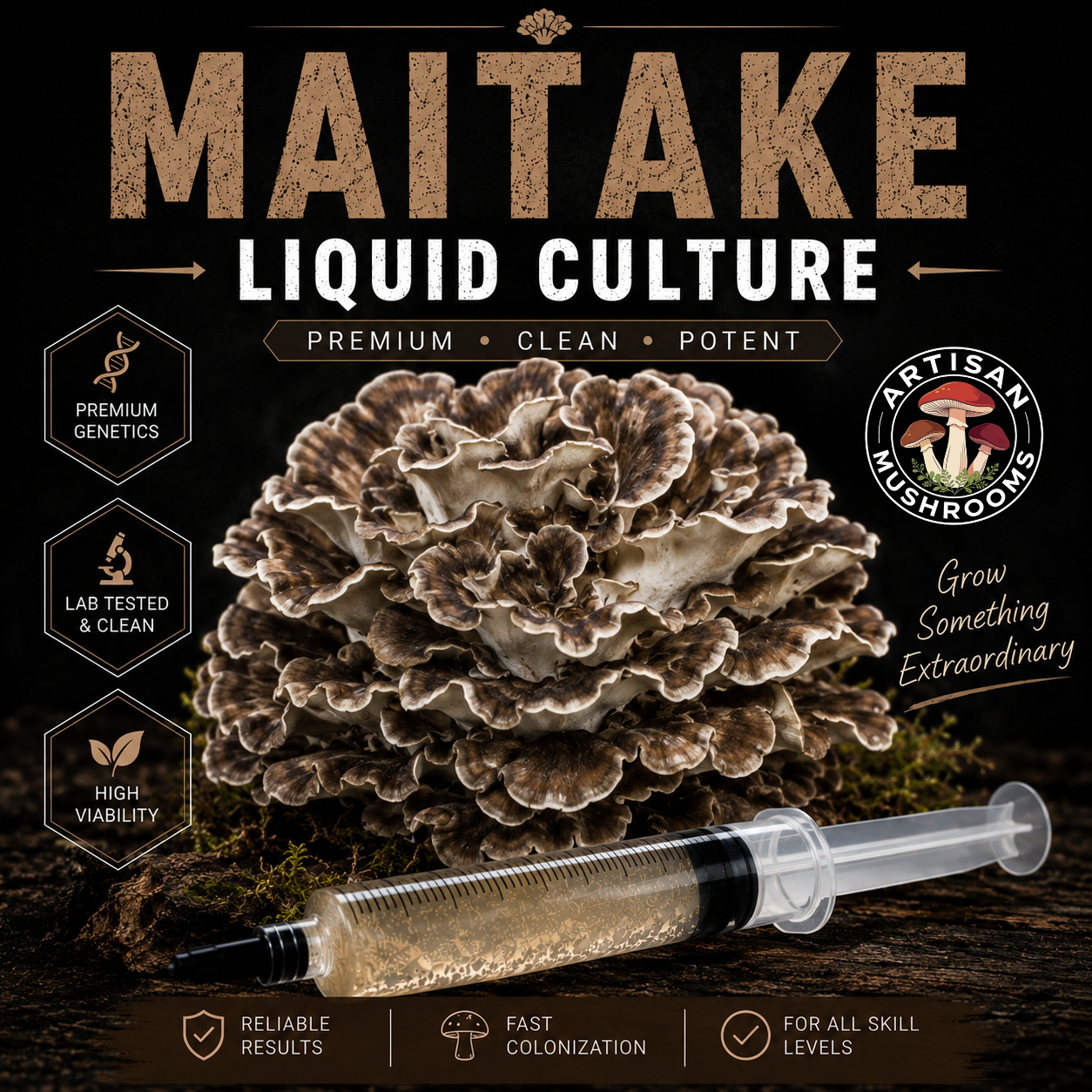
 Image 1 of 3
 Image 2 of 3
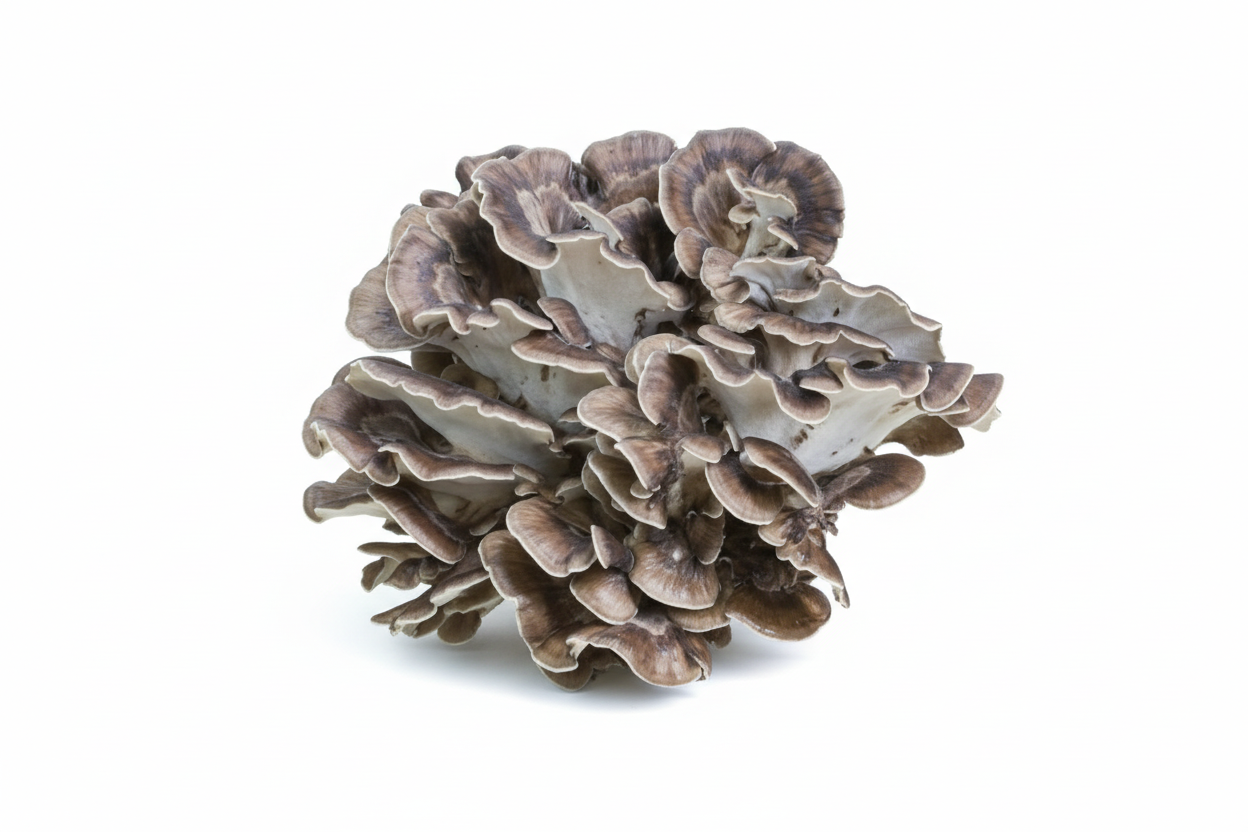 Image 3 of 3

Maitake Liquid Culture FAQ
What is the scientific name of Maitake?
The scientific name for Maitake is Grifola frondosa.
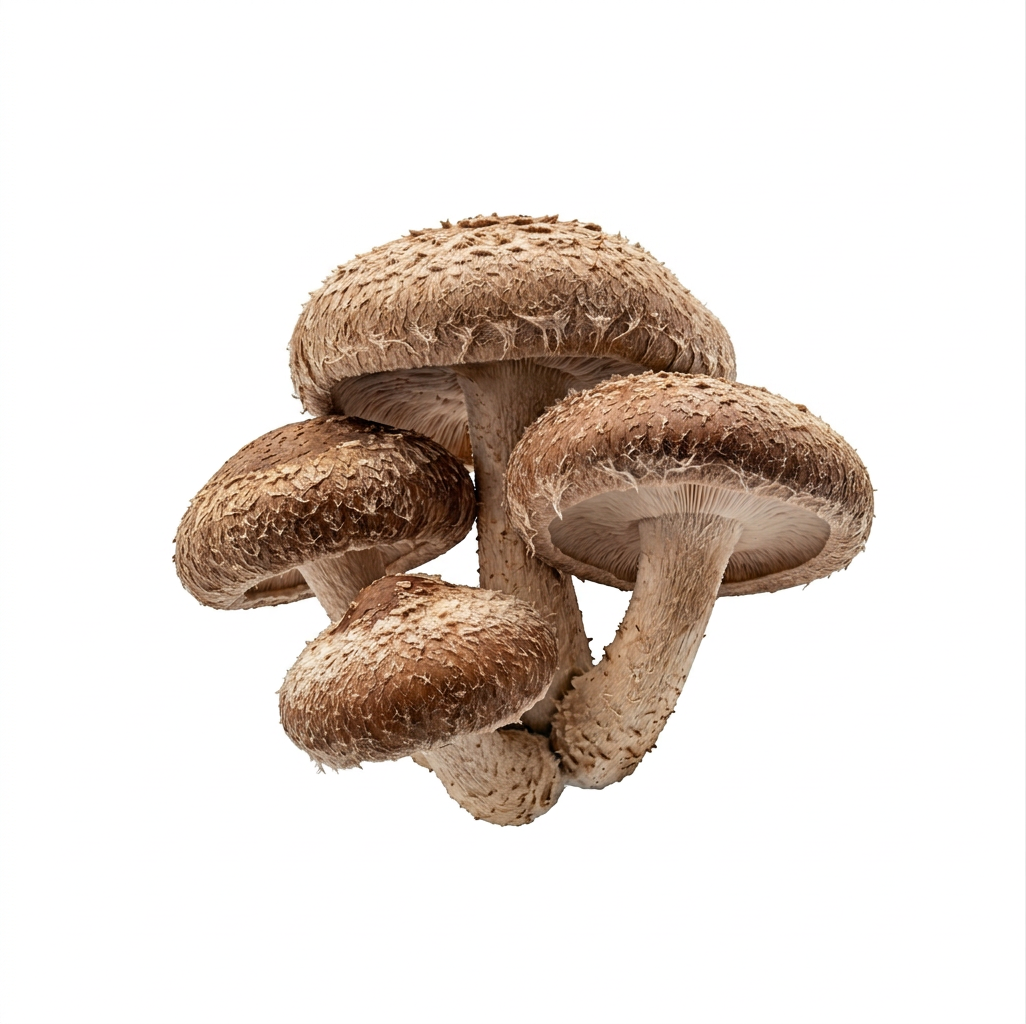
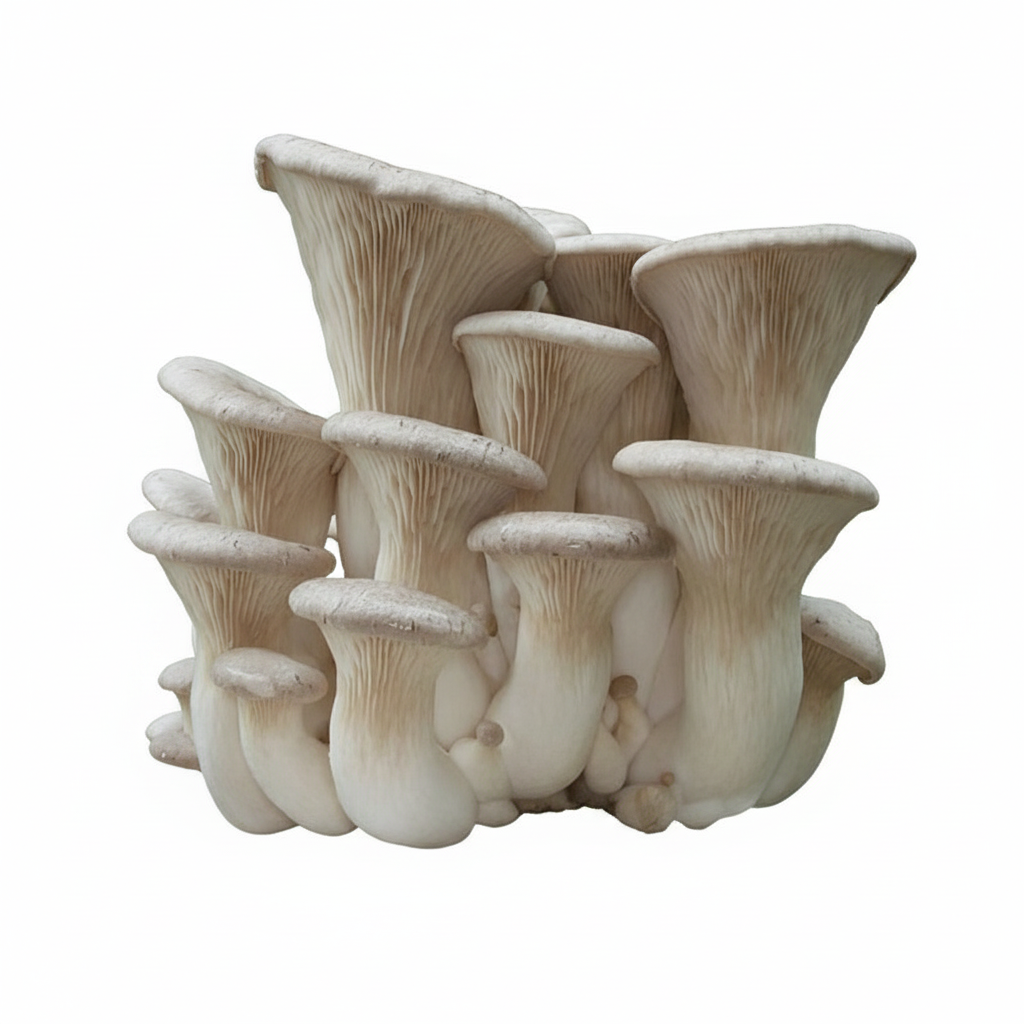
Maitake is also commonly known as Hen of the Woods, Ram’s Head or Sheep’s Head. It produces distinctive clustered fruiting bodies made up of numerous overlapping grey-brown, fan-shaped fronds.
Maitake is a wood-decaying gourmet mushroom that naturally grows around the bases and roots of mature hardwood trees, particularly oak.
What substrate is best for growing Maitake?
Maitake grows particularly well on sterilised hardwood-based substrates.
Supplemented hardwood sawdust containing hardwoods such as oak or beech is an excellent choice for indoor cultivation. Adding a suitable supplement such as wheat bran can provide additional nutrition and support healthy mycelial growth and mushroom production.
Supplemented hardwood substrate must be properly sterilised because its higher nutrient content makes it more susceptible to contamination.
Our 2kg Sterilised Hardwood and Wheat Bran Substrate provides a prepared fruiting substrate suitable for growing Maitake.
Maitake can also be cultivated outdoors using suitable hardwood logs, buried blocks or established hardwood stumps, although outdoor production generally takes considerably longer and is less predictable than controlled indoor cultivation.
Can I inoculate a grow bag directly?
Yes. Maitake liquid culture can be injected directly into our Sterile Hardwood Mushroom Grow Bag using a sterile needle and the self-healing injection port.
The bag contains sterilised hardwood substrate supplemented with wheat bran, allowing the culture to be introduced without preparing and pressure sterilising your own growing medium.
Direct liquid-culture inoculation can work, although Maitake is slower and more demanding than many Oyster mushroom species.
The more traditional method is to inoculate sterilised grain first. Once the grain has fully colonised, it can be mixed with sterilised hardwood fruiting substrate.
Using colonised grain helps distribute the Maitake mycelium more evenly throughout the final substrate and can provide faster, more consistent colonisation.
Can Maitake liquid culture be used on grain?
Yes. Sterilised grain is commonly used as the first stage of Maitake cultivation.
The liquid culture can be injected into our 2kg Sterilised Wheat Grain Bag and allowed to colonise the grain, creating Maitake grain spawn.
Once fully colonised, the grain spawn can be mixed with our 2kg Sterilised Hardwood and Wheat Bran Substrate.
Maitake may colonise more slowly than Oyster mushrooms, and its growth can initially appear fine or uneven. Allow sufficient time for the grain to become fully colonised before transferring it to the hardwood fruiting substrate.
Do you sell sterilised grain and substrate?
Yes. We offer pre-sterilised wheat grain bags, sterilised hardwood and wheat bran substrate, and ready-to-inoculate hardwood grow bags to simplify the cultivation process.
Using prepared grain and substrate removes the need to hydrate, mix and pressure sterilise your own growing media. It reduces the amount of specialist equipment required and can help lower the risk of contamination.
A typical Maitake growing process is:
Inoculate a pre-sterilised grain bag with Maitake liquid culture.
Allow the grain to become fully colonised with mycelium.
Mix the colonised grain spawn with sterilised hardwood and wheat bran substrate.
Allow the hardwood substrate to become fully colonised.
Give the block additional time to consolidate and mature.
Introduce cooler fruiting conditions with high humidity, gentle lighting and controlled fresh-air exchange.
Wait for a dense Maitake primordium to form.
Increase fresh-air exchange gradually as the fronds begin developing.
Harvest while the cluster remains tender and the frond edges are still fresh.
Alternatively, our Sterile Hardwood Mushroom Grow Bag provides a simpler all-in-one option.
The Maitake liquid culture can be injected directly through the self-healing injection port without preparing separate grain or hardwood substrate.
Is Maitake suitable for beginners?
Maitake can be grown by determined beginners, but it is generally considered more challenging than Oyster mushrooms, Lion’s Mane or Reishi.
Successful fruiting depends on:
Clean inoculation
Complete substrate colonisation
Sufficient block maturation
Suitable temperature reduction
High humidity
Carefully controlled fresh-air exchange
Patience during primordium development
Maitake cultures and strains can vary considerably in their willingness to produce fruiting bodies. A block may colonise successfully but still require precise conditions before mushrooms develop.
Using pre-sterilised grain and ready-to-use hardwood substrate simplifies the process because you do not need to prepare and sterilise the growing media yourself.
The ready-to-inoculate hardwood grow bag is the most straightforward option for customers who want to inject the culture directly into a prepared fruiting substrate.
How should I store the liquid culture?
Keep the Maitake liquid culture syringe refrigerated at approximately 2°C to 4°C until you are ready to use it. Do not freeze it.
For the best viability, use the culture within three months of receiving it.
Before inoculation, allow the syringe to come closer to room temperature and shake it gently to distribute the Maitake mycelium throughout the nutrient solution.
Always keep the protective cap fitted while the syringe is in storage. Attach a new sterile needle immediately before inoculating grain, agar or a grow bag.
How much liquid culture should I use?
The amount of Maitake liquid culture required depends on the size and type of growing medium.
For one of our sterile LME agar plates, one or two small drops are normally sufficient.
A small grain jar may require approximately 1 to 2 ml, while a larger grain or hardwood grow bag may require approximately 5 to 10 ml.
Using too much liquid culture can introduce excess moisture into the grain or substrate, which may increase the risk of bacterial contamination.
When inoculating our 2kg Sterilised Wheat Grain Bag, approximately 5 to 10 ml can be used and distributed across several areas of the grain.
Does the syringe contain mushroom spores?
No. Maitake liquid culture contains living Grifola frondosa mycelium suspended in a sterile nutrient solution.
It is not a mushroom spore solution.
Because the mycelium is already actively growing, liquid culture can provide faster and more predictable colonisation than starting from spores.
The culture can be used to inoculate sterilised grain, a suitable hardwood grow bag or a sterile LME agar plate.
What conditions does Maitake need to colonise?
Maitake generally colonises well under moderate temperatures.
Suitable starting conditions include:
Temperatures of approximately 21°C to 26°C
Darkness or low ambient light
A clean and stable growing environment
Gas exchange through the bag’s filter patch
No direct sunlight
Minimal disturbance while the mycelium becomes established
The grain or hardwood substrate should be allowed to become fully colonised before fruiting conditions are introduced.
Maitake can be slower than vigorous Oyster mushroom cultures. Colonisation time will depend on the temperature, inoculation rate, substrate density and amount of liquid culture or grain spawn used.
Avoid excessively warm conditions. The mycelium generates heat as it grows, meaning the internal temperature of a large substrate block can be higher than the surrounding room.
How long does Maitake take to colonise?
Maitake colonisation can take several weeks and may be slower than many commonly cultivated gourmet mushrooms.
A grain bag may require approximately three to six weeks to become fully colonised, depending on temperature, inoculation rate, grain preparation and culture vigour.
A hardwood fruiting block may require an additional six to twelve weeks or longer to colonise and mature.
The block should not be moved into fruiting conditions simply because the first visible areas have become white. Allow it to become fully colonised and firmly consolidated.
Maitake cultivation rewards patience. Attempting to fruit an immature block can result in delayed pinning, malformed growth or no mushrooms.
Does Maitake need a maturation period?
Yes. Maitake normally benefits from a maturation period after the substrate appears fully colonised.
During this stage, the mycelium continues digesting and consolidating the hardwood substrate. This allows the block to store sufficient energy and moisture for mushroom formation.
Keep the bag sealed during maturation and continue providing suitable gas exchange through the filter patch.
Depending on the strain and cultivation method, maturation may take several additional weeks after visible colonisation is complete.
A mature block should feel firm and well held together by mycelium. Avoid fruiting blocks that still contain loose, uncolonised or excessively wet areas.
What conditions does Maitake need to fruit?
Maitake generally performs best under cooler fruiting conditions than those used for colonisation.
Suitable starting conditions include:
Temperatures of approximately 15°C to 20°C
Relative humidity of approximately 90% to 95% during primordium formation
Relative humidity of approximately 85% to 92% during later development
Gentle indirect daylight or artificial lighting
Controlled fresh-air exchange
No direct sunlight
A clean and stable fruiting environment
A reduction in temperature helps signal that the mature block should begin producing mushrooms.
High humidity is particularly important while the Maitake primordium is forming. The developing growth should not be allowed to dry out.
Once the fronds begin separating and expanding, fresh-air exchange should be increased gradually while maintaining suitable humidity.
A digital thermometer and hygrometer can help you monitor conditions throughout colonisation, maturation and fruiting.
Does Maitake need a cold shock?
A mature Maitake block can benefit from a controlled reduction in temperature when it is moved from incubation into fruiting conditions.
A severe or freezing cold shock is not required. The aim is to provide a noticeable but controlled change from the warmer colonisation environment to cooler fruiting conditions.
Moving a mature block from approximately 22°C to 25°C into a fruiting space of approximately 15°C to 20°C may help encourage primordium formation.
Do not freeze the block or expose it to sudden extreme temperature changes.
What does a Maitake primordium look like?
The early Maitake fruiting body may initially appear as a dense, pale or greyish mass rather than immediately producing recognisable mushroom caps.
As it develops, the primordium may form:
A rounded or brain-like structure
Numerous small folds
Grey, brown or cream-coloured areas
A dense cluster emerging from one main location
Gradually separating fan-shaped fronds
This compact structure should be protected from drying during the early stage.
Do not cut it apart or assume that the unusual shape indicates contamination unless it develops clear mould colours, a foul smell or wet, decaying tissue.
How should a Maitake grow bag be opened for fruiting?
Maitake is commonly top-fruited or allowed to develop through a controlled opening near the top of the block.
One practical method is:
Allow the block to colonise and mature completely.
Leave sufficient air space above the substrate.
Introduce cooler fruiting conditions.
Wait for a Maitake primordium to begin developing near the substrate surface.
Open or cut the top of the bag carefully.
Leave the sides of the substrate covered to retain moisture.
Gradually increase fresh-air exchange as the fronds expand.
Avoid completely removing the plastic from an immature block.
Keeping most of the substrate covered helps prevent it from drying out while directing the fruiting body towards the opening.
Can Maitake be fruited inside the closed bag?
Early primordium formation may occur inside the humid space of a mostly closed bag.
However, the developing mushroom will eventually need additional fresh air and physical space to form properly separated fronds.
Leaving the bag closed for too long can result in:
Dense, undeveloped growth
Long or poorly separated branches
Pale or irregular fruiting bodies
Excessive moisture around the mushroom
Reduced cap development
Once a healthy primordium has formed, gradually open the bag and increase fresh-air exchange while maintaining high humidity.
Why is my Maitake not pinning?
Delayed or absent pinning can be caused by:
A block that has not matured for long enough
Fruiting temperatures that are too warm
Low humidity
Insufficient lighting
Inadequate fresh-air exchange
A substrate that is too wet or too dry
Incomplete internal colonisation
Weak or non-fruiting genetics
Contamination
Insufficient environmental change between incubation and fruiting
First confirm that the block is fully colonised, clean and mature.
Move it into cooler fruiting conditions and provide high humidity, gentle lighting and controlled fresh-air exchange.
Maitake may require more time than Oyster mushrooms to respond to fruiting conditions, so avoid repeatedly changing the environment when the block appears healthy.
Why is my Maitake forming a dense blob instead of fronds?
A dense or brain-like structure is often a normal early Maitake primordium.
If the structure remains compact and fails to develop separate fronds, possible causes include:
Insufficient fresh-air exchange
Excessively high carbon dioxide
Fruiting temperatures that are too warm
Low or unstable humidity
Inadequate lighting
Opening the bag too early or too late
Increase fresh-air exchange gradually while maintaining high surrounding humidity.
Do not place the developing cluster directly in a strong, drying airflow. Maitake requires ventilation, but the delicate primordium can be damaged if its surface dries.
Why are my Maitake fronds long, thin or poorly formed?
Long, thin or poorly separated fronds can indicate elevated carbon dioxide and insufficient fresh-air exchange.
Other possible causes include:
Fruiting temperatures outside the preferred range
Inadequate lighting
Low humidity
An immature substrate block
Overcrowding around the fruiting body
Increase ventilation gradually and provide gentle indirect light.
Maintain high humidity so that the expanding edges remain fresh and flexible. Strong airflow should not blow directly onto the mushrooms.
Why is my Maitake turning brown or grey?
Grey and brown colouring is normal for developing Maitake mushrooms.
Young growth may begin pale cream or grey before developing darker grey-brown fronds.
Colour can be influenced by:
Strain genetics
Fruiting temperature
Lighting
Humidity
Fresh-air exchange
Mushroom maturity
Healthy Maitake should remain firm and continue expanding.
Wet, slimy, foul-smelling or rapidly collapsing tissue may indicate excessive moisture, bacterial damage or contamination rather than normal colour development.
Why are there yellow or amber droplets on the Maitake block?
Small yellow or amber droplets may be fungal metabolites produced by the Maitake mycelium.
Occasional metabolites can appear when the block is:
Actively digesting the substrate
Experiencing environmental stress
Becoming overly warm
Remaining colonised for a long period
Responding to excess moisture
A small amount does not always indicate contamination.
Check that the bag is not overheating and that the substrate does not have an unpleasant smell or wet, uncolonised patches.
Large quantities of dark liquid combined with soft substrate, foul odours or unusual colours may indicate a problem.
When should Maitake mushrooms be harvested?
Maitake is best harvested when the cluster has developed numerous well-formed fronds but remains tender and fresh.
Signs that the mushroom is ready include:
The cluster has reached a substantial size.
The fan-shaped fronds are clearly separated.
The outer edges remain fresh and slightly curved.
The colour has developed from pale grey to grey-brown.
The underside pores are still fine and pale.
The mushroom remains firm rather than dry or brittle.
Avoid waiting until the frond edges become dry, heavily curled or fragile.
Use a clean, sturdy knife to cut the complete cluster close to the substrate. Maitake clusters can be dense at the base, so twisting may damage the block.
Can a Maitake block produce more than one flush?
Yes. A healthy Maitake block may produce an additional flush, although later production is often slower and smaller than the first.
After harvesting:
Remove remaining mushroom tissue from the fruiting area.
Allow the block to rest.
Keep it in a clean environment with moderate humidity.
Prevent the substrate from drying out completely.
Reintroduce cool fruiting conditions after the resting period.
Maintain high humidity and suitable fresh-air exchange.
The block may require several weeks before producing additional growth.
Do not keep it continuously soaking wet during the resting period.
Can Maitake be grown outdoors?
Yes. Maitake can be cultivated outdoors using suitable hardwood logs, buried hardwood blocks or inoculated material placed around compatible hardwood trees.
Oak is one of the most suitable hardwoods for outdoor Maitake projects.
Outdoor cultivation is generally slower and less predictable than indoor block cultivation. Establishment and fruiting can take one or more growing seasons and will depend on local climate, rainfall, tree condition and the quality of the inoculated material.
Liquid culture is normally expanded onto grain or sawdust spawn before being used for an outdoor project. Injecting liquid culture directly into a large untreated log is unlikely to provide reliable colonisation.
Where are your Maitake cultures shipped from?
All Maitake liquid cultures are prepared fresh under sterile laboratory conditions and shipped directly from Ireland.
Each order includes a 10 ml Maitake liquid culture syringe, a sterile 18G needle and an alcohol wipe.
Fast shipping is available to customers across Ireland, the UK, Europe, the United States and Canada.