 Image 1 of 3
 Image 2 of 3
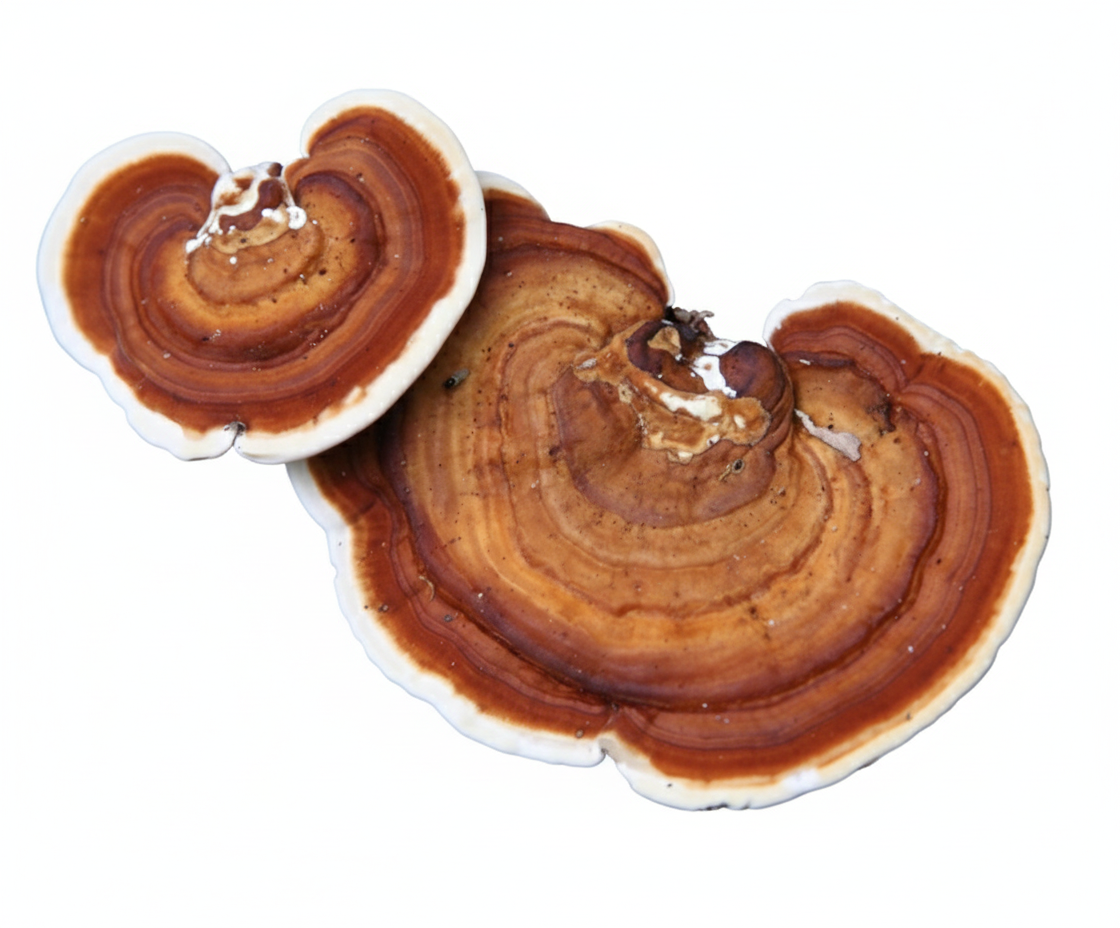 Image 3 of 3
Hemlock Reishi Liquid Culture FAQ
What is the scientific name of Hemlock Reishi?
The scientific name for Hemlock Reishi is Ganoderma tsugae.
It is also commonly known as Hemlock Varnish Shelf or Hemlock Ganoderma.
Hemlock Reishi produces firm, woody fruiting bodies with glossy red, reddish-brown or mahogany-coloured surfaces. Young growing margins are usually white or cream before gradually developing their darker lacquered appearance.
Like other Reishi mushrooms, it is a polypore. This means it releases spores through fine pores on the underside of the fruiting body rather than through gills.
Does Hemlock Reishi come from the poisonous hemlock plant?
No. The name refers to the hemlock tree, particularly trees belonging to the genus Tsuga.
It has no connection to the poisonous herbaceous plant commonly called hemlock.
In its natural habitat, Ganoderma tsugae is strongly associated with coniferous wood, especially dead or declining hemlock trees.
How is Hemlock Reishi different from Red Reishi?
Hemlock Reishi and Red Reishi are closely related mushrooms within the genus Ganoderma, but they are different species.
Hemlock Reishi is Ganoderma tsugae. It is naturally associated mainly with conifers and generally prefers cooler cultivation conditions.
Red Reishi is commonly listed as Ganoderma lingzhi or another closely related lacquered Ganoderma species. It is generally cultivated on deciduous hardwood sawdust.
Both can produce glossy red-brown fruiting bodies, antler-like growth and shelf-shaped conks. Their substrate preferences, temperature tolerances and natural host trees are different.
What substrate is best for growing Hemlock Reishi?
Hemlock Reishi is best suited to conifer-based growing media.
Suitable materials may include:
Hemlock sawdust
Larch sawdust
Douglas fir sawdust
Pine sawdust
Spruce sawdust
Mixed untreated conifer sawdust
Conifer wood chips
Sterilised conifer logs or wood sections
Supplemented sawdust containing wheat bran
A supplemented conifer sawdust substrate is the closest indoor equivalent to the wood on which Hemlock Reishi naturally grows.
Oak, beech and other deciduous hardwood substrates may support mycelial growth in some cultures, but a conifer-based substrate is generally the more species-appropriate choice.
Can I use your hardwood and wheat bran substrate?
Our 2kg Sterilised Hardwood and Wheat Bran Substrate can be used for culture expansion and experimental Hemlock Reishi cultivation.
However, it is made from deciduous hardwood rather than hemlock or another conifer. Hemlock Reishi is naturally adapted to coniferous wood, so results may vary.
Growers seeking the most species-appropriate substrate can prepare sterilised hemlock, larch, fir, spruce or pine sawdust supplemented with a moderate amount of wheat bran.
Our hardwood substrate remains a practical prepared option for customers who want to trial the culture without mixing and sterilising their own substrate, but fruiting should not be guaranteed.
Can I inoculate a hardwood grow bag directly?
Yes. Hemlock Reishi liquid culture can be injected directly into our Sterile Hardwood Mushroom Grow Bag through its self-healing injection port.
The bag contains sterilised hardwood substrate supplemented with wheat bran, allowing the culture to be introduced without preparing and pressure sterilising your own growing medium.
Leave the bag sealed while the mycelium colonises and consolidates the substrate.
Because the bag contains deciduous hardwood rather than conifer wood, it should be regarded as a convenient culture-expansion and experimental fruiting medium.
For the most species-specific approach, the liquid culture can first be expanded on grain and then transferred to a sterilised conifer sawdust substrate.
Can Hemlock Reishi liquid culture be used on grain?
Yes. Sterilised grain is commonly used to expand Hemlock Reishi mycelium before transferring it to a woody fruiting substrate.
The culture can be injected into our 2kg Sterilised Wheat Grain Bag.
Allow the grain to become fully colonised before mixing it with sterilised conifer sawdust or another suitable woody substrate.
Grain provides a nutritious expansion medium and creates numerous inoculation points throughout the final sawdust block.
Grain should normally be used as spawn rather than as the complete Hemlock Reishi fruiting substrate.
Do you sell supplies for growing Hemlock Reishi?
Yes. We offer several products that can simplify the culture-expansion and experimental cultivation stages.
Our 2kg Sterilised Wheat Grain Bag can be used to produce Hemlock Reishi grain spawn.
Our 2kg Sterilised Hardwood and Wheat Bran Substrate provides a prepared hardwood medium for experimental cultivation.
Our Sterile Hardwood Mushroom Grow Bag provides a convenient all-in-one option that can be inoculated directly.
Our sterile LME agar plates can be used for culture testing, isolation and further expansion.
Growers who want the most species-appropriate fruiting substrate may need to prepare sterilised hemlock, larch, pine, fir or spruce sawdust separately.
What is a typical Hemlock Reishi growing process?
A typical grain-to-sawdust cultivation process is:
Inoculate a pre-sterilised grain bag with Hemlock Reishi liquid culture.
Allow the grain to become fully colonised with mycelium.
Prepare a sterilised conifer sawdust substrate supplemented with wheat bran.
Allow the sterilised substrate to cool completely.
Mix the colonised grain spawn evenly through the sawdust.
Seal the filter bag and allow the substrate to colonise fully.
Give the block additional time to consolidate.
Introduce gentle lighting and suitable fruiting conditions.
Keep fresh-air exchange limited if antler-shaped growth is preferred.
Increase fresh-air exchange if shelf-shaped conks are preferred.
Maintain suitable humidity as the fruiting bodies develop.
Harvest once the desired shape and maturity have been reached.
Alternatively, the liquid culture can be injected directly into our Sterile Hardwood Mushroom Grow Bag.
Is Hemlock Reishi suitable for beginners?
Hemlock Reishi can be grown by beginners, but it is more specialised than Red Reishi or fast-growing Oyster mushrooms.
The main challenges include:
Obtaining an appropriate conifer-based substrate
Maintaining cooler temperatures
Allowing sufficient colonisation and maturation time
Controlling humidity
Managing carbon dioxide and fresh-air exchange
Deciding whether to produce antlers or shelf-shaped conks
Waiting for the slow-growing fruiting bodies to mature
The sterile expansion stage can be simplified with pre-sterilised grain.
Our ready-to-inoculate hardwood grow bag provides the simplest direct-inoculation option, although a conifer-based substrate is more closely matched to the natural requirements of Ganoderma tsugae.
How should I store the liquid culture?
Keep the Hemlock Reishi liquid culture syringe refrigerated at approximately 2°C to 4°C until you are ready to use it.
Do not freeze it.
For the best viability, use the culture within three months of receiving it.
Before inoculation, allow the syringe to move closer to room temperature and shake it gently to distribute the Hemlock Reishi mycelium throughout the nutrient solution.
Keep the protective cap fitted during storage. Attach a new sterile needle immediately before inoculating grain, agar or a grow bag.
How much liquid culture should I use?
The amount of liquid culture required depends on the size and type of growing medium.
For one of our sterile LME agar plates, one or two small drops are normally sufficient.
A small grain jar may require approximately 1 to 2 ml.
When inoculating our 2kg Sterilised Wheat Grain Bag or Sterile Hardwood Mushroom Grow Bag, approximately 5 to 10 ml can be used.
Using too much liquid culture can introduce excess moisture into the grain or substrate, increasing the risk of bacterial contamination.
Does the syringe contain mushroom spores?
No. Hemlock Reishi liquid culture contains living Ganoderma tsugae mycelium suspended in a sterile nutrient solution.
It is not a mushroom spore solution.
Because the mycelium is already actively growing, liquid culture provides a faster and more predictable starting point than spores.
The culture can be used to inoculate sterilised grain, a suitable sawdust substrate or a sterile LME agar plate.
Can I test Hemlock Reishi liquid culture on agar?
Yes. Agar testing allows you to observe the mycelium and check for clean growth before inoculating a larger quantity of grain or sawdust.
Place one or two small drops onto one of our sterile LME agar plates.
Keep the plate sealed and monitor the growth spreading from the inoculation point.
Healthy Hemlock Reishi mycelium is normally white to cream and may develop dense or slightly leathery growth as it matures.
Do not open the plate outside a clean working environment. Exposing sterile agar to ordinary room air can introduce mould spores and bacteria.
What conditions does Hemlock Reishi need to colonise?
Hemlock Reishi generally colonises well under moderate temperatures.
Suitable starting conditions include:
Temperatures of approximately 22°C to 25°C
Darkness or low ambient light
A clean and stable incubation area
Filtered gas exchange
No direct sunlight
Properly hydrated substrate
Minimal disturbance during early colonisation
Approximately 25°C is a useful starting temperature for culture expansion.
Hemlock Reishi is generally less tolerant of high temperatures than some warm-growing Reishi species. Avoid allowing the culture or substrate block to remain above approximately 27°C to 28°C for extended periods.
The centre of a large colonising bag can become warmer than the surrounding room because actively growing mycelium produces heat.
What does healthy Hemlock Reishi mycelium look like?
Healthy Hemlock Reishi mycelium usually appears white or cream-coloured.
As colonisation progresses, it may develop:
Fine white strands
Cotton-like patches
Dense white growth between grains
Thick surface growth
A leathery mycelial skin
Yellow or amber droplets
Pale yellow or tan pigmentation in older areas
Small amber droplets may be fungal metabolites and do not always indicate contamination.
Green, black, pink or strongly foul-smelling growth may indicate mould or bacterial contamination.
A healthy colonised substrate should smell earthy or mushroom-like rather than sour, rotten or fermented.
How long does Hemlock Reishi take to colonise?
Colonisation time depends on the temperature, inoculation rate, substrate, bag size and vigour of the culture.
A grain bag may require approximately two to five weeks to become fully colonised.
A supplemented sawdust block may require approximately four to eight weeks or longer.
Hemlock Reishi is slower to produce mature fruiting bodies than Oyster mushrooms, even when the substrate colonises strongly.
Allow the substrate to become fully colonised before introducing fruiting conditions. A block that appears white on the outside may still contain uncolonised material internally.
Does Hemlock Reishi need a maturation period?
Yes. A fully colonised Hemlock Reishi block can benefit from additional time to consolidate before fruiting.
During this period, the mycelium continues digesting the wood and forming a strong network throughout the substrate.
Keep the bag sealed and continue providing filtered gas exchange.
A mature block should:
Be colonised throughout
Feel firm and well consolidated
Have no large loose areas
Have no wet, uncolonised patches
Smell clean and mushroom-like
Show no spreading contamination
The exact maturation period varies between cultures and substrates.
What conditions does Hemlock Reishi need to fruit?
Hemlock Reishi generally performs well under cooler conditions than many tropical or warm-growing Ganoderma species.
Suitable starting conditions include:
Temperatures of approximately 18°C to 24°C
Relative humidity of approximately 85% to 95% during early growth
Relative humidity of approximately 80% to 90% as the fruiting bodies mature
Gentle indirect daylight or artificial lighting
Fresh-air exchange adjusted to the desired fruiting shape
No direct sunlight
A clean and stable fruiting environment
Avoid prolonged high temperatures. A warm fruiting environment may slow development, dry the growing margins or cause the culture to stall.
High humidity is especially important while the first primordia and soft white growing tips develop.
The mushrooms should not remain continuously wet. Persistent surface moisture combined with poor ventilation can encourage bacterial damage.
A digital thermometer and hygrometer can help monitor conditions throughout colonisation and fruiting.
Does Hemlock Reishi require light?
Yes. Hemlock Reishi benefits from gentle light during fruiting.
Suitable options include:
Indirect daylight
Diffused window light
A low-intensity grow light
A regular day-and-night lighting cycle
Direct sunlight should be avoided because it can overheat and dry the developing fruiting bodies.
Light helps guide the direction and shape of the growing fruiting bodies. A completely dark fruiting environment may result in weak orientation or irregular development.
Strong lighting is not required.
How do I grow Hemlock Reishi antlers?
Antler-shaped Hemlock Reishi is encouraged by elevated carbon dioxide and limited fresh-air exchange.
A practical method is:
Allow the substrate to colonise and consolidate fully.
Leave a generous air space above the substrate inside the bag.
Keep the top of the bag mostly closed.
Allow filtered gas exchange through the filter patch.
Provide gentle indirect light.
Maintain suitable temperatures and high humidity.
Allow the antlers to grow upwards into the humid air space.
The fruiting bodies may begin as white or cream growths before developing yellow, orange and reddish-brown colouring.
Do not seal the bag completely without filtered gas exchange.
How do I encourage Hemlock Reishi to form shelf-shaped conks?
Broad, shelf-shaped conks are encouraged by stronger fresh-air exchange and lower carbon dioxide levels.
Once antlers or early fruiting structures have formed:
Open the top of the bag or make a controlled fruiting cut.
Increase fresh-air exchange gradually.
Maintain high surrounding humidity.
Continue providing gentle indirect light.
Avoid placing the fruiting bodies directly in strong airflow.
Allow the growing tips to flatten and widen.
The pale growing edges should gradually expand into fan-shaped or kidney-shaped conks.
If carbon dioxide remains high, the fruiting bodies may continue developing as narrow antlers.
How should the grow bag be opened for fruiting?
The correct method depends on the fruiting shape you want.
For antler growth, keep the bag mostly closed and leave sufficient air space above the substrate.
For shelf-shaped conks, open the top of the bag or make a controlled side opening after early fruiting growth has developed.
Side fruiting can encourage the conks to grow horizontally, resembling their natural growth from logs and stumps.
Avoid removing the entire plastic bag from the substrate. Keeping most of the block covered helps retain moisture and reduces unnecessary drying.
Make openings only after the block is fully colonised and ready to fruit.
Why is my Hemlock Reishi only producing antlers?
Antler growth is normally caused by elevated carbon dioxide and limited fresh-air exchange.
This is a normal Reishi growth form and does not mean the culture has failed.
To encourage shelf-shaped caps:
Increase fresh-air exchange.
Open the top of the bag.
Make a small opening beside the developing antlers.
Maintain high humidity after increasing ventilation.
Continue providing indirect light.
Avoid strong airflow directly against the mushrooms.
The antler tips may begin flattening and expanding once carbon dioxide levels decrease.
Why is my Hemlock Reishi producing caps instead of antlers?
Cap or conk development normally occurs when the culture receives stronger fresh-air exchange.
Lower carbon dioxide encourages the fruiting body to widen rather than continue growing as a narrow antler.
If antlers are preferred, reduce fresh-air exchange while maintaining filtered gas exchange through the bag.
Do not completely seal the bag without ventilation.
Both antlers and shelf-shaped conks are normal Hemlock Reishi fruiting forms.
Why does my Hemlock Reishi have white growing tips?
White or cream growing tips are normal on actively developing Hemlock Reishi.
The newest tissue usually appears pale before gradually developing yellow, orange, red or reddish-brown colouring.
A broad white margin generally indicates that the fruiting body is still expanding.
As growth slows and maturity approaches, the pale margin may become narrower and the lacquered colour may extend towards the outer edge.
Why is my Hemlock Reishi changing colour?
Hemlock Reishi can change colour considerably as it matures.
Young fruiting structures may begin white or cream. They can later develop:
Yellow growing bands
Orange areas
Red colouring
Reddish-brown mature tissue
Dark mahogany sections
A glossy lacquered surface
Colour is influenced by genetics, age, temperature, lighting, humidity and airflow.
Changing colour is normally part of healthy development, provided the fruiting body remains firm and continues growing.
What are the yellow or amber droplets on the block?
Small yellow, amber or brown droplets may be fungal metabolites.
They can appear when the mycelium is:
Actively digesting the substrate
Consolidating a mature block
Experiencing environmental stress
Becoming too warm
Remaining in the bag for an extended period
Responding to excessive moisture
A small amount of clear or amber liquid does not necessarily indicate contamination.
Large quantities of dark liquid combined with a sour smell, slimy substrate or unusual mould colours may indicate a problem.
What is the brown dust around mature Hemlock Reishi?
Fine brown or rust-coloured dust around a mature Hemlock Reishi fruiting body is usually spores.
Mature Ganoderma conks can release large quantities of brown spores. These may collect on:
The upper surface of the mushroom
The grow bag
Shelves
Walls
Nearby equipment
The floor surrounding the fruiting area
Spore release is normal and does not indicate contamination.
Harvest before heavy sporulation if you want to reduce cleaning.
Grow mature Reishi in a ventilated area away from bedrooms and frequently occupied living spaces, particularly where anyone is sensitive to airborne particles.
Why has my Hemlock Reishi stopped growing?
Growth may stall because of:
Temperatures that are too high
Low humidity
Excessive drying
Insufficient fresh-air exchange
Too much fresh air during early antler development
Insufficient lighting
An immature substrate block
Unsuitable substrate composition
Exhausted substrate
Contamination
Repeated major environmental changes
Check the temperature first because Hemlock Reishi is more sensitive to heat than many warm-growing Reishi cultures.
Examine the pale growing margin. If it has disappeared and the fruiting body has become fully coloured and firm, the mushroom may simply be reaching maturity.
Why is the fruiting body dry or cracked?
Drying and cracking can result from:
Low humidity
Strong direct airflow
High temperatures
Direct sunlight
Infrequent environmental monitoring
A dry or exhausted substrate block
Increase the surrounding humidity without continuously soaking the mushroom.
Do not direct a fan at the fruiting body.
Mature Reishi naturally becomes hard and woody, but the actively growing margin should remain smooth and fresh while expansion is continuing.
When should Hemlock Reishi be harvested?
Hemlock Reishi can be harvested when the fruiting body has reached the desired size and maturity.
Signs of a mature shelf-shaped conk include:
The fruiting body has become firm and woody.
The upper surface has developed a glossy red-brown colour.
The pale growing margin has narrowed considerably.
The underside has formed a pale pore surface.
Brown spores may have begun appearing.
Antler-shaped growth can be harvested once the branches are firm, fully developed and have achieved the desired colour.
Use a clean, sturdy knife or pruning tool to cut the fruiting body close to the substrate.
Reishi is tough and may be difficult to remove by twisting.
Can a Hemlock Reishi block produce more than one flush?
Yes. A healthy Hemlock Reishi block may produce additional fruiting growth after the first harvest.
After harvesting:
Remove loose fruiting-body material from the opening.
Allow the block to rest.
Keep it in a clean area.
Maintain moderate humidity.
Prevent the substrate from drying completely.
Return it to suitable fruiting conditions after the resting period.
Adjust airflow according to the fruiting shape preferred.
Later flushes may be smaller or slower than the first.
The number of flushes depends on the moisture, cleanliness and nutrition remaining in the block.
Can Hemlock Reishi be cultivated on logs?
Yes. Hemlock Reishi can be cultivated experimentally on suitable conifer logs or wood sections.
Potential materials include:
Hemlock
Larch
Fir
Spruce
Pine
Other suitable untreated conifer wood
A basic log method is:
Select recently cut, untreated conifer logs.
Keep the logs from drying excessively.
Drill inoculation holes in a staggered pattern.
Pack fully colonised sawdust spawn into the holes.
Seal the holes with food-safe wax.
Keep the logs in a shaded, humid location.
Allow sufficient time for the fungus to colonise the wood.
Maintain moisture during prolonged dry weather.
Wait for suitable seasonal conditions to encourage fruiting.
Log cultivation can take one or more years and should be viewed as a long-term project.
Can a colonised grow bag be used to inoculate a log?
Yes. A fully colonised sawdust grow bag can be used as inoculation material for suitable conifer logs.
Once the bag is fully colonised:
Open it in a clean working area.
Break the colonised material into manageable pieces.
Pack it firmly into drilled holes in the log.
Seal the holes with food-safe wax.
Place the log in a shaded location.
Prevent it from drying completely.
For the best species match, use colonised conifer sawdust spawn when inoculating hemlock, larch, fir, spruce or pine logs.
Can I inoculate a living hemlock tree?
Do not deliberately inoculate a healthy living tree.
Hemlock Reishi is a wood-decaying fungus and can contribute to internal decay.
Use:
Dead logs
Cut stumps
Sterilised sawdust blocks
Wood sections no longer attached to a living tree
Do not inoculate valuable garden trees, trees close to buildings or trees that could create a safety risk if weakened.
Always obtain permission before inoculating logs or stumps on land you do not own.
Can Hemlock Reishi be grown on CVG?
CVG should not be used as the main Hemlock Reishi fruiting substrate.
Coco coir, vermiculite and gypsum retain moisture but do not provide the woody nutrition required by this species.
Hemlock Reishi requires a substrate based primarily on sawdust, wood chips or solid wood.
CVG is not required as a casing layer because Reishi fruits directly from colonised woody material.
Can Hemlock Reishi be grown on straw?
Straw alone is not the preferred substrate for Hemlock Reishi.
The species is naturally adapted to conifer wood and generally performs better on sawdust, wood chips or solid conifer logs.
A small amount of another plant-based ingredient may be included in an experimental substrate mixture, but woody material should remain the primary component.
For dependable culture expansion, use sterilised grain followed by an appropriately prepared sawdust substrate.
Where are your Hemlock Reishi cultures shipped from?
All Hemlock Reishi liquid cultures are prepared fresh under sterile laboratory conditions and shipped directly from Ireland.
Each order includes a 10 ml Hemlock Reishi liquid culture syringe, a sterile 18G needle and an alcohol wipe.
Fast shipping is available to customers across Ireland, the UK, Europe, the United States and Canada.