 Image 1 of 1
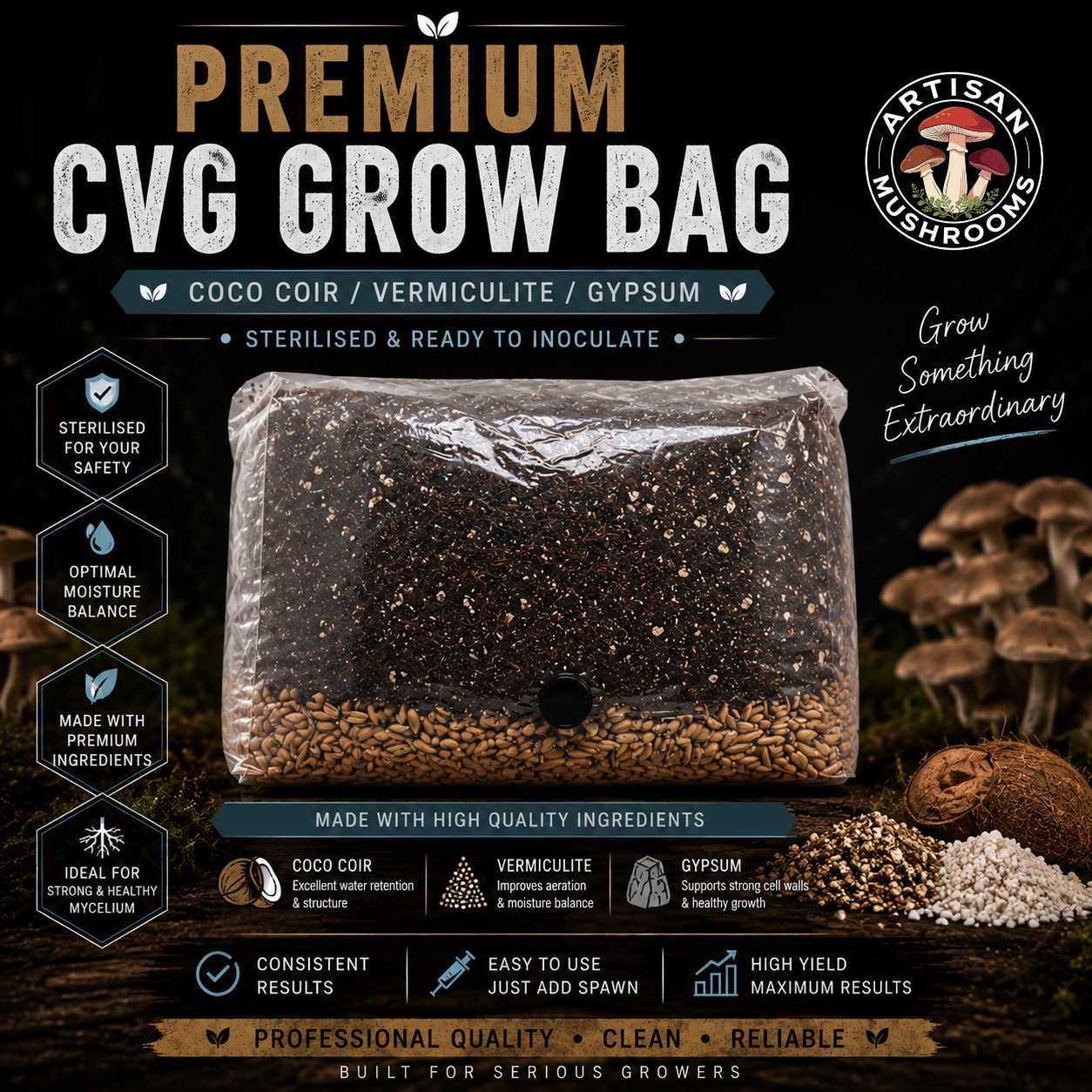
Sterile CVG Mushroom Grow Bag

Sterilised Bulk CVG Substrate FAQ
What is CVG substrate?
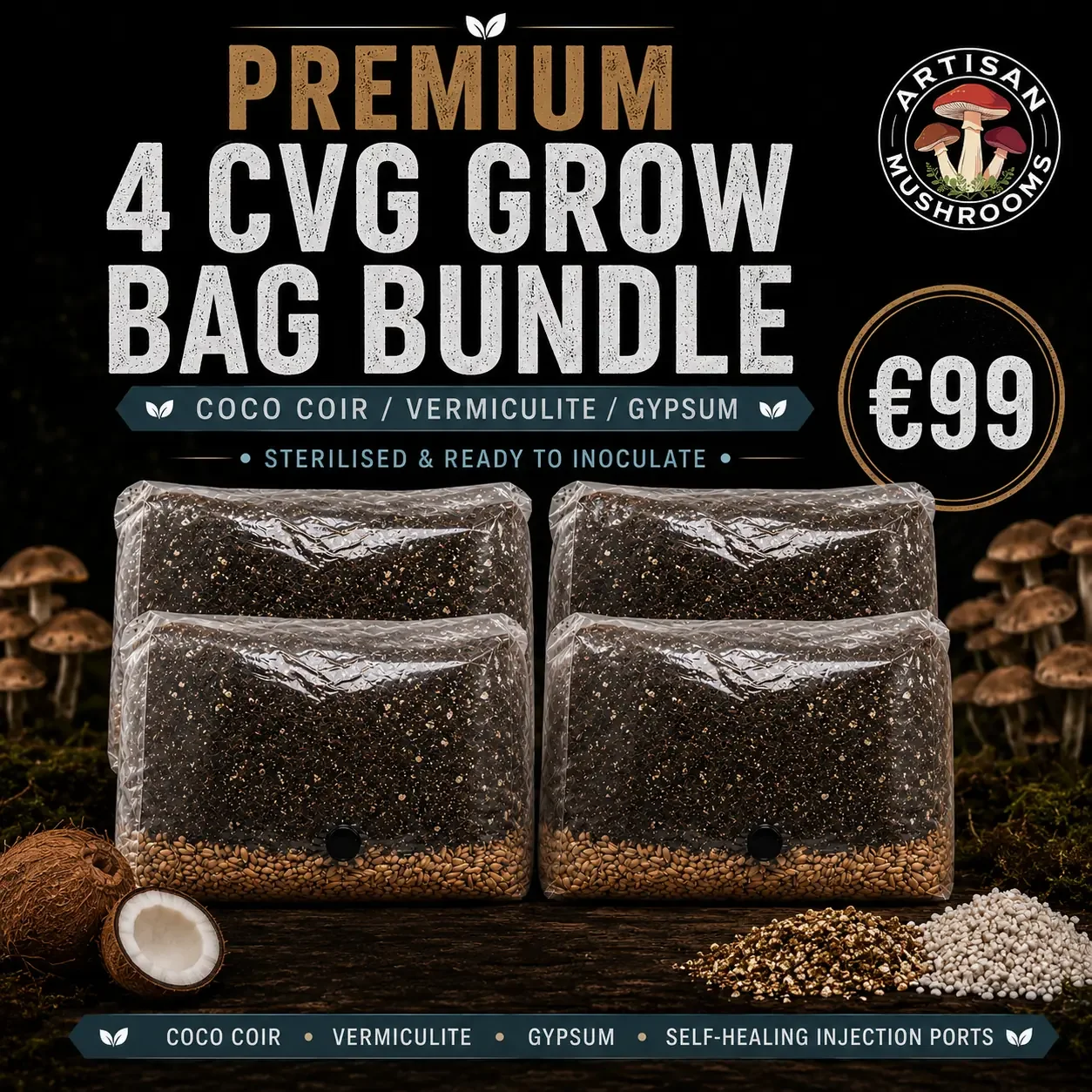
CVG is a mushroom-growing substrate made from:
Coco coir
Vermiculite
Gypsum
Coco coir forms the main body of the substrate and retains moisture.
Vermiculite improves water retention and creates air spaces throughout the mixture.
Gypsum provides calcium and sulphur while helping maintain a loose, workable substrate structure.
Our CVG is professionally hydrated, pressure sterilised and sealed, removing the need to prepare and sterilise the mixture yourself.
What is included in each bag?
Each bag contains approximately 2 kg of prepared CVG substrate.
The mixture includes:
Hydrated coco coir
Vermiculite
Gypsum
The substrate is supplied without grain spawn, liquid culture or mushroom mycelium.
A suitable mushroom culture and fully colonised grain spawn must be obtained separately.
Is the CVG ready to use?
Yes. The CVG arrives:
Properly mixed
Hydrated
Pressure sterilised
Sealed
Ready to combine with colonised grain spawn
You do not need to add water, vermiculite or gypsum before use.
Open the bag only when your grain spawn is fully colonised and you are ready to prepare the growing container.
Is the CVG sterilised or pasteurised?
Our CVG is pressure sterilised.
Sterilisation significantly reduces the microorganisms present in the substrate, providing a clean starting environment for mushroom cultivation.
The substrate must still be handled carefully after opening. Exposure to unclean hands, tools, surfaces or air can introduce mould spores and bacteria.
Sterilised substrate is not permanently protected once the bag has been opened.
Does the CVG contain mushroom culture?
No. The CVG contains prepared substrate only.
It does not contain:
Mushroom liquid culture
Mushroom spores
Grain spawn
Living mycelium
A pre-established mushroom culture
You will need to mix the substrate with fully colonised grain spawn before using it as a bulk fruiting substrate.
Browse our selection of mushroom liquid cultures if you need a culture to produce your own grain spawn.
Can I inject liquid culture directly into CVG?
Injecting liquid culture directly into bulk CVG is not the recommended method.
CVG contains very little readily available nutrition compared with sterilised grain. A small amount of liquid culture would also create only a limited number of inoculation points throughout the substrate.
The recommended process is:
Use liquid culture to inoculate sterilised grain.
Allow the grain to become fully colonised.
Break up the colonised grain spawn.
Mix the grain spawn evenly throughout the CVG.
Allow the mixture to colonise before fruiting conditions are introduced.
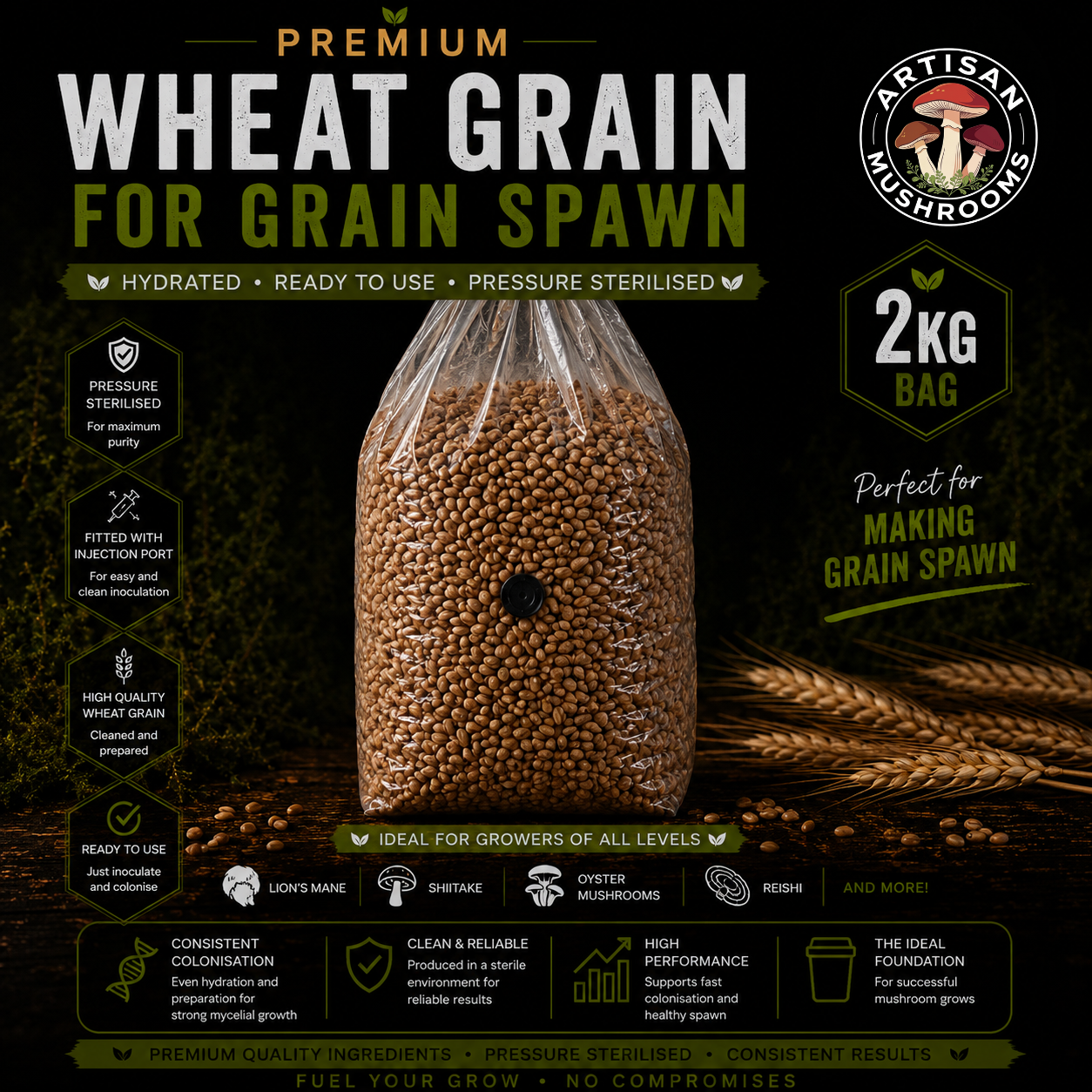
Our 2kg Sterilised Wheat Grain Bag can be inoculated directly with a suitable liquid culture.
Why should I use grain spawn with CVG?
Grain spawn provides the established mycelium and much of the nutrition required for colonisation.
Each colonised grain becomes an individual growth point after it is mixed throughout the CVG.
This provides:
Faster colonisation
More even mycelial distribution
Greater nutritional support
Reduced opportunity for competing organisms
More consistent use of the bulk substrate
CVG helps maintain moisture, structure and aeration around the colonised grain.
The two materials perform different roles and are normally used together.
Can I use an uncolonised grain bag with CVG?
No. Grain should be fully colonised before it is mixed with CVG.
Uncolonised grain is highly nutritious and vulnerable to contamination. If it is mixed into an open bulk substrate before the mushroom mycelium has established, mould or bacteria may colonise it first.
Fully colonised grain should show healthy species-appropriate mycelium throughout the bag with no large uncolonised sections.
Do not use grain that appears:
Slimy
Sour-smelling
Excessively wet
Green, black, pink or unusually coloured
Partially colonised
Contaminated
Which gourmet mushrooms can be grown using CVG?
CVG can be used experimentally as a bulk substrate or moisture-retaining component for selected saprotrophic mushroom species.
Some Oyster mushroom cultures may colonise a coir-based bulk substrate when it is mixed with a generous amount of healthy grain spawn.
Potential experimental options include:
Pearl Oyster
Blue Oyster
Phoenix Oyster
Pink Oyster
Golden Oyster
King Oyster
Black Pearl Oyster
King Blue Oyster
Tarragon Oyster
However, Oyster mushrooms generally perform more predictably on straw, hardwood sawdust or another lignocellulosic substrate containing more usable plant fibre.
CVG should not automatically be treated as the best substrate for every gourmet mushroom species.
Is CVG suitable for Portobello mushrooms?
CVG can be used as a casing layer for Portobello mushrooms.
Portobello, Agaricus bisporus, should first colonise a properly prepared compost-based substrate.
Once the compost is colonised, a layer of hydrated CVG can be applied over the surface to:
Retain moisture
Support pin formation
Protect the compost surface
Maintain a humid microclimate
Provide physical support for developing mushrooms
CVG does not replace the nutrient-rich mushroom compost underneath.
Our Portobello Liquid Culture can be expanded on sterilised grain before the grain spawn is transferred to properly prepared compost.
How thick should a Portobello casing layer be?
A practical starting depth is approximately 3 to 4 cm of loosely applied CVG.
The casing should be:
Evenly distributed
Moist but not waterlogged
Loose enough to maintain air spaces
Lightly levelled
Free from heavy compression
Do not mix the casing deeply into the compost.
The casing layer sits above the colonised compost and serves a different purpose from the main nutritional substrate.
Is CVG suitable for Lion’s Mane?
CVG is not the recommended primary substrate for Lion’s Mane.
Lion’s Mane is a hardwood-decaying species and performs more predictably on supplemented hardwood sawdust.
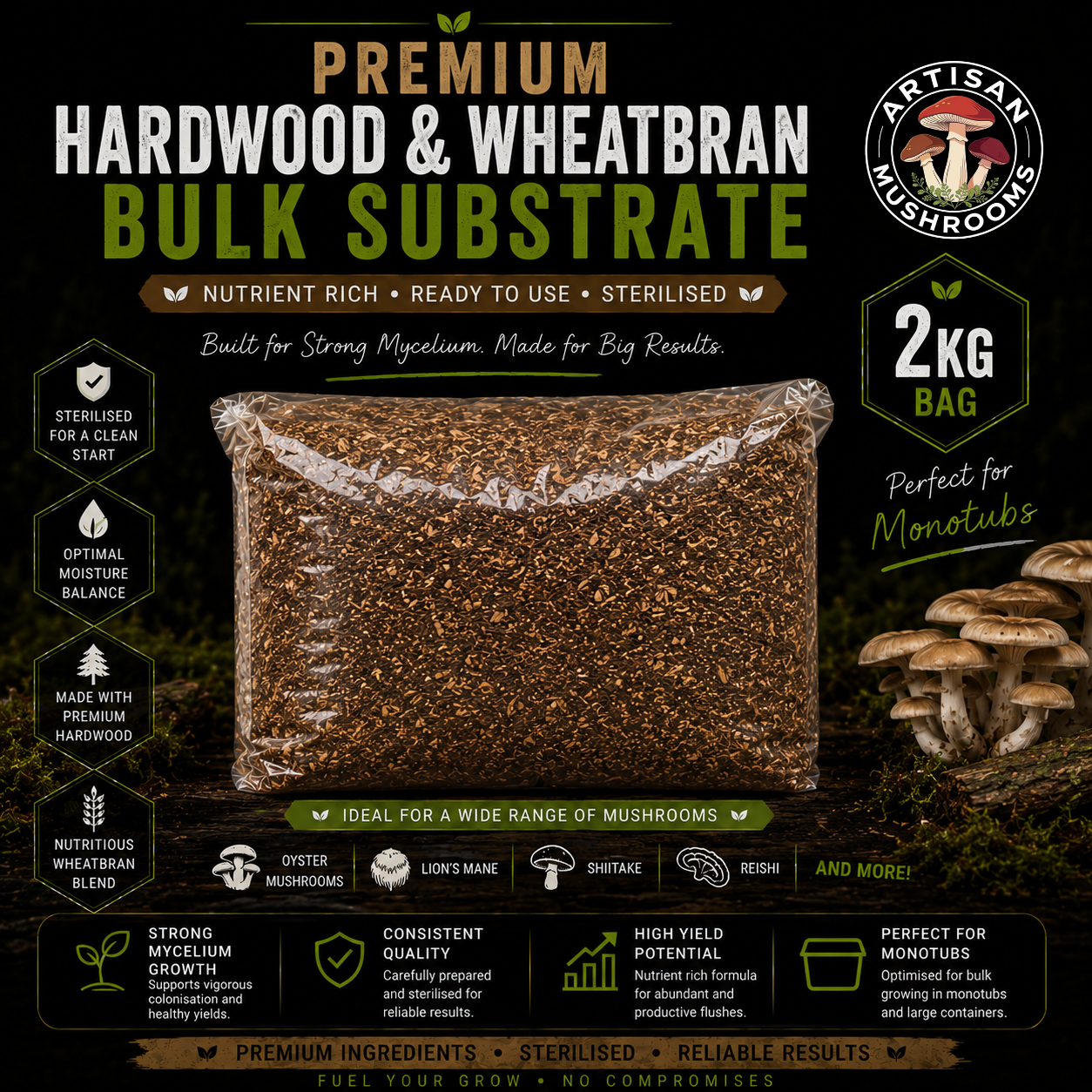
For Lion’s Mane and related Hericium species, use our:
These products provide the woody material and nutrition preferred by Lion’s Mane mycelium.
Is CVG suitable for Shiitake?
CVG is not the recommended primary substrate for Shiitake.
Shiitake is a hardwood-decaying species that is normally cultivated on supplemented hardwood sawdust or hardwood logs.
A CVG mixture does not provide the same woody nutrition or structure.
Use our Sterilised Hardwood and Wheat Bran Substrate or Sterile Hardwood Mushroom Grow Bag for Shiitake cultivation.
Is CVG suitable for Chestnut, Maitake, Enoki or Reishi?
CVG is not the preferred primary substrate for Chestnut, Maitake, Enoki or Reishi mushrooms.
These species are naturally adapted to woody materials and generally perform better on:
Hardwood sawdust
Supplemented hardwood substrate
Hardwood pellets
Appropriate logs
Other species-specific woody media
For these species, our 2kg Sterilised Hardwood and Wheat Bran Substrate is the more appropriate option.
Is CVG suitable for Wine Cap?
CVG should not be used as the main substrate for Wine Cap or Golden Wine Cap.
Wine Cap mushrooms perform best in outdoor beds containing:
Hardwood chips
Straw
Hardwood mulch
A mixture of chips and straw
Other suitable plant-based materials
CVG may retain moisture, but it does not provide the same long-term woody nutrition as hardwood chips or straw.
Is CVG suitable for Chanterelles or Hedgehog mushrooms?
No. CVG cannot replace the living host tree required by Chanterelles and Hedgehog mushrooms.
These are mycorrhizal species that must establish a relationship with suitable living tree roots before mushroom production can occur.
CVG can retain moisture, but it cannot provide the biological root association required by these fungi.
Is CVG suitable for Chicken of the Woods?
CVG is not the recommended substrate for Chicken of the Woods.
Chicken of the Woods is a wood-decaying species that requires hardwood-based material such as:
Hardwood sawdust
Hardwood chips
Dense hardwood blocks
Dead hardwood logs
Supplemented hardwood substrate
CVG lacks the woody structure and nutrition preferred by this species.
Can I mix CVG with hardwood substrate?
Yes, but the usefulness of the mixture depends on the mushroom species.
Adding a small amount of CVG to a hardwood-based substrate may increase water retention and change its texture.
However, adding too much can dilute the hardwood and reduce the amount of suitable nutrition available to wood-decaying mushrooms.
For hardwood-loving species, the main substrate should remain hardwood-based.
Any experimental mixture containing nutrient supplements should be properly sterilised before inoculation.
Can I mix CVG with straw?
Yes. CVG can be mixed with prepared straw as an experimental moisture-retaining component.
The straw supplies plant fibre and structure, while the CVG can help retain water.
The straw should be:
Clean
Properly hydrated
Suitably pasteurised or sterilised
Cooled completely before inoculation
Free from visible mould
The correct ratio will depend on the mushroom species and cultivation method.
For Oyster mushrooms, straw alone or straw combined with hardwood may provide a more predictable substrate than a mixture dominated by CVG.
Can CVG be used as a casing layer for other mushrooms?
CVG can be used experimentally as a casing layer for species that benefit from a moist, non-nutritious surface layer.
A casing layer can help:
Maintain surface moisture
Protect the colonised substrate
Create a humid pinning environment
Support developing mushrooms
Reduce rapid surface drying
Not every mushroom species requires casing.
Oyster mushrooms, Lion’s Mane, Shiitake and Reishi normally fruit directly from their colonised substrate without a CVG casing layer.
What type of container should I use?
CVG can be used in a clean monotub, shoebox-style container or another suitable bulk-growing container.
The container should:
Be clean
Be large enough for the substrate and grain spawn
Allow controlled gas exchange
Retain humidity
Have sufficient depth for the substrate
Be easy to inspect without unnecessary opening
Be suitable for the selected mushroom species
Avoid containers that have previously held chemicals, cleaning agents or unsafe materials.
How should I clean the growing container?
Wash the container thoroughly before use.
A basic cleaning process is:
Remove visible dirt and organic material.
Wash the container with warm water and detergent.
Rinse it thoroughly.
Allow it to dry.
Wipe the interior and lid with a suitable disinfectant.
Allow the disinfectant to evaporate before adding the substrate.
Handle the clean interior as little as possible.
Clean the surrounding working surface and wash your hands before mixing the CVG and grain spawn.
How do I mix colonised grain with CVG?
Prepare the growing container before opening either bag.
A practical process is:
Clean your hands, tools, container and working surface.
Confirm that the grain spawn is fully colonised and healthy.
Break up the grain inside its sealed bag.
Open the CVG only when ready to use it.
Add part of the CVG to the clean container.
Add the colonised grain spawn.
Mix the grain evenly throughout the substrate.
Add the remaining CVG.
Level the surface without compressing it heavily.
Close the container and allow colonisation to begin.
Even grain distribution helps the mycelium spread through the complete substrate.
How much grain spawn should I use?
The amount of grain spawn required depends on:
Mushroom species
Container size
Amount of CVG
Grain-spawn quality
Incubation temperature
Desired colonisation speed
Contamination risk
Using more healthy grain spawn creates more inoculation points and usually results in faster colonisation.
A low spawn rate may take longer to colonise and gives competing organisms more time to establish.
For experimental gourmet cultivation, a generous amount of fully colonised grain spawn is generally more reliable than adding only a small quantity.
Can one 2 kg CVG bag be mixed with one 2 kg grain bag?
Yes, one 2 kg CVG bag can be combined with a fully colonised 2 kg grain bag for a relatively high spawn rate.
A high spawn rate can provide:
Rapid colonisation
Numerous inoculation points
Strong nutritional support
Reduced time before the substrate is fully colonised
However, the ideal ratio depends on the selected mushroom species and the growing container.
Do not use a grain bag that is only partly colonised.
Should I use a separate top layer of CVG?
A thin top layer of CVG can be applied after the grain and substrate have been mixed.
This helps cover exposed grains and may reduce surface drying.
A practical method is:
Mix most of the CVG evenly with the grain spawn.
Level the mixture gently.
Apply a thin layer of remaining CVG over the surface.
Cover all exposed grain.
Avoid compacting the top layer.
A separate casing layer may later be applied when using CVG for Portobello cultivation.
Should I compress the substrate?
The substrate should be levelled and gently settled, but not heavily compacted.
Heavy compression can:
Reduce air spaces
Slow colonisation
Create poorly aerated areas
Cause uneven moisture distribution
Encourage bacterial problems
Make it harder for the mycelium to spread
Lightly press the edges and surface only enough to create an even substrate depth.
The mixture should remain loose and airy.
How deep should the bulk substrate be?
A practical starting depth for many container-based grows is approximately 7 to 10 cm.
The ideal depth depends on:
Container dimensions
Mushroom species
Amount of grain spawn
Amount of CVG
Moisture requirements
Fruiting method
A very shallow substrate may dry quickly.
An excessively deep substrate can generate additional heat and may take longer to colonise.
Keep the depth as even as possible across the container.
Does the CVG need additional water?
The CVG arrives hydrated and ready to use.
Do not automatically add water before mixing it with grain spawn.
Excess water can create:
Waterlogged substrate
Poor aeration
Slow mycelial growth
Bacterial contamination
Pooling at the bottom of the container
Stalled colonisation
If the sealed bag has been stored for an unusually long period and appears dry, assess it carefully before use rather than adding an unmeasured amount of water.
What does properly hydrated CVG feel like?
Properly hydrated CVG should feel evenly moist without dripping heavily.
When a handful is squeezed firmly, it may produce only a small amount of water.
The substrate should not be:
Muddy
Soupy
Dusty
Completely dry
Saturated
Dripping continuously
Surrounded by standing water
The coir and vermiculite should remain loose enough to maintain air spaces.
What should I do if the CVG seems too wet?
Do not add wet CVG to a growing container if water is visibly pooling or pouring from the substrate.
Excessive moisture increases the risk of bacterial contamination and reduces oxygen within the mixture.
If the sealed product appears unusually wet or damaged when received, photograph it and contact us before opening or using it.
Do not attempt to dry sterilised CVG by leaving it exposed to room air, as this can introduce contamination.
What should I do if the CVG seems too dry?
The product should arrive properly hydrated.
If the unopened bag appears unusually dry, inspect it for:
A damaged seal
A puncture
Prolonged storage
Excessive air loss
Dry or hardened sections
Contact us before using a bag that appears damaged or significantly dried.
Adding unsterilised water directly to sterile CVG can introduce contamination.
What conditions are needed during colonisation?
The ideal colonisation conditions depend on the mushroom species.
A practical general starting range for many gourmet cultures is:
Temperatures of approximately 20°C to 25°C
A clean and stable environment
No direct sunlight
Controlled gas exchange
Minimal disturbance
Consistent substrate moisture
Some warm-growing species may prefer higher temperatures, while cool-growing cultures may perform better below this range.
The substrate can become warmer than the surrounding room as the mycelium grows.
A digital thermometer and hygrometer can help monitor the growing environment.
Does the container need to be kept in darkness?
Complete darkness is not normally required.
Low ambient light or ordinary indirect room light is acceptable during colonisation for many gourmet mushroom species.
Avoid direct sunlight because it can:
Overheat the container
Dry the substrate
Create excessive condensation
Cause major temperature fluctuations
Stable temperature and cleanliness are more important than complete darkness.
How long does CVG take to colonise?
Colonisation time depends on:
Mushroom species
Spawn ratio
Grain-spawn health
Temperature
Substrate depth
Container design
Moisture content
Gas exchange
Contamination levels
Visible growth may begin within several days.
A high spawn rate may allow substantial colonisation within one to three weeks, while slower-growing species or lower spawn rates can take longer.
Do not introduce fruiting conditions based only on a fixed number of days.
Assess the actual condition of the substrate.
What does healthy colonisation look like?
Healthy mycelium is generally white or cream-coloured.
Depending on the species, it may appear:
Fine and thread-like
Cotton-like
Dense and solid
Rope-like
Patchy during early growth
Evenly spread across the surface
Visible along the sides of the container
Healthy growth should gradually spread from the colonised grains into the surrounding CVG.
Unusual green, black, pink or foul-smelling growth may indicate contamination.
Should I mix or disturb the substrate during colonisation?
No. Once the colonised grain and CVG have been mixed and placed in the container, leave the substrate undisturbed.
Mixing during colonisation can:
Break the developing mycelial network
Introduce contaminants
Delay recovery
Cause uneven moisture
Compact the substrate
Damage developing fruiting structures
Inspect the container from the outside whenever possible.
Avoid repeatedly removing the lid.
When should fruiting conditions be introduced?
Fruiting conditions should be introduced after the substrate is sufficiently colonised for the selected species.
Signs may include:
Mycelium visible across most of the substrate
The mixture becoming held together
No large uncolonised sections
Clean, healthy growth
No spreading contamination
Species-appropriate maturation
Some species benefit from additional consolidation after visible colonisation.
Fruiting too early can leave uncolonised material exposed and increase contamination risk.
What fruiting conditions are required?
Fruiting requirements vary by mushroom species.
Most gourmet species require some combination of:
Fresh-air exchange
High humidity
Species-appropriate temperature
Gentle indirect light
A fully colonised substrate
Controlled evaporation from the surface
A practical humidity range during early pin formation is often approximately 85% to 95%.
Oyster mushrooms require frequent fresh-air exchange. Portobello cultivation requires cooler conditions after casing and careful moisture management.
Follow the requirements of the specific mushroom culture being grown.
Should I mist the CVG surface?
Mist only when the surface requires additional moisture.
Use a fine mist rather than pouring water directly onto the substrate.
The surface should appear moist without developing puddles.
Excessive misting can cause:
Water pooling
Matted mycelium
Bacterial damage
Stalled pin formation
Overly wet substrate
Mushroom damage
Once mushrooms begin developing, avoid repeatedly spraying them directly.
Maintain humidity in the growing environment instead.
Why are there water droplets on the container walls?
Condensation can form when the temperature inside the colonising container differs from the surrounding air.
Growing mycelium produces heat, and moisture may collect against the cooler container walls.
A moderate amount of condensation can be normal.
Heavy water pooling may indicate:
Excess substrate moisture
Large temperature changes
Insufficient gas exchange
Excessive misting
An overheating substrate
Bacterial activity
The surface condition of the substrate is more informative than condensation alone.
Why is the substrate not colonising?
Possible causes include:
Grain spawn that was not fully colonised
Weak or contaminated grain spawn
Unsuitable mushroom species
Temperatures that are too high or low
CVG that is excessively wet
Insufficient grain spawn
Poor gas exchange
Bacterial contamination
Grain that dried before mixing
Damaged or weakened mushroom culture
Check whether healthy growth is visible around the individual grains.
Do not add liquid culture to a stalled open container. This can introduce more moisture without correcting the underlying problem.
How can I recognise contamination?
Possible contamination signs include:
Green mould
Black mould
Pink or red growth
Rapidly spreading grey mould
Slimy areas
Sour or fermented smells
Rotten odours
Pooling liquid with stalled growth
Uncolonised grain becoming wet or discoloured
Mushroom mycelium stopping abruptly around another organism
Some mushroom species naturally produce cream, yellow or amber pigmentation, so colour alone should not always be used for diagnosis.
When uncertain, isolate the container from other cultivation projects.
What should I do with a contaminated container?
Do not open a heavily contaminated container inside the home or growing area.
Opening it can release mould spores.
A safer process is:
Keep the lid closed.
Move the container away from clean cultures.
Take it outdoors if it must be opened.
Dispose of heavily contaminated substrate safely.
Clean and disinfect the container before reuse.
Clean the surrounding shelf and work area.
Wash your hands after handling it.
Do not attempt to remove one visible patch of mould and continue the grow. Contamination may already be present throughout the substrate.
Can unused CVG be resealed and stored?
Opening the sterile bag exposes the remaining substrate to airborne microorganisms.
For the best results, use the full bag after opening.
If some substrate remains:
Handle it as little as possible.
Reseal the bag immediately.
Store it in a cool, clean location.
Use it promptly.
Do not assume that it remains sterile.
Inspect it carefully before use.
Dividing the bag across several projects increases the chance of contamination.
How should an unopened CVG bag be stored?
Store the sealed bag in a cool, clean and dry location away from direct sunlight.
Avoid:
Freezing
High temperatures
Radiators
Hot vehicles
Direct sunlight
Sharp objects
Compression that may damage the seal
Excessive handling
Use the substrate as soon as reasonably possible after delivery for the best results.
Does the CVG need refrigeration?
Refrigeration is not normally required when the sealed substrate will be used promptly.
Store it at a cool and stable room temperature.
Do not freeze the bag.
If the bag has been stored in a cool location, allow it to return to the appropriate cultivation temperature before mixing it with colonised grain.
Can the substrate be sterilised again?
Re-sterilising the substrate is not normally necessary or recommended.
A second sterilisation cycle can:
Alter moisture content
Compress the mixture
Damage the packaging
Change the physical structure
Create excessively wet or dry areas
Use the substrate directly from the sealed bag.
If the bag has been opened, damaged or contaminated, re-sterilising it does not guarantee that it will perform as originally intended.
Can the CVG be reused after a grow?
Spent CVG should not be sterilised and reused for a new indoor cultivation project.
After the growing cycle is complete, healthy spent substrate can be:
Added to a compost heap
Mixed into garden soil
Used as organic matter
Added beneath outdoor mulch
Used in an experimental outdoor mushroom bed
Spread around ornamental plants
Remove any plastic or non-compostable material first.
Do not reuse heavily contaminated substrate in an indoor growing space.
Can spent CVG produce additional mushrooms outdoors?
A healthy spent substrate may occasionally produce additional mushrooms when placed outdoors under suitable conditions.
It can be:
Buried beneath mulch
Added to a shaded compost area
Mixed with suitable fresh plant material
Placed beneath shrubs
Added to an outdoor mushroom bed
Outdoor fruiting depends on:
Mushroom species
Remaining nutrition
Weather
Rainfall
Temperature
Competition from other organisms
Substrate moisture
Additional mushrooms cannot be guaranteed.
Is CVG suitable for beginners?
Yes. Prepared CVG removes several substrate-preparation steps and can simplify bulk mushroom cultivation.
You do not need to:
Measure coco coir
Measure vermiculite
Add gypsum
Calculate hydration
Mix the ingredients
Load the substrate into a bag
Pressure sterilise it
Cool it before use
However, the grower must still produce clean, fully colonised grain spawn and provide suitable conditions for the selected mushroom species.
Is successful mushroom production guaranteed?
No substrate can guarantee successful mushroom production.
Results depend on:
The mushroom species
Grain-spawn health
Culture genetics
Clean handling
Spawn ratio
Temperature
Humidity
Fresh-air exchange
Lighting
Container design
Fruiting conditions
Contamination control
The CVG provides a prepared growing medium, but mushroom cultivation involves living organisms and environmental variables.
Where is the CVG prepared and shipped from?
Our Sterilised Bulk CVG Substrate is prepared, hydrated, pressure sterilised and sealed in Ireland.
Each order contains one 2 kg bag of prepared coco coir, vermiculite and gypsum substrate.
Fast shipping is available to customers across Ireland, the UK, Europe, the United States and Canada.