 Image 1 of 3
 Image 2 of 3
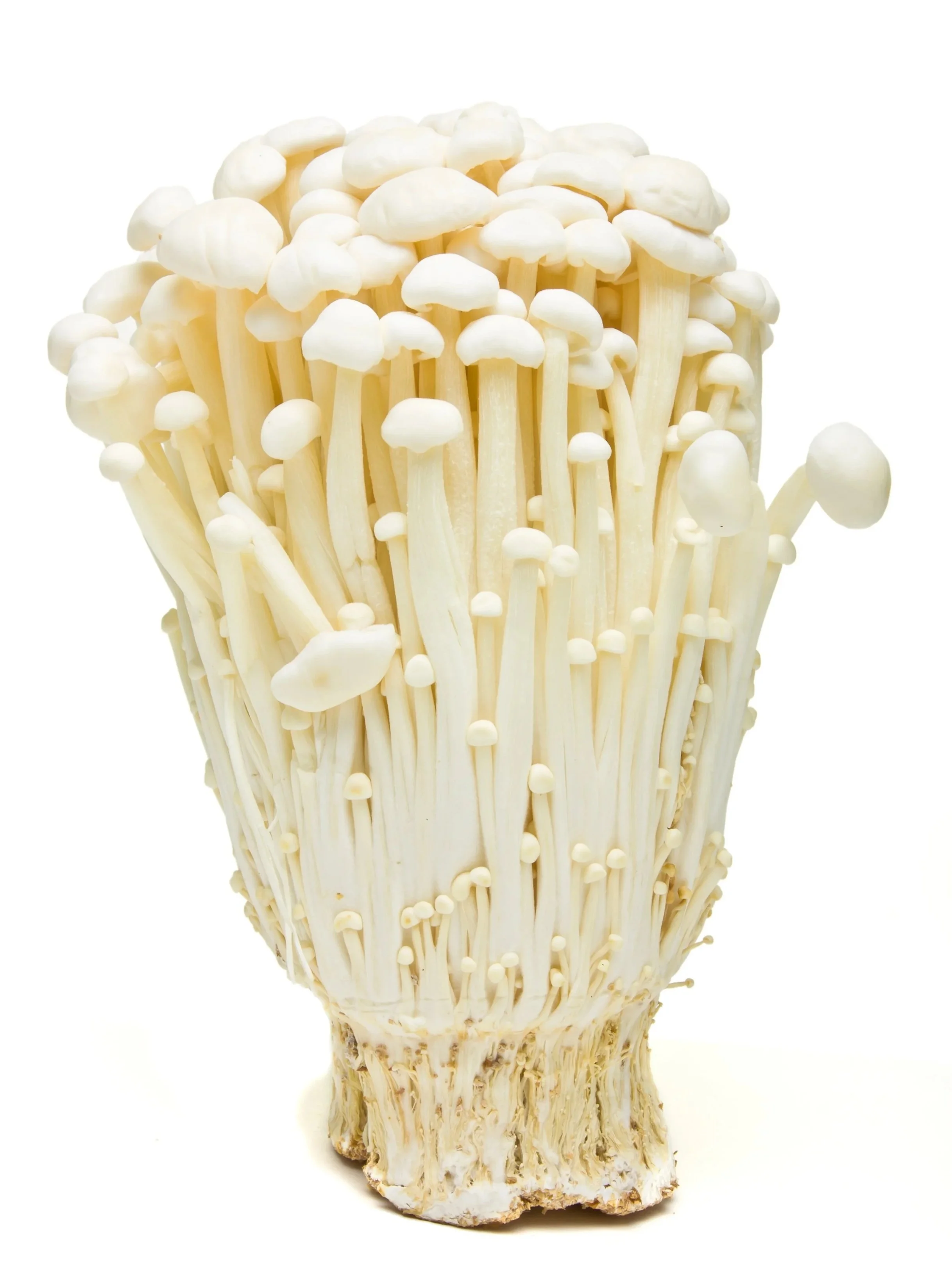 Image 3 of 3
Enoki Mushroom Liquid Culture FAQ
What is the scientific name of Enoki Mushroom?
The scientific name for cultivated Enoki Mushroom is Flammulina filiformis.
Enoki is also commonly known as Enokitake, Golden Needle Mushroom or Velvet Shank.
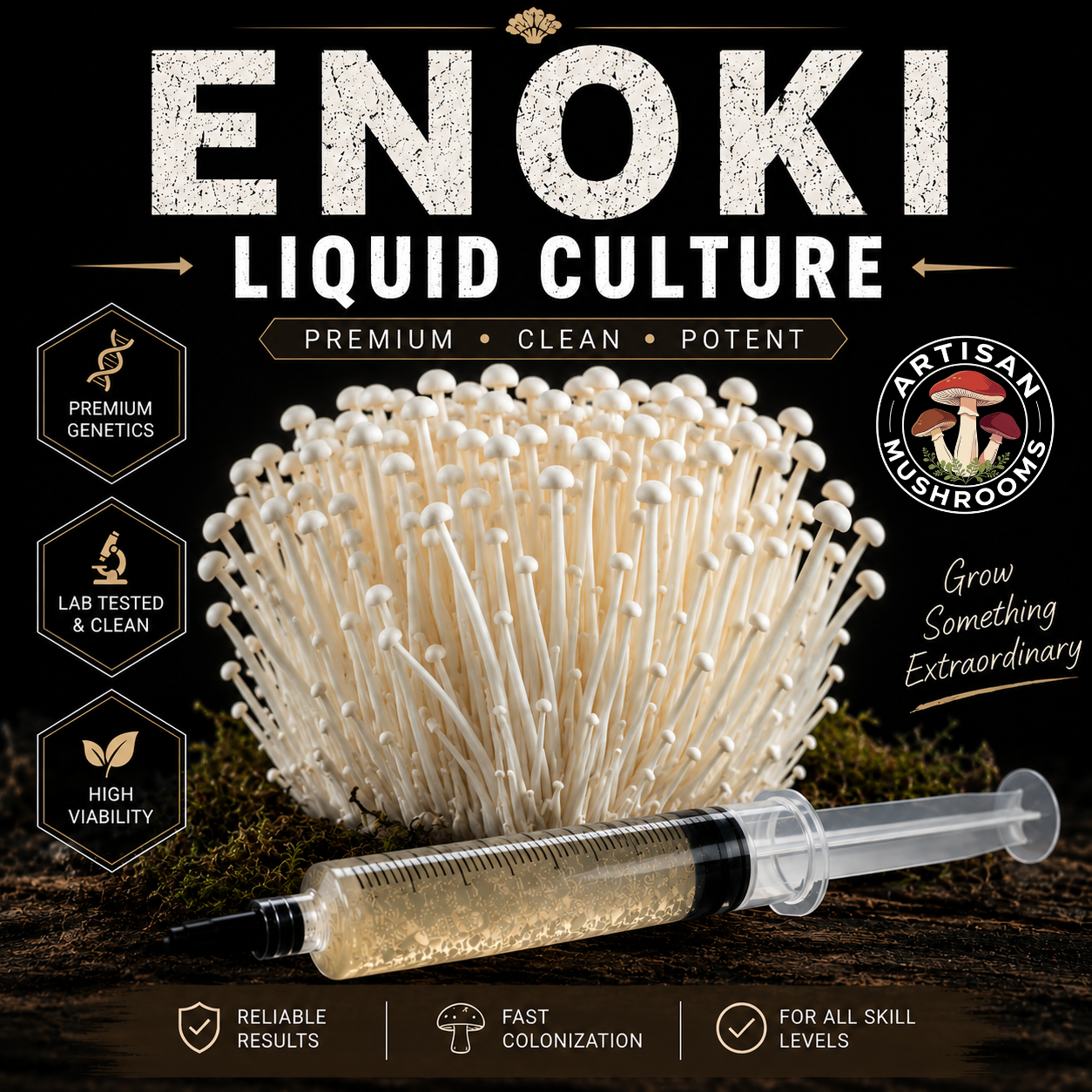
Cultivated Enoki typically produces dense clusters of long, slender white stems with small rounded caps. Its distinctive appearance is created through a combination of strain genetics, cool fruiting temperatures, low light and elevated carbon dioxide.
Wild forms usually look very different. They often produce shorter stems and larger yellow, orange-brown or caramel-coloured caps.
Is Enoki the same as Flammulina velutipes?
Cultivated Asian Enoki was historically identified as Flammulina velutipes, and this older scientific name is still widely used in cultivation guides and product descriptions.
Modern genetic research separates the commonly cultivated Asian Enoki as Flammulina filiformis. The name Flammulina velutipes is now more commonly applied to the closely related European Velvet Shank.
Our Enoki liquid culture is identified as Flammulina filiformis.
Why does cultivated Enoki look different from wild Enoki?
Commercially cultivated Enoki is grown under specially controlled conditions that encourage long white stems and small caps.
These conditions normally include:
Cool fruiting temperatures
Low light
Elevated carbon dioxide
Restricted fresh-air exchange
A tall collar around the developing mushrooms
Dense clusters growing from a small opening
Wild Enoki receives natural daylight and unrestricted fresh air. This produces shorter stems, wider caps and stronger yellow, orange or brown colouring.
Both forms can be normal for the species. The final appearance is strongly influenced by the growing environment.
What substrate is best for growing Enoki?
Enoki grows particularly well on sterilised sawdust-based substrates.
Suitable materials include:
Hardwood sawdust
Hardwood pellets
Oak sawdust
Beech sawdust
Poplar sawdust
Alder sawdust
Mixed deciduous hardwood sawdust
Hardwood sawdust supplemented with wheat bran
Sawdust supplemented with rice bran
Suitable plant-based substrate blends
A nutrient supplement such as wheat bran can support vigorous colonisation and mushroom production.
Supplemented sawdust should be fully sterilised because the additional nutrition makes it more vulnerable to mould and bacterial contamination.
Our 2kg Sterilised Hardwood and Wheat Bran Substrate provides a prepared substrate suitable for Enoki cultivation.
Can I inoculate a hardwood grow bag directly?
Yes. Enoki liquid culture can be injected directly into our Sterile Hardwood Mushroom Grow Bag.
The bag contains sterilised hardwood substrate supplemented with wheat bran and includes a self-healing injection port and filter patch.
After inoculation, keep the bag sealed while the Enoki mycelium colonises the substrate.
Direct inoculation is the simplest option for growers who do not want to produce separate grain spawn.
Producing grain spawn first may provide faster and more even colonisation because each colonised grain creates an additional inoculation point throughout the hardwood substrate.
Can Enoki liquid culture be used on grain?
Yes. Sterilised grain is commonly used to expand Enoki mycelium before transferring it to a sawdust-based fruiting substrate.
The liquid culture can be injected into our 2kg Sterilised Wheat Grain Bag.
Allow the grain to become fully colonised before mixing it with our 2kg Sterilised Hardwood and Wheat Bran Substrate.
Grain is normally used as an expansion medium rather than as the complete Enoki fruiting substrate.
Fully colonised grain spawn helps distribute the mycelium evenly throughout the final sawdust substrate and may shorten the block-colonisation period.
Do you sell sterilised grain and hardwood substrate?
Yes. We offer pre-sterilised wheat grain bags, sterilised hardwood and wheat bran substrate, and ready-to-inoculate hardwood grow bags.
Using prepared grain and substrate removes the need to hydrate, mix and pressure sterilise the growing media yourself.
A typical grain-to-sawdust cultivation process is:
Inoculate a pre-sterilised wheat grain bag with Enoki liquid culture.
Allow the grain to become fully colonised.
Mix the colonised grain spawn with sterilised hardwood and wheat bran substrate.
Allow the hardwood substrate to become completely colonised.
Give the block additional time to consolidate.
Reduce the temperature to encourage pin formation.
Open the top of the bag or provide a controlled top-fruiting opening.
Fit or retain a tall collar around the developing cluster.
Maintain cool temperatures, high humidity, low light and restricted fresh-air exchange.
Harvest while the stems remain firm and the caps are still small.
Alternatively, inject the liquid culture directly into our Sterile Hardwood Mushroom Grow Bag.
Is Enoki suitable for beginners?
Enoki can be grown by beginners, but producing the familiar long, thin commercial form requires more environmental control than growing Oyster mushrooms.
The main requirements are:
Clean inoculation
Complete substrate colonisation
A substantial reduction in temperature
High humidity during pin formation
A narrow fruiting area
A tall collar around the cluster
Low light
Carefully restricted fresh-air exchange
Patience during slow, cool fruiting
Growers without a cool fruiting area may successfully colonise the substrate but struggle to produce mushrooms.
Enoki may also develop shorter stems and wider caps when grown in ordinary fresh-air conditions. These mushrooms can still be healthy even though they do not resemble supermarket Enoki.
How should I store the liquid culture?
Keep the Enoki liquid culture syringe refrigerated at approximately 2°C to 4°C until you are ready to use it.
Do not freeze it.
For the best viability, use the culture within three months of receiving it.
Before inoculation, allow the syringe to move closer to room temperature and shake it gently to distribute the Enoki mycelium throughout the nutrient solution.
Keep the protective cap fitted during storage. Attach a new sterile needle immediately before inoculating grain, agar or a hardwood grow bag.
How much liquid culture should I use?
The amount of Enoki liquid culture required depends on the size and type of growing medium.
For one of our sterile LME agar plates, one or two small drops are normally sufficient.
A small grain jar may require approximately 1 to 2 ml.
When inoculating our 2kg Sterilised Wheat Grain Bag or Sterile Hardwood Mushroom Grow Bag, approximately 5 to 10 ml can be used.
Using too much liquid culture can introduce excess moisture into the grain or substrate and increase the risk of bacterial contamination.
Does the syringe contain mushroom spores?
No. Enoki liquid culture contains living Flammulina filiformis mycelium suspended in a sterile nutrient solution.
It is not a mushroom spore solution.
Because the mycelium is already actively growing, liquid culture can begin colonising a suitable medium without waiting for spores to germinate.
The culture can be used to inoculate sterilised grain, hardwood substrate or a sterile LME agar plate.
Can I test Enoki liquid culture on agar?
Yes. Testing the culture on agar allows you to observe the mycelium before inoculating a larger grain or substrate bag.
Place one or two small drops onto one of our sterile LME agar plates.
Keep the plate sealed and monitor the mycelium as it spreads from the inoculation point.
Healthy Enoki mycelium is normally white or cream-coloured. It may appear fine, cotton-like or slightly rope-like as it develops.
Do not open a colonised agar plate outside a clean working environment. Exposure to ordinary room air can introduce mould spores and bacteria.
What conditions does Enoki need to colonise?
Enoki generally colonises well under moderate temperatures.
Suitable starting conditions include:
Temperatures of approximately 20°C to 25°C
Darkness or low ambient light
A clean and stable incubation area
Filtered gas exchange
No direct sunlight
Properly hydrated grain or substrate
Minimal disturbance during early colonisation
Approximately 22°C to 24°C is a practical starting range for home cultivation.
Avoid prolonged temperatures above approximately 27°C to 28°C. The centre of a large colonising bag may become warmer than the surrounding room because growing mycelium produces heat.
Leave space between bags so that excess heat can escape.
What does healthy Enoki mycelium look like?
Healthy Enoki mycelium normally appears white or cream-coloured.
As it colonises grain or hardwood substrate, it may develop:
Fine white strands
Cotton-like patches
Denser white areas
Rope-like growth
A white surface layer
Pale yellow or amber droplets
Mycelium growing upwards along the inside of the bag
Small yellow or amber droplets may be fungal metabolites and do not always indicate contamination.
Green, black, pink or foul-smelling growth may indicate mould or bacterial contamination.
A healthy colonised bag should smell earthy or mushroom-like rather than sour, fermented or rotten.
How long does Enoki take to colonise?
Colonisation time depends on temperature, inoculation rate, grain preparation, bag size, substrate density and culture vigour.
A grain bag may require approximately two to five weeks to become fully colonised.
A supplemented sawdust block may require approximately four to eight weeks or longer.
The visible outside of a block may become white before the centre is completely colonised. Allow sufficient time for the mycelium to spread throughout the complete substrate.
Enoki fruiting is slower under cool temperatures, so the total growing process may take considerably longer than a warm-growing Oyster mushroom crop.
Should I shake the grain bag during colonisation?
A grain bag can normally be mixed once approximately 20% to 30% of the grain has become colonised.
Breaking up and redistributing the colonised grains creates additional growth points and can help the remaining grain colonise more evenly.
Before mixing:
Confirm that the visible growth appears clean.
Check that there are no unusual mould colours.
Make sure the grain does not appear excessively wet.
Avoid mixing immediately after inoculation.
Handle the bag carefully to protect the filter patch.
After mixing, the visible mycelium may temporarily appear to disappear. Healthy growth should recover and spread again over the following days.
Do not repeatedly break up the bag once it is close to complete colonisation.
Does an Enoki block need a maturation period?
Yes. A fully colonised Enoki block can benefit from a short consolidation period before fruiting conditions are introduced.
During consolidation, the mycelium continues spreading through the centre of the substrate and building sufficient energy for mushroom production.
A mature block should:
Be colonised throughout
Feel firm and well held together
Contain no large loose sections
Contain no wet or uncolonised areas
Smell clean and mushroom-like
Show no spreading contamination
Allowing approximately one to two additional weeks after visible colonisation may help ensure that the interior of the block is fully established.
Does Enoki need a cold shock?
Enoki requires a noticeable reduction in temperature to encourage pin formation.
A freezing cold shock is not required.
A practical method is to move a fully colonised and consolidated block from a colonisation temperature of approximately 20°C to 25°C into a fruiting area of approximately 7°C to 15°C.
Some growers begin pin formation near the lower end of this range and then allow the mushrooms to develop at approximately 10°C to 16°C.
The exact response depends on the strain and substrate.
Do not freeze the block. Do not apply a cold shock to a partially colonised or contaminated substrate.
What conditions does Enoki need to fruit?
Enoki performs best under cool fruiting conditions.
Suitable starting conditions include:
Pinning temperatures of approximately 7°C to 12°C
Development temperatures of approximately 10°C to 16°C
Relative humidity of approximately 90% to 95% during pin formation
Relative humidity of approximately 85% to 92% during stem development
Low or diffused light
Restricted fresh-air exchange for long stems
Sufficient oxygen for continued growth
No direct sunlight
A stable and clean fruiting area
Enoki can fruit outside these ranges, but warmer conditions may result in weaker pinning, shorter stems, larger caps or reduced yields.
A digital thermometer and hygrometer can help monitor temperature and humidity throughout colonisation and fruiting.
Does Enoki require light?
Enoki benefits from a small amount of light during fruiting, but strong lighting is not required.
Low or diffused lighting helps produce the pale appearance associated with cultivated Enoki.
Suitable options include:
Dim indirect daylight
A low-intensity artificial light
A short daily lighting period
Light reaching the grow indirectly from elsewhere in the room
Strong or prolonged lighting can encourage stronger pigmentation and larger caps.
Complete darkness may still allow fruiting, but a small amount of light can help guide the direction of the developing cluster.
Avoid direct sunlight because it can overheat and dry the mushrooms.
How do I grow long, thin white Enoki mushrooms?
The familiar commercial Enoki shape is encouraged by combining several conditions.
Use the following approach:
Allow the substrate to colonise and consolidate fully.
Reduce the temperature to initiate pinning.
Fruit from a narrow opening at the top of the substrate.
Keep the developing mushrooms close together.
Place a tall collar around the cluster.
Maintain cool temperatures.
Provide only low or diffused light.
Restrict fresh-air exchange moderately.
Maintain high humidity without soaking the mushrooms.
Harvest before the caps expand significantly.
The collar traps some carbon dioxide around the mushrooms and encourages the stems to stretch upwards.
The environment should not be airtight. Enoki still requires oxygen and filtered gas exchange.
What can I use as an Enoki growing collar?
A clean collar can be made from:
The upper section of the grow bag
A clean polypropylene sleeve
A food-safe plastic sheet
A clean flexible container with the base removed
A reusable commercial Enoki collar
The collar should extend upwards around the developing mushrooms and remain open at the top.
It should be tall enough to encourage upward stem growth without pressing tightly against the cluster.
Clean and sanitise reusable collar materials before placing them around the mushrooms.
Avoid cardboard in a consistently humid fruiting area because it may absorb water, soften and develop mould.
How tall should the Enoki collar be?
A collar approximately 10 to 20 cm tall can provide a practical starting point for home cultivation.
The ideal height depends on:
The container or grow bag
The available vertical space
The Enoki strain
The desired stem length
The strength of the developing cluster
The fresh-air conditions
The collar can be added after pins begin forming or created by leaving the upper section of the grow bag standing around the substrate.
Do not allow the collar to collapse against the mushrooms.
How should the grow bag be opened for fruiting?
Enoki is normally top-fruited.
A practical method is:
Allow the hardwood block to colonise and consolidate completely.
Move it into cool fruiting conditions.
Open the top of the bag.
Leave the sides of the substrate covered.
Fold or arrange the upper plastic into a tall collar.
Maintain high humidity around the open top.
Keep light levels low.
Restrict fresh-air exchange sufficiently to encourage stem elongation.
Allow the cluster to grow upwards through the collar.
Avoid removing the complete plastic bag from the substrate. Keeping the sides covered helps retain moisture and directs fruiting towards the top.
Can Enoki be side-fruited?
Enoki can produce mushrooms from a side opening, but top fruiting is better suited to producing dense, upright clusters with long stems.
Side fruiting may result in:
Mushrooms growing horizontally
Irregularly shaped clusters
Shorter stems
Wider caps
Difficulty fitting a collar around the fruiting area
For the familiar cultivated Enoki form, use a level substrate surface and a controlled opening at the top of the bag or container.
Why are my Enoki stems short and the caps large?
Short stems and large caps are usually caused by stronger fresh-air exchange and lower carbon dioxide levels.
Other possible causes include:
Strong light
Warm fruiting temperatures
No growing collar
Too much space between mushrooms
A large unrestricted fruiting opening
Fruit development continuing for too long before harvest
To encourage longer stems and smaller caps:
Use a taller collar.
Reduce unnecessary fresh-air exchange.
Maintain cool fruiting temperatures.
Reduce light intensity.
Keep the cluster dense.
Harvest before the caps expand fully.
Short-stemmed Enoki can still be healthy and edible when correctly identified and properly cooked.
Why are my Enoki mushrooms brown or yellow instead of white?
Enoki colour is influenced by both genetics and growing conditions.
Yellow, orange-brown or caramel colouring may develop because of:
Exposure to light
Stronger fresh-air exchange
Warmer fruiting conditions
Natural strain characteristics
Wild-type growth
Mushroom maturity
Commercial white Enoki is produced using selected pale strains combined with low-light cultivation.
A healthy brown or golden fruiting body is not necessarily contaminated. It may simply be expressing a more natural form.
Why are my Enoki stems extremely thin and weak?
Very thin, weak or collapsing stems may result from:
Excessively high carbon dioxide
Insufficient oxygen
Low light
Overcrowded pin formation
Low humidity
An exhausted substrate
Excessively warm temperatures
A collar that is too restrictive
Poor air circulation above the collar
Slightly elevated carbon dioxide encourages stem elongation, but an almost airtight environment can produce weak growth or cause development to stall.
Increase fresh-air exchange slightly while maintaining the collar and suitable humidity.
Why are my Enoki mushrooms not pinning?
Delayed or absent pinning can be caused by:
A block that is not fully colonised
Insufficient consolidation time
Fruiting temperatures that are too warm
No meaningful temperature reduction
Low humidity
An excessively wet substrate surface
Insufficient light
Stale air
A damaged or exhausted culture
Contamination
First confirm that the block is fully colonised, firm and clean.
Move it into cooler conditions, maintain high humidity and provide a small amount of diffused light.
Enoki may take longer to pin than aggressive Oyster mushroom varieties, particularly when temperatures are only slightly below the colonisation range.
What do Enoki pins look like?
Young Enoki pins usually appear as dense clusters of tiny white, cream, yellow or pale brown rounded growths.
As they develop, they begin producing:
Small rounded caps
Thin stems
Closely packed clusters
Numerous mushrooms from a small surface area
Pale growth under low-light conditions
The first pins may be very small and difficult to distinguish from dense surface mycelium.
Avoid touching or directly spraying the pins.
Why is there fluffy growth around the base of the stems?
White fluffy growth around the stem bases may be aerial mycelium.
A small amount can be normal, particularly in a humid environment.
Heavy fuzzy growth may indicate:
Excessive humidity
Insufficient fresh-air exchange
Very high carbon dioxide
Water collecting around the stem bases
An overcrowded cluster
Increase fresh-air exchange slightly while maintaining sufficient humidity to prevent the mushrooms from drying.
Do not place the cluster directly in a strong airflow.
Why are the Enoki caps drying or cracking?
Dry caps can result from:
Low humidity
Strong airflow
Direct sunlight
Warm fruiting temperatures
A dry substrate block
The collar being removed too early
Infrequent environmental monitoring
Increase the surrounding humidity without continuously wetting the mushrooms.
Avoid direct spraying of the caps. Fine water droplets can remain trapped inside the dense cluster and encourage bacterial deterioration.
Maintain a humid environment while allowing gentle air movement above the collar.
Why are the stems becoming slimy?
Slimy stems may be caused by:
Excessive direct misting
Water collecting inside the cluster
Poor fresh-air exchange
Bacterial growth
Overmature mushrooms
Warm fruiting conditions
Mushrooms remaining wet for prolonged periods
Healthy cultivated Enoki stems should be firm and fresh rather than slimy or foul-smelling.
Remove heavily deteriorated mushrooms and improve hygiene, ventilation and moisture control.
Maintain high surrounding humidity without soaking the cluster.
When should Enoki mushrooms be harvested?
Enoki is generally harvested while the stems are long and firm and the caps remain small.
Suitable harvest signs include:
The cluster has reached the desired height.
The stems remain firm and upright.
The caps are still small and rounded.
The mushrooms have not become slimy or soft.
The cluster has not begun drying.
The caps have not expanded significantly.
Harvest the complete cluster by holding it near the base and cutting it cleanly from the substrate with a sterile knife.
Trim away the compact substrate-covered base before cooking.
Can an Enoki block produce more than one flush?
Yes. A healthy Enoki block may produce additional flushes.
After harvesting:
Remove remaining stem material from the substrate surface.
Allow the block to rest for approximately one to two weeks.
Keep it in a clean and cool environment.
Prevent the block from drying completely.
Rehydrate carefully if necessary.
Return it to suitable pinning conditions.
Maintain high humidity and low temperatures.
Replace the collar when new pins begin developing.
Later flushes may contain fewer mushrooms, but individual stems or caps may become larger.
Do not keep the block continuously soaking wet during the resting period.
Can Enoki be grown outdoors?
Yes. Enoki can be grown outdoors on suitable deciduous hardwood logs, stumps or woody material.
Potential woods include:
Willow
Poplar
Alder
Beech
Maple
Birch
Elm
Other clean and untreated broadleaf wood
Outdoor Enoki normally develops a more natural appearance with shorter stems and yellow-brown or orange-brown caps.
It is most likely to fruit during cool, damp periods from autumn through winter or early spring.
Outdoor log cultivation may take many months or more than one year before producing mushrooms.
Can Enoki be cultivated on logs?
Yes. Enoki can be cultivated experimentally on recently cut deciduous hardwood logs.
A basic log method is:
Select clean, untreated hardwood logs.
Prevent the logs from drying excessively.
Drill inoculation holes in a staggered pattern.
Pack fully colonised sawdust spawn into the holes.
Seal the holes with food-safe wax.
Keep the logs in a shaded outdoor location.
Maintain moisture during prolonged dry weather.
Allow sufficient time for the mycelium to colonise the wood.
Wait for cool and humid seasonal conditions to encourage fruiting.
Liquid culture should normally be expanded into grain or sawdust spawn before log inoculation.
Injecting a small amount of liquid culture directly into a large untreated log is unlikely to provide reliable colonisation.
Can a colonised hardwood grow bag be used to inoculate logs?
Yes. A fully colonised Sterile Hardwood Mushroom Grow Bag can be used as sawdust-based spawn for suitable hardwood logs.
Once the bag is completely colonised:
Open it in a clean working area.
Break the colonised material into manageable pieces.
Pack it firmly into drilled holes.
Seal the holes with food-safe wax.
Place the logs in a shaded location.
Prevent the wood from drying completely.
Outdoor log cultivation is slower and less predictable than indoor cultivation using sterilised sawdust blocks.
Can Enoki be grown on straw?
Enoki can colonise properly prepared straw and other plant-based substrates, but supplemented sawdust is generally a more dependable choice for indoor cultivation.
Straw should be:
Clean
Free from visible mould
Properly hydrated
Pasteurised or sterilised as appropriate
Allowed to cool before inoculation
Kept moist but not waterlogged
A mixture containing hardwood sawdust and straw may provide better structure and nutrition than straw alone.
For predictable indoor cultivation, sterilised hardwood sawdust supplemented with wheat bran remains the recommended substrate.
Can Enoki be grown on CVG?
CVG should not be used as the main Enoki fruiting substrate.
Coco coir, vermiculite and gypsum can retain moisture, but they do not provide the same woody nutrition as hardwood sawdust or other lignocellulosic materials.
Enoki is a wood-decaying species and performs best on a substrate containing hardwood sawdust, hardwood pellets, straw or other suitable plant material.
Enoki does not normally require a separate CVG casing layer.
Should Enoki mushrooms be cooked before eating?
Yes. Enoki mushrooms should be cooked thoroughly before consumption.
Raw Enoki has been associated with foodborne illness, including contamination by Listeria monocytogenes.
Safe handling includes:
Refrigerating harvested mushrooms promptly
Keeping raw Enoki separate from foods that will not be cooked
Washing hands and utensils after handling
Discarding slimy, deteriorated or foul-smelling mushrooms
Cooking Enoki thoroughly before eating
Cleaning the growing and preparation areas carefully
Anyone trying a new mushroom species for the first time should begin with a modest cooked portion.
How should harvested Enoki be stored?
Refrigerate harvested Enoki promptly in a clean container.
Avoid sealing wet mushrooms inside an airtight container because trapped moisture can encourage deterioration.
For better storage:
Harvest while the mushrooms are fresh and firm.
Trim away the substrate-covered base.
Keep the mushrooms refrigerated.
Store them separately from raw meat and ready-to-eat foods.
Use them promptly.
Discard mushrooms that become slimy, strongly discoloured or foul-smelling.
Cook thoroughly before consumption.
Where are your Enoki cultures shipped from?
All Enoki liquid cultures are prepared fresh under sterile laboratory conditions and shipped directly from Ireland.
Each order includes a 10 ml Enoki liquid culture syringe, a sterile 18G needle and an alcohol wipe.
Fast shipping is available to customers across Ireland, the UK, Europe, the United States and Canada.