

How To Grow Shiitake Mushrooms Using Hardwood Grow Bags
How to Grow Shiitake Mushrooms
Shiitake mushrooms (Lentinula edodes) reward a little patience with firm texture, rich savoury flavour and reliable flushes from a properly matured hardwood block.
For most home growers, the easiest route is to use Shiitake 3790 liquid culture with an Artisan Mushrooms ready-to-inoculate hardwood grow bag. The bag contains a lower grain layer and an upper hardwood and wheat-bran substrate, so the grain and fruiting-substrate stages can happen inside the same sealed bag.
The easiest way to grow Shiitake at home
All-in-one hardwood grow bag
Inject Shiitake liquid culture into the lower grain layer of the ready-to-inoculate hardwood grow bag.
Let the grain establish first, then mix the colonised grain through the hardwood substrate inside the same bag. Allow the entire block to colonise, popcorn and develop its characteristic brown surface before fruiting.
This avoids a separate sterile grain-to-substrate transfer and is the simplest complete Shiitake route for most home growers.
Separate grain to hardwood
Inoculate a sterilised grain bag first, let it fully colonise, then transfer that grain spawn into a separate sterilised hardwood and wheat-bran fruiting substrate.
This route gives more flexibility but requires an additional transfer stage and more sterile handling.
Inject the grain layer, not the hardwood
Your all-in-one bag contains the food source for the first stage and the fruiting substrate for the second stage in one sealed system. Aim the liquid culture into the lower grain layer. Once that grain has developed strong white mycelium, break it up and mix it throughout the hardwood and wheat-bran substrate above.
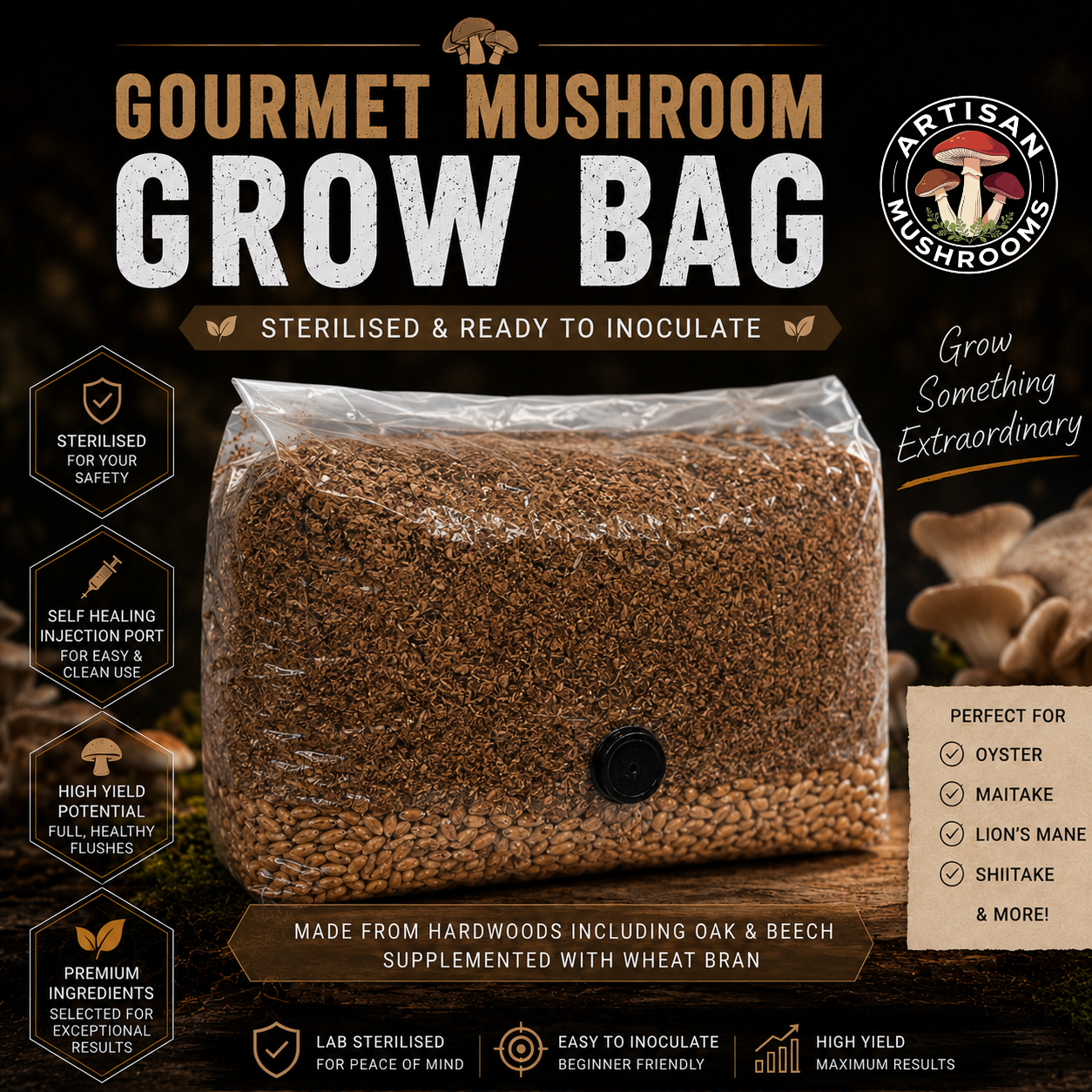
The lower grain layer is inoculated first. After strong colonisation, mix it through the hardwood substrate while keeping the bag sealed.
Why Shiitake grows differently
Shiitake is a wood-loving gourmet mushroom traditionally associated with hardwood. Indoor cultivation recreates that environment using a hydrated hardwood block, often supplemented with wheat bran.
Shiitake also has a distinctive maturation stage. After the substrate has colonised, healthy mycelium commonly forms raised white “popcorn” patches before gradually developing a brown, bark-like outer surface. This browning is normal and desirable.

A mature hardwood block can produce Shiitake from many points once colonisation, popcorning and browning are complete.
Hardwood species
Supplemented hardwood is an excellent indoor substrate for Shiitake.
Patient beginner
The technique is straightforward, but Shiitake takes longer to mature than fast Oyster mushrooms.
Brown before fruiting
A fully white block is not necessarily ready. Shiitake should be allowed to popcorn and brown before fruiting.
What you'll need
- Shiitake 3790 liquid culture
- Ready-to-inoculate hardwood grow bag
- Sterile needle
- Alcohol wipes or 70% isopropyl alcohol
- Clean inoculation area
- Stable colonisation space
- Humid fruiting area with fresh-air exchange
- Thermometer & hygrometer
The easiest method: all-in-one hardwood grow bag
Prepare a clean work area
Close windows, reduce air movement, wash your hands and disinfect the work surface and the injection port. Keep the grow bag sealed.
Inject the lower grain layer
Shake the Shiitake liquid culture syringe to distribute the mycelium, attach a sterile needle and inject through the self-healing port.
Direct the culture into the grain layer at the bottom of the bag, rather than trying to inject the hardwood above it.
Let the grain establish
Keep the sealed bag upright at roughly 18-24°C, out of direct sunlight, with the filter patch unobstructed.
Wait for healthy white Shiitake mycelium to establish through the lower grain section. Shiitake is naturally slower than Oyster mushrooms, so do not worry if progress is gradual.
When roughly 20-30% of the grain is colonised, gently break and redistribute the grain section only if needed, then allow it to recover.
Mix the grain through the hardwood
Once the grain section is well colonised, gently break it up and mix the colonised grain throughout the upper hardwood and wheat-bran substrate.
Reform the substrate into a compact block after mixing. The colonised grains now act as many inoculation points throughout the hardwood.
Let the entire block colonise
Leave the bag sealed while white Shiitake mycelium spreads through the hardwood substrate. Avoid repeatedly handling or squeezing the bag.
Do not move directly to fruiting as soon as the substrate appears white. Shiitake has another important maturation stage still to come.
Wait for popcorning and browning
Healthy Shiitake blocks commonly develop raised white bumps or “popcorn” patches. These gradually turn into a brown, bark-like surface as the block matures.
This browning is a normal part of Shiitake development and one of the most important signals that the block is approaching fruiting readiness.
Introduce fruiting conditions
Once the block has matured and developed a good brown outer surface, remove it from the bag and move it into fruiting conditions.
Aim for roughly 12-20°C, high humidity, gentle indirect light and frequent fresh-air exchange.
What Shiitake needs to fruit well
Maintain humid air while allowing gentle surface evaporation. Avoid leaving water pooled on the block or saturating developing caps.
White, popcorn, brown: what should you expect?
White colonisation
Healthy Shiitake mycelium first spreads through the hardwood as white growth.
Popcorning
Raised white patches and bumps begin forming as the block matures.
Browning
The surface gradually develops a firm brown skin. This is desirable maturation, not normal mould contamination.
When should you harvest Shiitake?
Harvest when the caps have opened but their edges remain slightly curled under. Waiting until every cap becomes completely flat can reduce shelf life and increase spore release.
Hold the mushroom low on the stem and twist gently, or cut it cleanly at the base. Remove any remaining stem tissue from the block so it does not become a soft spot during the rest period.
Resting and re-fruiting the block
A healthy Shiitake block can often produce more than one flush. After harvesting, allow the block to rest in cool, stable conditions.
Rehydrate only if the block has lost significant moisture, then return it to suitable fruiting conditions when it is ready for another cycle.
Common Shiitake growing problems
The block is white but won't fruit
The substrate may be colonised but not mature. Keep it sealed and wait for popcorning and browning before fruiting.
The block is turning brown
Even browning on a firm Shiitake block is normally desirable maturation rather than contamination.
Green growth or a sour smell
Isolate the bag and avoid opening a visibly contaminated block in the growing area.
Cracked or dry caps
Raise ambient humidity and reduce dry draughts, while avoiding constant direct spraying of the mushrooms.
Long stems and small caps
Increase fresh-air exchange while protecting the block from drying out.
Patchy or slow colonisation
Check that temperatures are stable and give the culture time. Shiitake naturally colonises and matures more slowly than many Oyster species.
Shiitake growing questions
What is the easiest way to grow Shiitake at home?
For most beginners, the easiest route is Shiitake liquid culture plus an all-in-one hardwood grow bag. This keeps the grain and hardwood stages inside one sealed bag.
Where do I inject the liquid culture?
Inject through the self-healing injection port and direct the culture into the lower grain layer. Allow that grain to establish before mixing it throughout the hardwood above.
Do I need to mix an all-in-one Shiitake bag?
Yes. Once the lower grain layer is sufficiently colonised, break it up and mix the colonised grain through the hardwood substrate. This distributes many active inoculation points throughout the fruiting block.
Should I fruit Shiitake as soon as the block turns white?
No. A white block may be fully colonised but still immature. Allow it to popcorn and develop a substantial brown outer surface before introducing fruiting conditions.
Is a brown Shiitake block contaminated?
Usually not. A firm block that develops an even brown skin is normally maturing correctly. Green, black or vividly coloured mould, slime and unpleasant odours are different warning signs.
How long does Shiitake take?
Expect a longer cycle than Oyster mushrooms. Colonisation can take several weeks and the block then needs additional time to popcorn and brown before fruiting.
Does Shiitake need light?
It does not need direct sunlight. Gentle indirect daylight or normal room lighting is useful during fruiting.
Can a Shiitake block produce another flush?
Often yes. Rest the block after harvest and rehydrate only if it has lost significant moisture before returning it to fruiting conditions.
The simplest culture-to-harvest route
Pair Shiitake 3790 liquid culture with the ready-to-inoculate hardwood grow bag. Inject the lower grain layer, let it establish, mix it through the hardwood, allow the full block to colonise and brown, then fruit.